


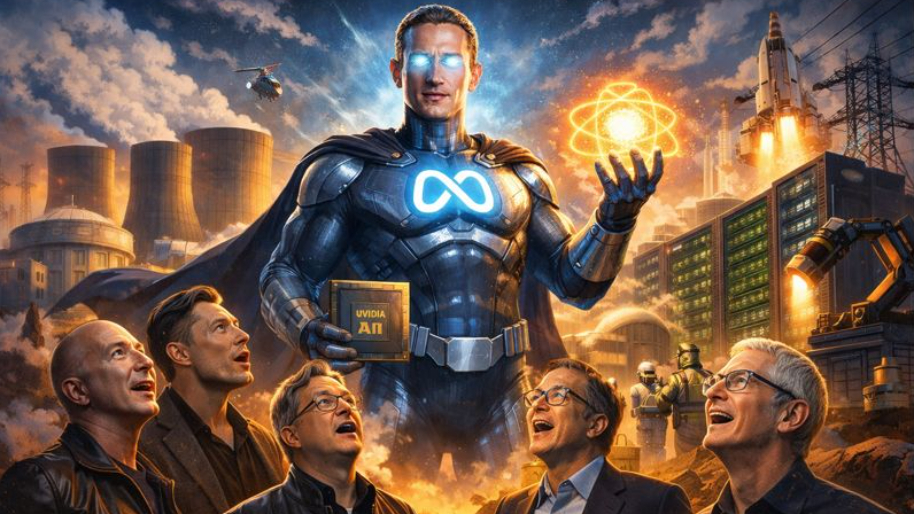
Zuck has got a fever, and the only prescription is more electricity… preferably the kind that glows in the dark.

After all, when you promise Wall Street you’re going to spend hundreds of billions turning your company into an AI powerhouse, you can’t exactly power that dream with wishful thinking and a couple of rooftop solar panels.
So Meta just went full Dr. Manhattan and signed a pile of nuclear power deals big enough to make the grid blink twice.
We’re talking multi-gigawatt energy commitments. As in: north of 6 gigawatts when it’s all said and done. And if that just sounds like a random number Biden would toss out mid-press conference, here’s the translation: that’s enough juice to power 5 million homes… or let Zuck’s AI chew through data without ever hitting a power warning.
With these new deals, Meta is now officially the biggest nuclear power buyer among Big Tech hyperscalers. Yes, that includes the usual suspects who swear they’re “carbon neutral” while quietly panic-buying whatever electrons they can get their hands on.

Here’s how Zuck’s building his own atomic Avengers lineup. For starters, Meta is buying power from existing nuclear plants owned by Vistra Corp., including Ohio’s Davis-Besse and Perry reactors, plus Beaver Valley in Pennsylvania.
That alone gets Meta more than 2.1 GW of steady, already-online generation, with another 400 megawatts coming from efficiency upgrades. Traders saw that press release and immediately smashed the buy button… Vistra ripped about 10% premarket.
But Zuck didn’t stop with the credit card there, because of course he didn’t.
Meta is also backing future nuclear reactors. The “trust me bro, it’ll be online by the 2030s” kind. That includes up to 1.2 GW from Oklo (yes, the one backed by Sam Altman), plus two reactors from TerraPower (backed by Bill Gates) capable of nearly 700 MW. There are also rights to another 2.1 GW of future projects because I think we can all agree moderation has never been Meta’s thing.

(Source: Wall Street Journal)
Now as big as these deals are, they shouldn’t be all that shocking. Somewhere along the way, nuclear went from “scary Cold War relic” to “the only thing that can keep AI from stalling out.” Data centers can be built in a couple of years. But nuclear plants take a decade. The mismatch is ugly.
And while Big Tech has flirted with natural gas as a faster fix, nuclear is still the holy grail: clean, always-on, and capable of feeding GPU clusters that never sleep (due to single folks repeatedly asking AI bots “create a girlfriend for me in this picture.”)
This all feeds directly into Zuck’s flagship AI builds. Prometheus, the 1-gigawatt Ohio data center cluster coming online this year, will tap into these nuclear deals. Hyperion, a Louisiana monster that could scale to 5 gigawatts by 2028, is starting with gas power because reality exists… but nuclear is clearly the endgame. When Mark Zuckerberg says he’s more afraid of under-spending on AI than overdoing it, this is what that looks like in real life.
(Source: Gizmodo)
Meanwhile, U.S. power demand is expected to jump 30% by 2030, mostly thanks to data centers. Grids are straining. Permits are slow. Everyone wants electrons yesterday. And Meta’s response was essentially: fine, we’ll help build the damn power plants ourselves… because Zuck wants everyone to know he’s just a chill guy.
His ultimate goal, in case you forgot, is “superintelligence”... AI that outperforms humans at a whole lot of things. And if that future is coming, it’s apparently arriving on a cloud of enriched uranium and long-term power purchase agreements.
And sure, shareholders won’t be thrilled about Zuck running up the credit cards yet again after a 2025 that would have Dave Ramsey in disgust…. but on AI infrastructure Meta just claimed the high ground and challenged anyone to catch up. And right now in the AI race, that’s the most important part.
At the time of publishing this article, Stocks.News holds positions in Meta as mentioned in the article.
Did you find this insightful?
Bad
Just Okay
Amazing
Disclaimer: Information provided is for informational purposes only, not investment advice. We do not recommend buying or selling stocks. Stock price discussions are based on publicly available data. Readers should conduct their own research or consult a financial advisor before investing. Owners of this site have current positions in stocks mentioned throughout the site, Please Read Full Disclaimer for details Here https://app.stocks.news/page/disclaimer