


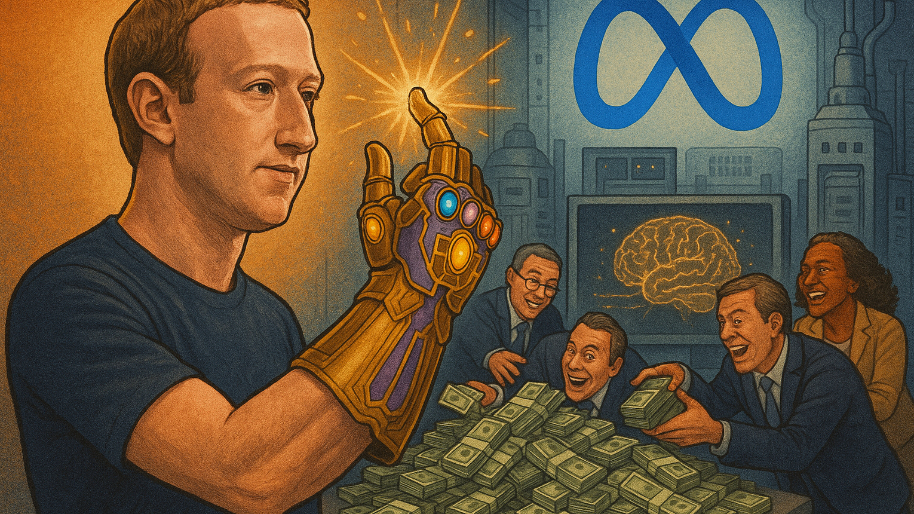
With a Thanos-like snap of the finger… Meta added more than $150 billion to its market cap. The stock’s up 11%, and Wall Street pretty much held up a glowing neon sign that said “APPROVED” to Mark Zuckerberg’s latest AI obsession. I guess going back to his roots and stealing (this time, not college code, but top AI execs from OpenAI, Apple, Google, and Anthropic) is what qualifies as visionary leadership now. And as dramatic as it may seem? Who am I to argue with the market? Especially when Meta backed up their AI hopes and dreams with 22% revenue growth, real profits, and a plan that, for now at least, investors are thrilled about.

Let’s talk about the numbers first… because this quarter was actually impressive (especially when you consider Meta is throwing as much money as they can at AI development). For starters, Meta hauled in $47.5 billion in revenue, up 22% from a year ago, which destroyed the $44.8B analysts had penciled in (nice try, guys). Net income was even more mouthdropping… a ridiculous $18.3 billion, up 36%, which is pretty much Zuckerberg standing on the earnings call channeling his inner Conor McGregor: “They say I talk and I talk… but guess what? I back it up!” (Irish accent and all.)
And boy did he. With a 43% operating margin, Meta reminded everyone that Zuckerberg has more money than most AI startups combined… and even a few legacy tech giants who still couldn’t sniff a profit if you handed it to them on a napkin (looking at you, OpenAI). While others are out here promising to revolutionize grocery shopping or how to make AI generated memes, Meta is clearly playing on another level… they’re planning for the future AND making a killing in the meantime.
(Source: AP News)

A big part of that is advertising, which remains the foundation of the business. But here’s the key: AI is already making it better. Zuckerberg pointed to improvements in ad recommendations and content feeds, driven by AI, that have already increased user engagement. For instance, Facebook usage is up 5% and Instagram is up 6%. Simply put, that’s more scrolling, more impressions, and more money. It’s not theoretical. It’s measurable. And Wall Street noticed.
Of course, it wouldn’t be a Zuckerberg earnings call without a big, nerdy tease about the future… and this time, he’s not talking about cartoon legs in the metaverse. No, now it’s all about something he’s calling personal superintelligence. The idea isn’t to automate every job or build a robot army (yet). Zuck’s focus is to build AI tools that help people be more creative, more connected, and maybe even more fulfilled… whatever that means. Think of it as Zuck trying to make the case that Meta’s AI won’t replace you… it’ll enhance you. Also: help you post better Instagram Stories (which, for some people, you can’t put a price on that).

And behind this lofty vision is a very real, very expensive operation. Zuckerberg has quietly built a new unit called Meta Superintelligence, and he’s stocking it with high-powered AI researchers like it’s a draft day war room. The star of the show here is Alexandr Wang, the founder of Scale AI. Meta dropped $14 billion for a stake in Wang’s company and gave him the title of Chief AI Officer. In case that wasn’t aggressive enough, Zuck’s been sending out job offers via text, WhatsApp, email… reportedly dangling hundreds of millions in comp, and in at least one case, up to $1 billion to lure top talent. When you’ve got that much free cash flow, apparently anything goes.
But all of this comes at a cost… literally. Meta raised its expected capital expenditures for 2025 to between $66 billion and $72 billion, up from a previous low-end estimate of $64B. And they’re already saying that 2026 will be even more expensive, due to infrastructure buildout and higher comp tied to these AI efforts. Just to support this vision, Meta is reportedly trying to raise $29 billion from private equity firms like Apollo and KKR to help co-develop a massive data center expansion in the U.S.

What’s worth noting here (and what makes this different from the metaverse saga) is that Meta isn’t promising fast money. CFO Susan Li made it clear: there won’t be “meaningful” revenue from generative AI in 2025 or even 2026. This is a long-term investment. But for once, the core business is strong enough to absorb that kind of forward-looking spend. And that’s the real difference. Investors were happy to SELL Meta when they poured billions into virtual cartoon legs. But AI? AI has already made the ad business better. It’s showing up in engagement metrics. It’s leading to revenue growth. And, unlike VR, it doesn’t require strapping electronics to your face.
Wall Street is responding accordingly. When the fundamentals are accelerating and the long-term vision feels at least plausible, you get rewarded. The $150B market cap gain wasn’t based on Zuck’s TED Talk-style speech about personal empowerment. It was based on cold, hard numbers… with a narrative that just happens to align with where the entire industry is heading.

Zuckerberg is repositioning Meta not just as a social platform… but as a next-generation AI-native infrastructure company. Whether that vision sticks depends on whether they can continue delivering results while building what he calls “superintelligence for everyone.” But right now, investors can’t get enough.
At the time of publishing this article, Stocks.News holds positions in Meta, Apple, and Google as mentioned in the article.
Did you find this insightful?
Bad
Just Okay
Amazing
Disclaimer: Information provided is for informational purposes only, not investment advice. We do not recommend buying or selling stocks. Stock price discussions are based on publicly available data. Readers should conduct their own research or consult a financial advisor before investing. Owners of this site have current positions in stocks mentioned throughout the site, Please Read Full Disclaimer for details Here https://app.stocks.news/page/disclaimer