


Last summer, when Elon Musk was campaigning for Donald Trump and said, “We’re gonna have to go through some pain to get this country back on track,” most people probably assumed he meant higher interest rates, a few belt-tightening quarters, and maybe a couple weeks worth of the stock market dipping. No one thought he meant watching their “safe” index fund portfolios swing like it was 2018 crypto season (remember that? Crazy times).

Yet here we are. After weeks of markets saying “I can go lower” (2%, 3%, even the occasional 5% drop just for fun) April 9th rolled around, and the Nasdaq suddenly spiked 12% in a single day… all because Trump announced a 90-day pause on reciprocal tariffs.
That move marked the second-largest daily gain in Nasdaq history, only behind the 14.2% pop on January 3, 2001… which, as every financial historian knows, was followed by every tech stock with “.com” in it’s name to faceplant 90%+. For anyone hoping this year would bring some calm… this was about as reassuring as Elon Musk tweeting “funding secured” while live-streaming from Mars.
(Source: Wall Street Journal)

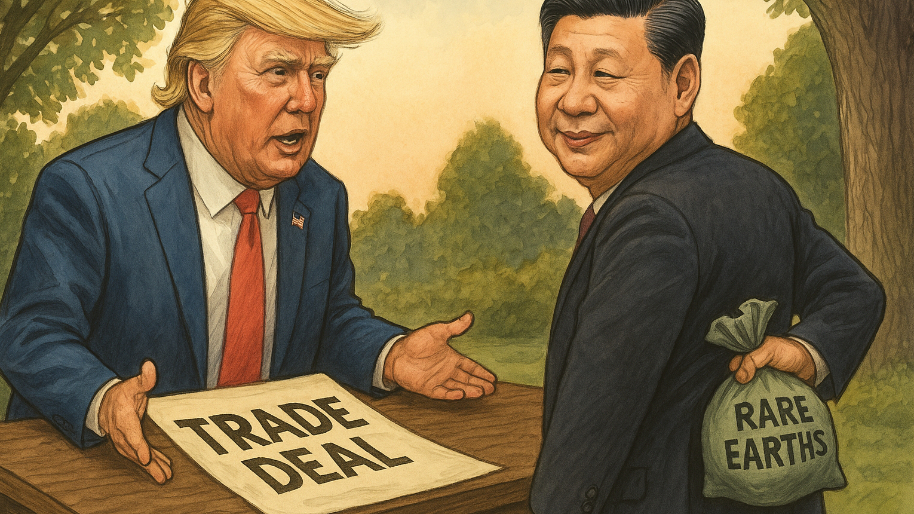
And after 121 days of dramatic headlines, trade threats, tariff deadlines, awkward handshakes, and about seven different versions of “we’re very close to a deal”... the U.S. and China have reportedly reached one. Probably. Maybe. It depends who you ask. (And what day of the week it is.)
According to China’s Ministry of Commerce, the two nations have agreed to a trade framework involving the easing of technology restrictions and the resumption of rare earth exports. The U.S., in turn, will remove a series of “restrictive measures” on Beijing. No one’s exactly sure what those measures are, because the details are vague and the statements read like they were drafted by someone who just skimmed the Geneva agreement during their layover.

President Trump, in classic form, announced during a White House event that “we just signed with China yesterday.” This was later clarified (of course) by officials who said the two sides reached “an additional understanding” related to implementing the Geneva framework. Translation: they didn’t sign a deal, but they signed something. Kind of. Probably. (Think of it like the LinkedIn version of a relationship status: it’s complicated.)
Earlier this month, Treasury Secretary Scott Bessent and Chinese Vice Premier He Lifeng met in London for two days of high-level talks. They walked away with what was described as an agreement to implement the Geneva consensus. Before that, both sides accused each other of violating the original agreement. And before that, we had the Geneva agreement itself, which was born after a few tense weeks of mutual tariff escalation.

In theory, this new agreement suggests we’re finally retiring the “spin the wheel of tariffs” strategy, and China will open up exports of key rare earth elements… the stuff that powers everything from smartphones and EVs to fighter jets and wind turbines. But Alfredo Montufar-Helu, senior advisor at The Conference Board (and apparently the only adult in the room), cautioned investors to temper expectations. Rare earth exports, especially those related to national security, are still likely to remain tightly controlled (they don’t call them rare for no reason). Still, the market took the news and ran with it. Asian equities surged. European futures popped. U.S. indexes rallied like they just found out Powell brought donuts to the next Fed meeting. Investors, desperate for anything resembling stability, grabbed onto the headlines (of course).
And Trump’s just getting started. The administration is now teasing not one, not two, but ten trade deals on deck with other countries. Canada, Japan, India, the EU… all supposedly in line for their own one-on-one negotiations with Washington. (It’s like trade policy via speed dating.) The White House has even hinted that Trump may soon begin sending letters to countries dictating their new tariff rates. If you don’t like your offer? Tough. You’ve been bucketed. (And no, there’s no appeals process.)

One major sticking point has been the scattershot nature of Trump’s tariff strategy. Many countries aren’t eager to sign trade deals without clarity on whether the U.S. will keep or remove existing duties. That includes tariffs on metals, semiconductors, cars, and basically anything that makes the modern economy function. (Imagine going into a business partnership and not knowing if your partner is going to screw up your supply chain next quarter.) Meanwhile, the administration is still juggling other economic priorities, including trying to push through its tax bill and deciding whether interest rates should be touched again. Fed Chair Jerome Powell has been watching the data roll in like a nervous diner eyeing the kitchen door for his entree… and so far, he's still waiting to see how the tariffs impact prices before making a move.
Commerce Secretary Howard Lutnick, who’s been quarterbacking the trade talks, confirmed the U.S. and China had finalized the understanding reached in London, including terms for rare earth shipments and the rollback of select U.S. countermeasures. He also claimed that agreements with a slate of other key trading partners are “imminent,” with a July 9 deadline looming.

But let’s get one thing clear: this so-called China accord isn’t exactly the cure-all for global trade. It leaves major topics unresolved… fentanyl regulation, full tech access for U.S. firms in China, even basic enforcement timelines. It’s the diplomatic equivalent of agreeing to go on a second date without mentioning the part where your ex still lives in your guest room.
And in the background, Section 899 (the “revenge tax” provision in Trump’s new tax bill) has been dropped, much to the relief of U.K. companies. That section would have allowed the U.S. to put retaliatory taxes on foreign firms if their countries imposed “unfair” levies on U.S. businesses. So… is this a win? I mean, I’ll take it. At this point, a pause in the chaos feels like a victory. A chance for markets to stop panic-refreshing every headline like they’re waiting on lab results. But let’s not break out the party hats just yet.

Because how many times have we heard someone in D.C. say, “We have a trade deal with China”? Exactly. It’s been said so often it should be printed on coffee mugs in the White House gift shop. It’s the diplomatic version of The Boy Who Cried Deal… only this time, weirdly enough, China is also crying “deal.” (Which is either promising... or the setup to the same plot twist we’ve seen five times already.)
At the time of publishing this article, Stocks.News doesn’t hold positions in companies mentioned in the article.
Did you find this insightful?
Bad
Just Okay
Amazing
Disclaimer: Information provided is for informational purposes only, not investment advice. We do not recommend buying or selling stocks. Stock price discussions are based on publicly available data. Readers should conduct their own research or consult a financial advisor before investing. Owners of this site have current positions in stocks mentioned throughout the site, Please Read Full Disclaimer for details Here https://app.stocks.news/page/disclaimer