


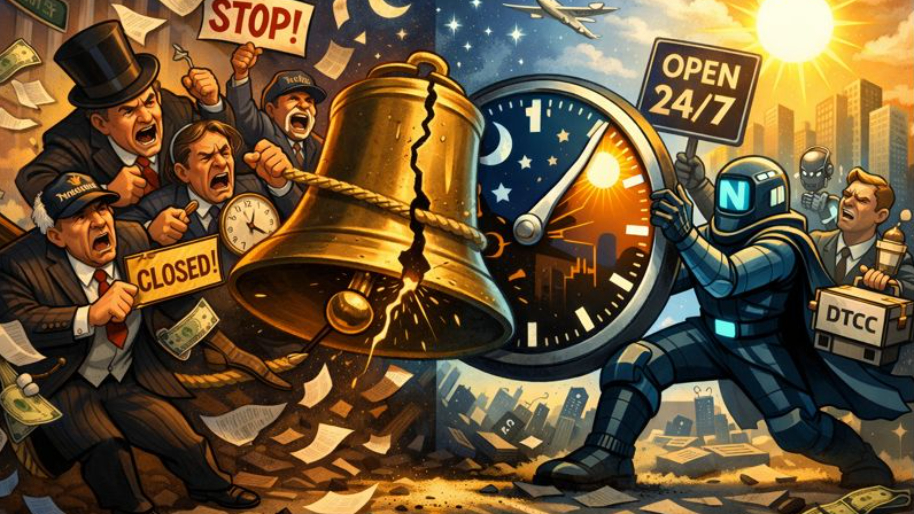
Nasdaq is preparing to do something that would have sounded absurd not that long ago: keep the stock market open almost all the time.
According to new filings set to land with the SEC, the exchange plans to roll out 23-hour trading on weekdays, a move that would push U.S. equities to the brink of a true 24/7 market. If approved, the change would take effect in the second half of 2026… and it would mark one of the biggest structural shifts in how Wall Street operates in over a century.
The motivation is simple. Investor demand for nonstop access to U.S. stocks has gone through the roof, driven largely by overseas investors who don’t live on Eastern Time and don’t want to wait for the opening bell to react to earnings, macro headlines, or geopolitical events.
Foreign holdings of U.S. equities hit roughly $17 trillion last year, and American stocks now make up nearly two-thirds of global market value. The center of gravity has moved, even if the clock hasn’t… yet.
Nasdaq’s plan would stretch its current 16-hour trading day into a 23-hour cycle, five days a week. The “day” session would run from 4 a.m. to 8 p.m. Eastern, followed by a one-hour break for maintenance and clearing.
Trading would then resume at 9 p.m. and continue through the night until 4 a.m. the next calendar day. Under this structure, the trading week would effectively start Sunday night and end Friday evening.
Importantly, the opening and closing bells aren’t going anywhere. The familiar 9:30 a.m. open and 4 p.m. close would still anchor the market. What changes is everything around them.
Nasdaq isn’t alone in this push. The New York Stock Exchange and CBOE have already filed proposals to extend trading hours as well, signaling a broader industry shift rather than a one-off experiment. Behind the scenes, regulators have also been laying the groundwork. The Depository Trust and Clearing Corp., the central clearing hub for U.S. equities, plans to roll out nonstop clearing by the end of 2026… a critical prerequisite for any true round-the-clock market.
For advocates, the argument is that the market already trades around the clock in practice. Overnight demand has been growing rapidly, even if volumes are thinner, and investors currently rely on alternative venues like Blue Ocean or OTC platforms to trade U.S. stocks outside normal hours. Nasdaq’s view is that bringing that activity onto regulated exchanges improves transparency and stability rather than undermining it.
Wall Street banks are less enthusiastic. Extended hours historically come with lower liquidity, wider spreads, and sharper price swings… conditions that make risk management harder and returns less predictable.
There’s also the question of cost. Running markets nearly nonstop requires infrastructure upgrades, staffing, and coordination across brokers, market makers, and clearing systems.
Still, the broader trend feels difficult to reverse. Markets were designed for a time when trades were handwritten on slips of paper and shouted across a floor. Today, trading is global, electronic, and instantaneous… and investors increasingly expect access on their own terms, in their own time zones.
Nasdaq executives argue the technology is already there. Systems have been built to handle extreme volatility, heavy traffic, and sudden surges in activity. From their perspective, keeping the lights on longer is a natural next step, not a leap into the unknown.
If the filings move forward as planned, 2026 could mark the moment Wall Street finally admits what the rest of the world already knows: the market never really sleeps anymore… it just pretends to.
At the time of publishing this article, Stocks.News doesn’t hold positions in companies mentioned in the article.
Did you find this insightful?
Bad
Just Okay
Amazing
Disclaimer: Information provided is for informational purposes only, not investment advice. We do not recommend buying or selling stocks. Stock price discussions are based on publicly available data. Readers should conduct their own research or consult a financial advisor before investing. Owners of this site have current positions in stocks mentioned throughout the site, Please Read Full Disclaimer for details Here https://app.stocks.news/page/disclaimer