


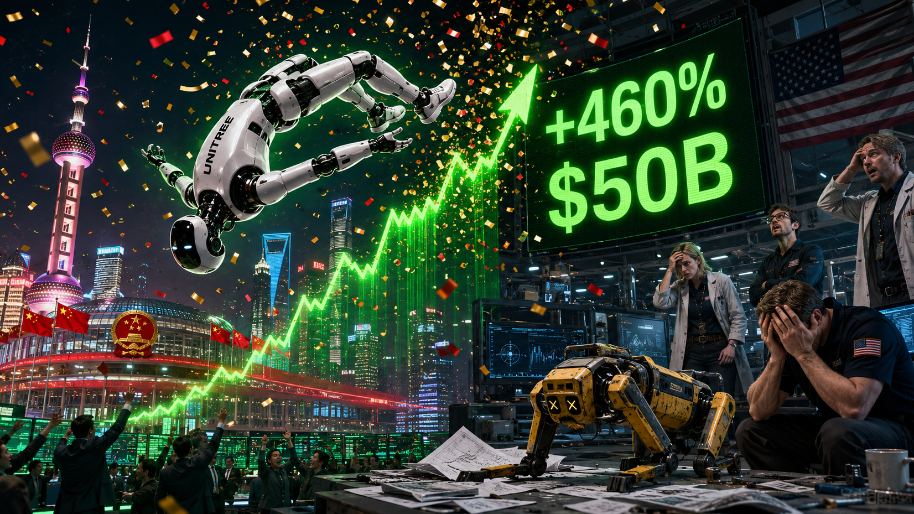
“No, you can’t do this to me. Do you know how much I’ve sacrificed?!?” -lead engineer at Boston Dynamics, probably
In what’s given a whole new meaning to “the robots are coming”… China’s backflipping humanoid manufacturer Unitree just made its stock-market debut and immediately launched 460%.
Shares were priced at $22 before closing Wednesday at $125.40 on Shanghai’s STAR Market (China’s Nasdaq), valuing the nine-year-old company at $50 billion.
At one point, the stock reached $163.23 for a completely normal and financially responsible first-day gain of 629%. (Clearly, teaching a humanoid robot kung fu is considerably better for shareholder health than giving it another warehouse box to stack).
For the uninitiated, Unitree is responsible for those viral humanoid and four-legged robots that can run, dance, perform martial arts, and do backflips in front of a live audience.
Well get this… the company’s newest creation, “Superman,” can reportedly leap more than 6.5 feet and run above 28 miles per hour. That makes it faster than (checks notes in humanity’s stupidity) Usain Bolt at top speed.
What practical purpose does a superhuman robot serve besides fighting wars or starring opposite Cillian Murphy in Christopher Nolan’s $300 million robot-apocalypse movie?
Your guess is as good as mine.
Investors watched the footage and decided valuation models were for companies whose products couldn’t hunt down the analysts questioning them.
The blockbuster debut turned founder and CEO Wang Xingxing, who owns one-fifth of Unitree, into one of the world’s newest paper billionaires. His stake is now worth north of $10 billion, depending on how violently the stock is backflipping at any given moment. Safe to say, Wang’s Wang just got a whole lot bigger.
Unitree also became the first humanoid robotics manufacturer to go public on a mainland Chinese exchange, giving investors their first clean shot at buying into Beijing’s plan to populate factories and research labs with metal employees.
And China is moving fast.
Unitree and fellow Chinese robotics company AgiBot accounted for more than 70% of the 13,000 humanoid robots shipped worldwide last year.
And Beijing clearly wants to pump those rookie numbers. With China’s economy crawling through its weakest growth in more than three years, the government is throwing money and political support at AI and advanced robotics.
The latest five-year plan put robotics near the center of the country’s technology agenda.
And unlike Boston Dynamics’ robot dogs, Unitree has apparently been trained to fetch profits.
The company generated around $250 million in revenue last year and is already profitable, pretty much an enigma in the industry.
Still, there is one tiny complication hiding beneath the 460% stock explosion.
Most Unitree robots are being purchased by universities and research institutions, not factories, hospitals, restaurants, or homes.
Meaning the company has proven people enjoy watching its robots kick things. It has not yet proven the world needs enough of them to justify a $50 billion valuation.
On top of that, Unitree’s American business just received the Old Yeller treatment.
The United States banned imports of newly manufactured foreign humanoid robots last month over national security concerns, effectively cutting Unitree off from a market that accounted for 13% of its revenue last year. Meaning: existing models can still be sold, but future shipments have been shown the door.
The Pentagon also added Unitree to its list of Chinese military companies in June, describing the company as a contributor to China’s defense industrial base.
Unitree insists its robots are strictly designed for civilian use, although “civilian robot capable of beating up 10 navy seals” is not exactly the calming sentence Wang thinks it is.
The designation doesn’t sanction Unitree, but it does stop the U.S. military from ordering Chinese super soldiers with taxpayer-funded overnight shipping.
But none of that stopped degens from YOLO’ing into the stock.
Unitree’s debut followed Chinese memory-chip maker CXMT’s equally deranged Shanghai listing last month, when its shares launched 466% on their first trading day and briefly made it the most valuable company listed on a mainland Chinese exchange.
China has now produced consecutive IPOs where investors looked at triple-digit opening-day gains and said, “yeah, that seems normal.”
With the ceremonial gong packed away, Unitree now has to prove its robots have a market beyond researchers asking other researchers what the robots are useful for.
Several other Chinese robotics firms are preparing to go public, and Unitree will serve as the industry’s first major public-market test dummy.
If factories begin ordering Unitree robots by the thousands, the valuation may age beautifully. If they don’t, investors just valued a university science project above Ford.
Either way, please be respectful when shorting it. The product can run 28 miles per hour.
At the time of publishing this article, Stocks.News holds positions in Ford as mentioned in the article.
Did you find this insightful?
Bad
Just Okay
Amazing
Disclaimer: Information provided is for informational purposes only, not investment advice. We do not recommend buying or selling stocks. Stock price discussions are based on publicly available data. Readers should conduct their own research or consult a financial advisor before investing. Owners of this site have current positions in stocks mentioned throughout the site, Please Read Full Disclaimer for details Here https://app.stocks.news/page/disclaimer