


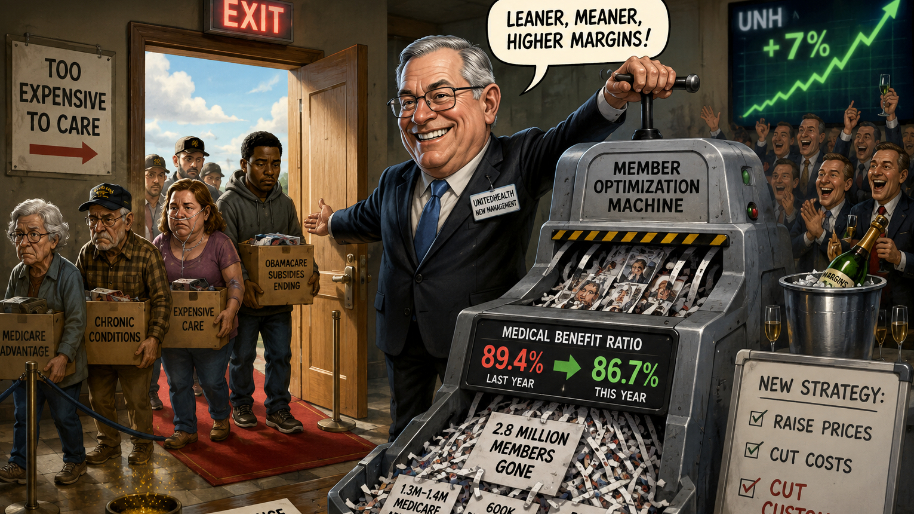
Turns out the easiest way to lower medical expenses is to stop covering the people creating them.
Ladies and gentlemen, allow me to introduce the stock market equivalent of losing 30 pounds by amputating a leg.
Just 24 hours after Elevance Health got sent to the gulag (-11%) for posting an earnings beat that wasn't quite good enough... UnitedHealth walked onto the field, beat expectations by a country mile, and reminded the entire healthcare sector who's still running the managed-care circus.
The company reported adjusted earnings of $6.38 per share this morning, steamrolling the $4.85 analysts were expecting. Revenue came in around $112 billion, guidance got bumped higher for the rest of the year, and investors wasted approximately three seconds before sending the stock up 7% when the news dropped.
On the cover of this book, it looks like new CEO Stephen Hemsley walked in, sprinkled a little AI fairy dust around the office, and magically fixed America's largest health insurer overnight.
Except... that's not really what happened. The narrative everyone wants to tell is that UnitedHealth finally got medical costs under control. The numbers tell a much more entertaining story. Because while everyone was celebrating lower medical costs, UnitedHealth was showing millions of its most expensive customers the front door.
This year alone, the company expects total membership to fall by 2.3 to 2.8 million people. That includes around 1.3 to 1.4 million Medicare Advantage members. About 600,000 members whose plans were simply discontinued. Another half-million Obamacare enrollees as pandemic-era subsidies disappear.
And Medicaid enrollment continues shrinking as reimbursement rates fail to keep up with medical costs. To be clear, this definitely wasn’t some accident. It was the whole strategy from the get go.
Think about it like owning a restaurant where half your customers order lobster... then insist on paying for chicken nuggets. Eventually you stop advertising to the lobster crowd. Or in UnitedHealth's case... you stop offering them the menu entirely. The company's medical benefit ratio fell from 89.4% a year ago to just 86.7%.
For anyone unfamiliar with insurance accounting, that's the percentage of premium dollars that actually get spent paying medical claims. To oversimplify: lower is better.
If an insurer collects $100 and only spends $87 treating patients instead of $89... shareholders suddenly become a whole lot happier. Across tens of billions in premium revenue, that tiny percentage swing translates into billions of additional profit.
Naturally everyone assumed UnitedHealth had become dramatically better at managing healthcare costs. And while that's certainly what the numbers seem to say. The company's CFO, however, told a very different story.
He flat out admitted these results were not because medical cost trends had magically improved. Instead, he said the company was simply working to bring down what was already an elevated cost base.
And hey, you have to respect that kind of honesty from one of the slimiest businesses out there.
Meanwhile, traders had spent the past several weeks preparing for complete disaster. The put-to-call ratio heading into earnings ranked higher than 97% of readings over the past year.
So I’m not exaggerating when I say almost no one believed this report was going to go well.
Before I wrap this up, there’s still one rather large elephant wandering around the hospital waiting room. The Department of Justice is still conducting both criminal and civil investigations into UnitedHealth. The probe has reportedly expanded beyond Medicare Advantage billing into OptumRx pharmacy practices and physician reimbursement.
As of now the market seems to be ignoring it. But investigations like these have a funny habit of staying irrelevant... ...right up until they aren't.
It's also worth mentioning that nearly half of UnitedHealth's top 100 executives have been replaced over the past year.
That's not exactly what stable, fully healed companies usually look like. This is still a business undergoing major surgery.
The difference is that management appears perfectly willing to cut away entire chunks of the business if those customers aren't making enough money.
For now, Mr. Market doesn’t seem particularly interested in how UnitedHealth improved its margins. He only cares that they improved.
At the time of publishing this article, Stocks.News doesn’t hold positions in companies mentioned in the article.
Did you find this insightful?
Bad
Just Okay
Amazing
Disclaimer: Information provided is for informational purposes only, not investment advice. We do not recommend buying or selling stocks. Stock price discussions are based on publicly available data. Readers should conduct their own research or consult a financial advisor before investing. Owners of this site have current positions in stocks mentioned throughout the site, Please Read Full Disclaimer for details Here https://app.stocks.news/page/disclaimer