


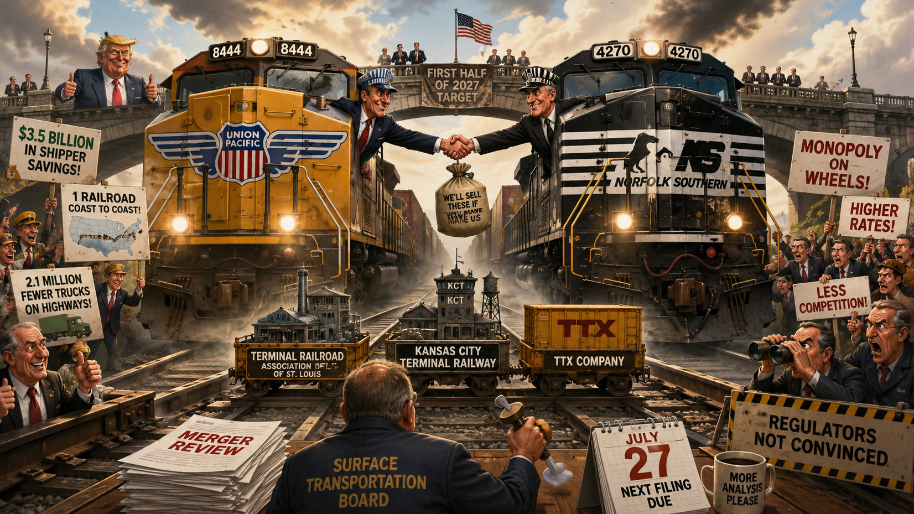
11 months after unveiling plans to create America's first coast-to-coast freight railroad, Union Pacific and Norfolk Southern are now trying to convince regulators they aren't building a monopoly on wheels.
The two railroads told the U.S. Surface Transportation Board on Tuesday they're willing to sell off ownership stakes in several smaller railroads if that's what it takes to win approval for their proposed $85 billion merger.
The offer centers around three jointly owned rail assets that competitors have argued could give the combined company too much influence over critical freight infrastructure.
Union Pacific and Norfolk Southern said they would give up their ownership interests in the Terminal Railroad Association of St. Louis, Kansas City Terminal Railway, and the freight-car cooperative TTX if regulators require it. The companies argue they don't actually control those organizations anyway because they're jointly owned by multiple major railroads and operated independently.
In fact, the railroads took things a step further, accusing rivals of using those smaller railroads as political pawns to slow down the merger.
According to the filing, competing carriers have been leaning heavily on the Terminal Railroad Association of St. Louis as part of their campaign against the deal. Union Pacific and Norfolk Southern even claimed representatives from those opposing railroads skipped a special meeting meant to discuss what ownership would look like after the merger.
The concessions are part of a bigger effort to satisfy questions raised by the Surface Transportation Board after regulators conditionally accepted the revised merger application back in May.
The companies still have another major filing due by July 27 that will focus on how the merger would preserve competition before regulators officially begin the full review process.
For Union Pacific and Norfolk Southern, getting over that hurdle is worth a lot.
The companies estimate the merger would save shippers roughly $3.5 billion every year by eliminating interchange delays, improving service reliability, and creating the first single railroad stretching from the East Coast to the West Coast.
Management also says the combined network could remove roughly 2.1 million trucks from U.S. highways annually, lowering transportation costs while reducing congestion and emissions.
Not everyone is buying the sales pitch, though.
Freight customers have warned the merger could ultimately lead to higher shipping rates, while several state attorneys general have voiced concerns about reduced competition. Meanwhile, rival railroads including BNSF Railway and Canadian Pacific Kansas City continue lobbying aggressively against the transaction.
The political backdrop has also shifted in the companies' favor.
President Donald Trump has publicly endorsed the merger and earlier replaced Democratic Surface Transportation Board member Robert Primus with Republican Patrick Fuchs as chairman, a move widely viewed as making the regulator more receptive to large railroad consolidation.
Even so, approval is far from guaranteed.
The Surface Transportation Board still has months of analysis ahead before deciding whether the merger delivers enough public benefits to outweigh concerns over competition.
For now, Union Pacific and Norfolk Southern are sticking to their original timeline and continue targeting completion during the first half of 2027.
At the time of publishing this article, Stocks.News doesn’t hold positions in companies mentioned in the article.
Did you find this insightful?
Bad
Just Okay
Amazing
Disclaimer: Information provided is for informational purposes only, not investment advice. We do not recommend buying or selling stocks. Stock price discussions are based on publicly available data. Readers should conduct their own research or consult a financial advisor before investing. Owners of this site have current positions in stocks mentioned throughout the site, Please Read Full Disclaimer for details Here https://app.stocks.news/page/disclaimer