


Hey Sir, play “Fortunate Son” on repeat…
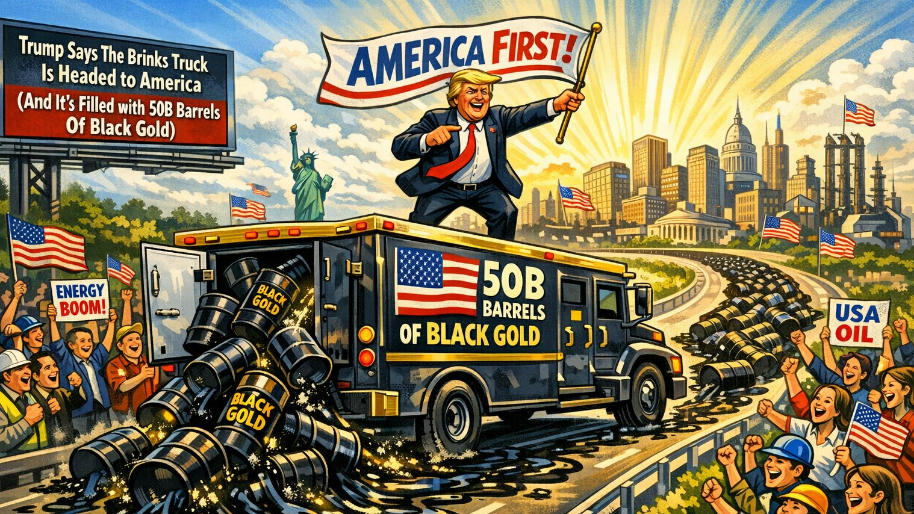
At some point Tuesday night, Donald Trump logged onto social media and shouted at the clouds that Venezuela’s interim authorities are handing the United States between 30 and 50 million barrels of oil. Real barrels at market price… loaded onto storage ships and sailed straight into U.S. docks with Fortunate Son or Money For Nothing (take your pick) on full blast.

(Source: Giphy)
However, the part that really made crude traders sip a fat cup of concrete wasn’t the volume… it was the follow-up. In short, Trump said the proceeds would be “controlled by me” to make sure the money benefits both countries. Which is how you know this isn’t a State Department memo, it’s a Trump production. Cue WTI immediately slipping, because Trump is gonna Trump. Translation: Prices dropped about 1.3% on the headline because the oil market, for all its bravado, is still deeply allergic to surprise supply… especially when it shows up wrapped in red, white, and regime change.
But it gets even more interesting from there. Of course, we all know about the all-expense-paid, one-way trip to NYC Trump gave to Maduro over the weekend. So with him out of the picture, Venezuela’s oil sector… the largest proven reserves on Earth, currently producing like it’s running Windows Vista… suddenly became actionable again. That’s where the real money starts sniffing around.

(Source: CNBC)
According to the Wall Street Journal, Trump is meeting with Chevron, Exxon Mobil, and ConocoPhillips to talk about “significant investments” in Venezuela’s oil infrastructure. Translation: pipelines, refineries, ports, and decades of neglect that now look like a distressed asset with geopolitical tailwinds. As we mentioned in yesterday's article, Chevron is already there, quietly operating under supervision while everyone else sat on nationalized assets and old grudges. Exxon and Conoco still remember the mid-2000s expropriations like it was yesterday. But capital has a short memory when the terms flip. And if the U.S. is effectively underwriting the reset, suddenly those old scars start looking like leverage.
And now, what matters most for markets isn't whether 50 million barrels hit tomorrow. It’s what this signals about future flow. Venezuela currently accounts for roughly 1% of global output despite sitting on an ocean of heavy crude. If even a fraction of that capacity comes back online over the next few years, OPEC’s already wobbly grip gets weaker, not stronger. Saudi Arabia can jawbone all it wants, but it’s hard to cartel-manage a market when a sanctioned reserve the size of a continent gets reactivated with U.S. backing. That’s why crude sold off instead of spiking. Traders are pricing the idea that tomorrow’s supply curve just got fatter. And that’s also why this is bullish and bearish at the same time, depending on where you sit.

(Source: Imgflip)
Refiners that can handle heavy Venezuelan crude are licking their chops. Infrastructure and oilfield services are already sketching out bids. Upstream producers without pricing power are suddenly staring at a world where marginal barrels get cheaper, not scarcer. Now whether this all turns into a controlled reopening or a chaotic flood is almost beside the point. The market heard one thing loud and clear: Venezuela is back on the playing board… and oil just lost some of its scarcity premium. “Merica! Until next time, friends…

At the time of publishing, Stocks.News holds positions in Exxon Mobil as mentioned in the article.
Did you find this insightful?
Bad
Just Okay
Amazing
Disclaimer: Information provided is for informational purposes only, not investment advice. We do not recommend buying or selling stocks. Stock price discussions are based on publicly available data. Readers should conduct their own research or consult a financial advisor before investing. Owners of this site have current positions in stocks mentioned throughout the site, Please Read Full Disclaimer for details Here https://app.stocks.news/page/disclaimer