


Since Amazon reported blowout earnings in late July, the stock has somehow fallen almost 10%… and this next piece of news probably isn’t going to do much to ease the selling pressure.
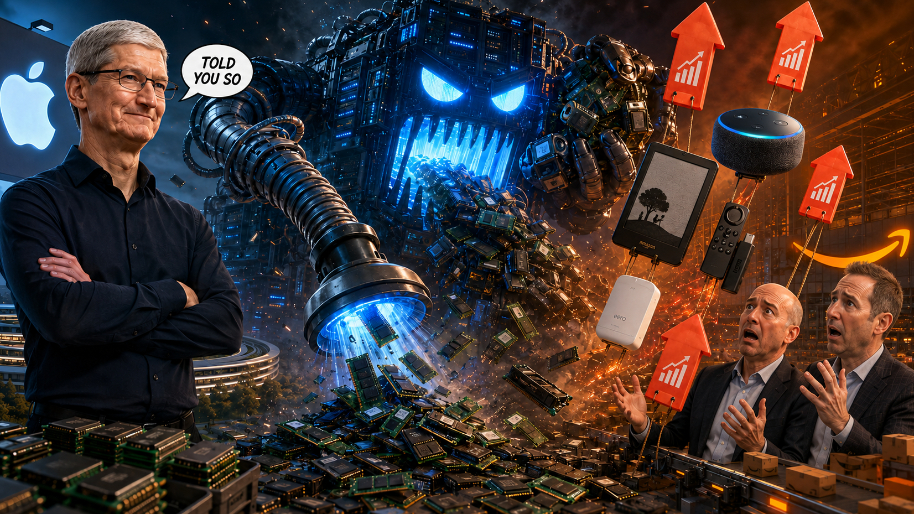
Amazon raised prices across much of its device lineup overnight, blaming the increases on soaring memory and storage costs tied to the AI boom.
The biggest increase hit the basic Echo Dot, which jumped from $49.99 to $79.99.
Amazon also raised the Echo Show 11 from $219.99 to $249.99, while its 16-gigabyte Kindle climbed from $109.99 to $149.99. The 16-gigabyte Kindle Paperwhite increased from $159.99 to $199.99.
And if you use Fire TV, Amazon has a price increase waiting for you too.
The Fire TV Stick HD now costs $39.99 instead of $34.99, while the 4K Max climbed from $59.99 to $84.99. The eero 7 also rose by $50 to $399.99, and the eero Pro 7 increased by $100 to $799.99.
Amazon did leave one major part of its hardware lineup untouched, with no price increases for Ring products.
An Amazon spokeswoman blamed the increases on “significant increases in memory and storage component costs,” saying the company absorbed the added expense for as long as it could before finally passing it along to customers.
Amazon says it will continue offering promotions throughout the year, which I’m assuming means raising the price now so Prime Day can heroically lower it again later.
The reason for all of this is self explanatory. AI companies are buying up huge amounts of memory, leaving the rest of the electronics industry competing for what remains.
And Amazon isn’t the only company making customers pay for it.
Apple raised prices on Macs and iPads in June, with Tim Cook describing the memory situation as a “100-year flood.” Microsoft recently increased Xbox prices by $100 to $150 and stopped selling its highest-end two-terabyte models.
Dell, HP, Lenovo and Asus have also raised prices or reduced the amount of memory included in some products.
The increases are especially notable for Amazon because cheap hardware has always been part of the company’s playbook. Sell people an affordable speaker, tablet or streaming stick, place Amazon’s ecosystem directly inside their homes and make the real money once everyone starts buying subscriptions and ordering products through it.
Now the front door costs 60% more.
The irony is that Amazon is helping create the same shortage squeezing its devices.
CEO Andy Jassy recently said Amazon expects to spend $220 billion this year, up from its previous $200 billion estimate, with most of that money going toward the data centers and equipment needed to power its AI services.
Even with the additional $20 billion in spending, Jassy said Amazon still won’t have enough capacity to meet all of its expected demand in 2026… and that the shortage will likely continue into 2027.
The good news is that the investment is already producing significant growth.
Amazon Web Services generated $42.2 billion in second-quarter revenue, up 37% from $30.9 billion a year earlier and marking its fastest growth in 18 quarters.
So Amazon is spending $220 billion to expand its AI infrastructure, helping drive up memory costs in the process, and then passing some of those costs along to its hardware customers.
That’s the downside of an AI boom that keeps getting bigger faster than the supply chain can handle.
At the time of publishing this article, Stocks.News holds positions in Amazon, Apple, Microsoft, and Dell as mentioned in the article.
Did you find this insightful?
Bad
Just Okay
Amazing
Disclaimer: Information provided is for informational purposes only, not investment advice. We do not recommend buying or selling stocks. Stock price discussions are based on publicly available data. Readers should conduct their own research or consult a financial advisor before investing. Owners of this site have current positions in stocks mentioned throughout the site, Please Read Full Disclaimer for details Here https://app.stocks.news/page/disclaimer