


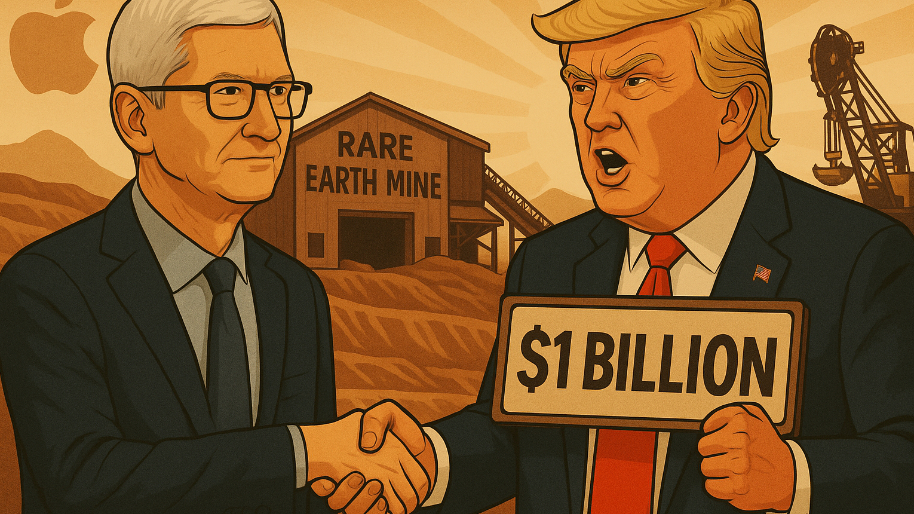
If you asked the CEO of any small-cap company, “Which two organizations would you most want backing your business?” you’d probably get a few standard responses. A handful of tech folks would say Nvidia (because, of course, they would). Some would quietly whisper “Palantir” (as they scroll through the subreddit looking at Alex Karp memes). But if you pressed them for an honest answer (one rooted in long-term survival and serious funding) they’d probably land on Apple and the United States government. Well, as of today, MP Materials doesn’t have to imagine it. That dream pairing is now their actual cap table.

If you’re not up on your rare earths (don’t worry, nobody’s flexing that knowledge at brunch), here’s the gist: MP Materials runs Mountain Pass, the only rare earth mine in the U.S. Meaning, if we ever want to stop relying on China for the tiny magnets that power everything from iPhones to fighter jets, this is our one shot. For years, MP’s been quietly playing the long game… greasing wheels in D.C., reviving a bankrupt mine, and pitching itself as the “Made in America” fix for a very real national security problem. And now the payoff has arrived.
First came the U.S. government. The Department of Defense invested $400 million, taking a major equity stake in MP and locking in a 10-year supply agreement. More importantly, the Pentagon agreed to pay nearly double the going rate for key rare earths. This means MP gets guaranteed revenue… even if China decides to crash global prices again out of spite. (Meanwhile, most small-caps are out here personally begging people on Twitter to buy 100 shares just to meet the bid.)
(Source: CNBC)

Then along came Apple, dropping a fresh $500 million into the mix. The deal includes magnet purchases from MP’s upcoming facility in Fort Worth, Texas, plus a new recycling facility they’ll build together at Mountain Pass. MP expects magnets to start shipping in 2027. Meaning, within a couple years, the rare earths in your iPhone might actually come from the California desert, not a Chinese state-run operation. The fact that these two deals came just days apart is no coincidence. This was a coordinated show of confidence… one that reflects how high the stakes have gotten.
So why does any of this matter? Because rare earth magnets are the hidden engine behind modern life. They’re inside smartphones, laptops, EVs, wind turbines, drones, and most high-end military systems. For instance, without these magnets, there’s no F-35 jet. No nuclear subs. No MacBooks, either. That’s why China’s 70% control of global rare earth production (and 85% of processing) has been a massive national security risk for years. This means the U.S. needs a Plan B. And that’s exactly what MP has spent the last decade becoming.

For Apple, the deal fits into its broader $500 billion initiative to onshore its supply chain. For instance, the company is already building an AI server factory in Texas. Partnering with MP gives it a stable, domestic source of rare earth magnets and reduces exposure to geopolitical blowback every time Washington and Beijing get into a shouting match. Or, as Tim Cook more diplomatically put it: “Rare earth materials are essential for making advanced technology, and this partnership will help strengthen the supply of these vital materials here in the United States.” (In other words: We’d prefer not to have China holding our entire product lineup hostage, thanks.)
For the Department of Defense, this is about control… specifically, over the materials needed to build and maintain advanced weapons systems. Rare earth magnets are essential components in everything from missile guidance to F-35s. Without them, the defense machine grinds to a halt. The Pentagon’s $400 million investment makes it clear: they’re done relying on foreign supply chains for critical parts. By backing MP Materials, they’re locking in access, locking out risk, and putting serious money behind reshoring what’s become a national security priority.

So what does all this mean for MP Materials? It means the company is no longer just a speculative mining play. It now has a 10-year government customer, a blue-chip commercial partner, and institutional backing from firms like Goldman Sachs and JPMorgan… who are helping finance its expansion with over $1 billion in additional capital. Not bad for a company that, just a few years ago, was best known for owning a dusty old mine that had already gone bankrupt once. MP’s founder, James Litinsky, bought the failed remnants of Molycorp in 2015 and turned it into a national asset.
Of course, there are still limitations. Mountain Pass primarily produces light rare earths, meaning MP may still need to import certain heavy elements like dysprosium and terbium to complete the magnet supply chain. So, no… the U.S. isn’t fully self-sufficient yet. But this week’s announcements move us significantly closer than we’ve been in decades.

All this means MP Materials has now become a critical player in two of the most important economic and geopolitical stories of the decade: America’s race to rebuild its supply chains and the slow-motion divorce from Chinese industrial dependence. And they’re doing it with two of the biggest backers imaginable.
Last week, I pointed out that this might be worth watching purely because the Pentagon was backing up the dump truck full of taxpayer cash and unloading it straight into MP’s front yard. (Guaranteed government contracts? Say less.) That alone made it a pretty attractive setup. But now that Apple’s joined the party and is writing checks too? It’s looking less like a speculative mining gamble and more like a front-row seat to the future of American manufacturing… with two of the most creditworthy sugar daddies a company could ask for. (One has nuclear submarines, the other has AirPods… both have unlimited budgets.)
At the time of publishing this article, Stocks.News holds positions in Apple as mentioned in the article.
Did you find this insightful?
Bad
Just Okay
Amazing
Disclaimer: Information provided is for informational purposes only, not investment advice. We do not recommend buying or selling stocks. Stock price discussions are based on publicly available data. Readers should conduct their own research or consult a financial advisor before investing. Owners of this site have current positions in stocks mentioned throughout the site, Please Read Full Disclaimer for details Here https://app.stocks.news/page/disclaimer