


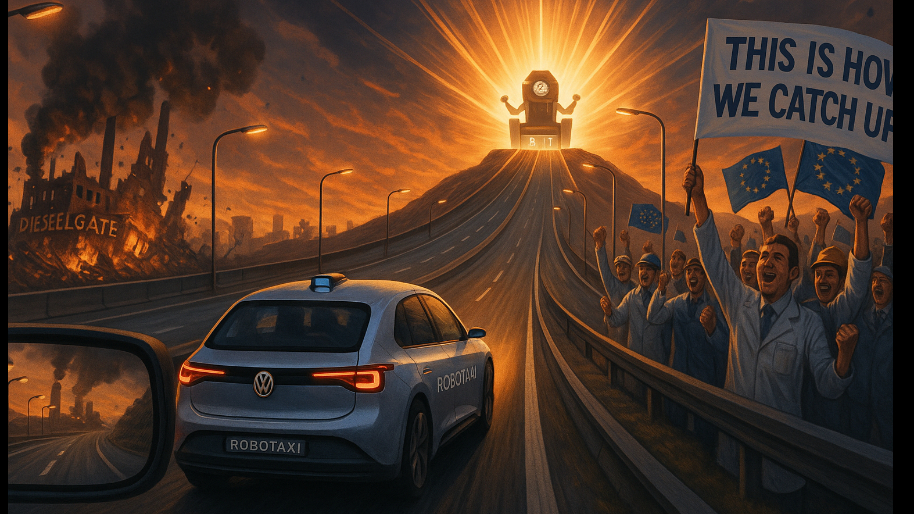
And people said German engineering peaked with the bratwurst. Volkswagen, still wheezing from the trauma of Dieselgate and decades of “innovation” that mostly involved cupholders, finally admits it might have to copy someone else’s homework. The homework? ID.Buzz AV: the world’s first minivan to require not just a backup driver, but apparently a small squadron of paramedics on retainer.

(Source: Giphy)
In short, Volkswagen now has its own Robotaxi on the streets, claiming their operation is “less expensive” than the others, which is kind of like saying your off-brand AirPods are “less expensive”... yes, but also nobody trusts them to get you anywhere reliably. The cost edge is that VW can pool sensors and software across Porsche and Audi, which, if you’re keeping score, just means the same hardware gets stuffed in something with better seats and a more expensive logo.

(Source: The Wall Street Journal)
The ID Buzz AV gets 13 cameras, nine lidars, five radars, and still needs a human ready to slam the brakes when the car’s brain lags out in real traffic. Meanwhile, Waymo is in the U.S. quietly racking up 250,000 rides a week without the need for a sacrificial backup driver on every trip. Tesla’s out here letting its cars reenact Grand Theft Auto on Austin streets, and Baidu is running more robotaxis in China than Germany has functioning start-ups. Europe’s response? Decades of regulatory committee meetings, a couple of pilot zones, and a lot of “we’re almost there.”
And yet, the flop sweat is so thick in Europe you can taste it. The entire autonomous push is a last-ditch effort to avoid total irrelevance… a Hail Mary from a continent that spent a decade telling Silicon Valley “not safe, not ready, too risky” and then woke up to discover the only thing riskier was becoming the Nokia of the global auto market. For Uber (who is partnered with VW on this), they’re desperate for a new headline as there’s now a deal to drop these rolling midlife crises onto the streets of Los Angeles by 2026.

(Source: Giphy)
For the first phase, every robotaxi will have a human babysitter upfront… Uber will call them “safety operators,” but you can call them “the last line of defense between you and a headline.” These operators will stay in the vehicles until the system proves it can survive LA’s Mad Max traffic without regular human intervention. Volkswagen says the “no human required” milestone could come by the end of 2026 (stop laughing).
Additionally, VW’s American rollout is supposed to be turnkey: cities, airports, or transit agencies buy the Buzz AVs bundled with Moia’s ride-pooling platform and let Uber handle the customer-facing circus. In a perfect world, these vehicles will fill the gap between what’s left of public transit and the dystopia that is LA’s current ride-hailing scene. The question though, is will they make a dent? Well, other than a Euro minivan, 27 sensors, a highly paid “safety operator” sweating through their shirt, and a city full of people who already drive like they’re playing Mario Kart with real consequences… maybe. VW’s dream is to sell this whole “robotaxi-in-a-box” package to transport agencies desperate to look modern.

(Source: Giphy)
And yet, to be fair, if anyone in Europe’s going to drag themselves out of the self-driving tar pit, it’s probably Volkswagen. They’ve got scale… actual, industrial-grade scale. VW’s ability to slap the same sensor suite on everything from a Buzz to an Audi means they might finally make autonomy affordable for the masses (or at least for city governments desperate to look “innovative” in their annual reports). And unlike the American robo-cowboys, VW knows how to play the regulatory game, which means they’ll be the last ones standing when the EU finally stops writing new rules and starts certifying actual vehicles. If robotaxis ever become more than science projects for US hype machines, it could be because a boring German car company quietly made it possible.
Meaning, if anyone’s going to drag Europe into the robo-taxi future… kicking, screaming, and occasionally swerving into traffic… it’s these guys. For now, keep your eyes on VW’s rollout of the auto market's answer to “innovation” and place your bets accordingly. Until next time, friends…

At the time of publishing, Stocks.News holds positions in Tesla and Uber as mentioned in the article.
Did you find this insightful?
Bad
Just Okay
Amazing
Disclaimer: Information provided is for informational purposes only, not investment advice. We do not recommend buying or selling stocks. Stock price discussions are based on publicly available data. Readers should conduct their own research or consult a financial advisor before investing. Owners of this site have current positions in stocks mentioned throughout the site, Please Read Full Disclaimer for details Here https://app.stocks.news/page/disclaimer