


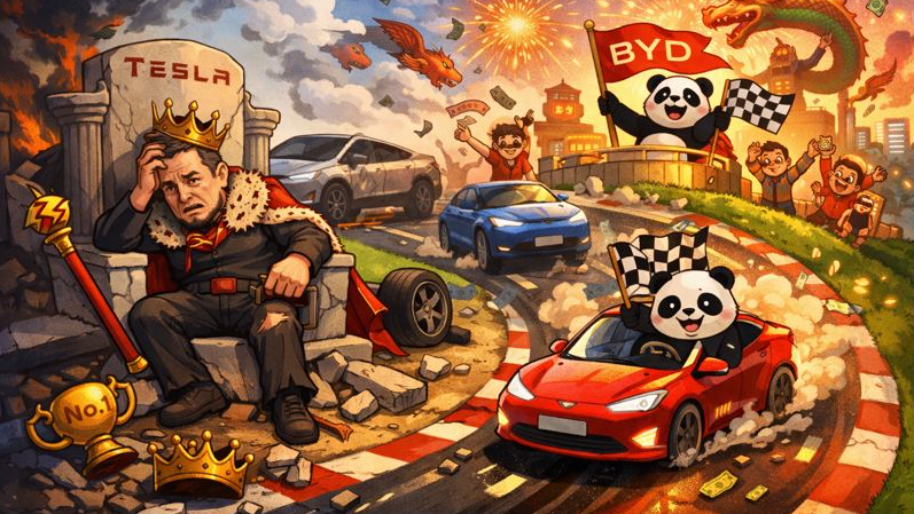
For as long as electric vehicles have been a major trend, Tesla sat alone at the top of the market. Lately, though, that throne has come under real pressure… and based on the company’s latest numbers, it’s no longer theirs.
In 2025, Tesla’s annual vehicle deliveries fell for the second year in a row, sliding 9% to 1.63 million units from 1.79 million in 2024. Once the undisputed leader of the EV market, Tesla has now been overtaken in global sales by BYD, signaling a clear shift in the industry’s balance of power.
The numbers tell the entire story. Of Tesla’s 2025 deliveries, roughly 50,850 vehicles fell into an “other models” category that includes the Cybertruck alongside the aging Model S and Model X. While Tesla remains a dominant force in the U.S. market, its position in Europe and China has weakened as Chinese manufacturers have expanded aggressively on price, scale, and model variety. BYD, delivering 2.26 million EVs last year, now holds the top spot globally, underscoring how quickly competitive advantages can change in a capital-intensive industry.
In the United States, the most immediate drag came from policy… not actually the competition. The elimination of the $7,500 federal EV tax credit reshaped demand almost overnight. Tesla’s third quarter offered a glimpse of how powerful the incentive had been: deliveries exploded to a record 497,099 vehicles, up 29% from the prior quarter, as buyers rushed to lock in the subsidy. When the credit disappeared, sales momentum faded just as quickly, despite Tesla’s attempts to stimulate demand through pricing and promotions.
At the same time, Elon Musk is trying to take Tesla somewhere very different. He’s been talking more and more about artificial intelligence, robotics, and what he calls “sustainable abundance,” all laid out in Tesla’s latest Master Plan. The idea is to build an ecosystem that ties together cars, energy production, battery storage, and autonomous machines. It’s a big vision, but a lot of it is still more promise than reality.
For now, however, Tesla remains an automaker at its core. In the third quarter alone, the company generated $28 billion in revenue, $21.2 billion of which came directly from vehicle sales. That dependence leaves Tesla exposed to the same cyclical pressures, policy shifts, and competitive dynamics that affect the rest of the auto industry… no matter how ambitious its long-term vision may be.
The takeaway isn’t that Tesla is falling apart. It’s that the company is moving into a new phase. Tesla no longer has the EV market to itself, and the easy growth years are gone. The challenge ahead is keeping the car business on solid ground while making the case that what comes next can eventually stand on its own.
At the time of publishing this article, Stocks.News holds positions in Tesla as mentioned in the article.
Did you find this insightful?
Bad
Just Okay
Amazing
Disclaimer: Information provided is for informational purposes only, not investment advice. We do not recommend buying or selling stocks. Stock price discussions are based on publicly available data. Readers should conduct their own research or consult a financial advisor before investing. Owners of this site have current positions in stocks mentioned throughout the site, Please Read Full Disclaimer for details Here https://app.stocks.news/page/disclaimer