


By Gregor Stuart Hunter
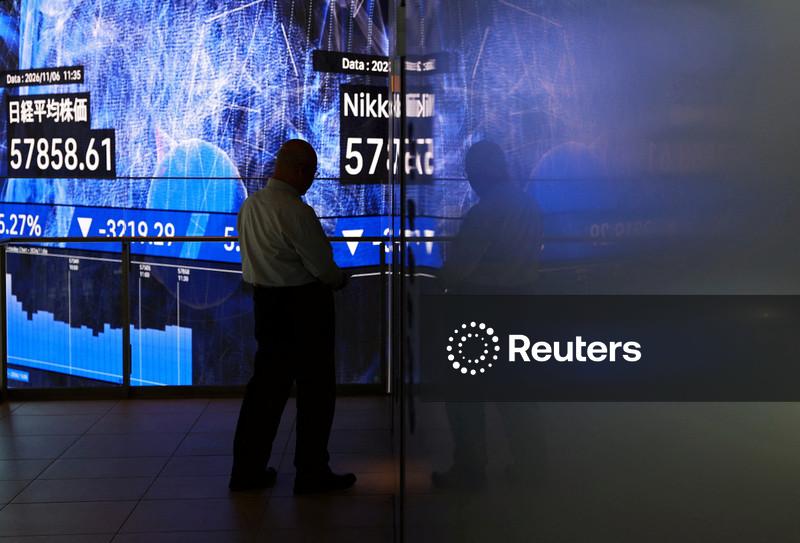
SINGAPORE, Nov 25 (Reuters) - Asian stocks plunged on Wednesday as fresh US tariff threats hit sentiment and a tech-led rally fizzled, with the region's chip-heavy markets bearing the brunt of the selloff.
MSCI's broadest index of Asia-Pacific shares outside Japan was down 3.2%, led by a drop of as much as 6.4% in South Korean shares and an 8.6% decline at the worst point in Taiwan.
Japan's Nikkei 225 fell as much as 3.7%, while S&P 500 e-mini futures were 0.6% lower.
"Mainly it's the impact of the tariff issue," said Hua Nan Securities analyst Kevin Su in Taipei. "Stock markets across all of Asia are being sold off, and expectations of rate hikes are also suppressing risk appetite."
The US Trade Representative's office is preparing to release the findings of a probe that could pave the way for new tariffs, three people with knowledge of the matter told Reuters on Tuesday. The investigation focuses on alleged excess industrial capacity among 16 major US trading partners, including China and the EU.
"The re-emergence of tariffs from the USTR has been met with a collective sigh from investors," said Chris Weston, head of research at Pepperstone Group Ltd in Melbourne. "Much like the US debt ceiling, which is also making an unwelcome comeback onto the radar, traders appear reluctant to commit significant capital on the headlines alone."
Wall Street stocks closed mixed on Tuesday, with the S&P 500 down 0.5% and the tech-heavy Nasdaq Composite off 1.5%, while the small-cap Russell 2000 gained 0.6% and the Dow Jones Industrial Average rallied 0.9%. Attention now turns to US core personal consumption expenditures (PCE) data due on Wednesday ahead of the Thanksgiving holiday later in the week.
"Wall Street pared its Monday advance as sobriety returned to the market and a focus returned to fundamentals," said Kyle Rodda, senior market analyst at Capital.com in Melbourne.
The moves followed data showing US consumer confidence increased by more than expected in November, touching its highest level in nearly two years, as well as better-than-expected earnings from Dell on surging AI server demand. Dell shares rose 4.1% in after-hours trading.
Nvidia surrendered some of its gains after Jensen Huang's return as CEO earlier this week, falling 5.9%, while Anthropic fell 6.5% to below its IPO price.
Australian shares slid 0.9% and the Australian dollar strengthened 0.2% after the release of data showing consumer prices climbed by more than expected in October as fuel and clothing jumped.
The annualised trimmed mean measure of 3.8% means inflation is still running well above target and ramps up pressure on the Reserve Bank of Australia, which has already raised rates by 125 basis points this year.
The yield on super-long 40-year Japanese government bonds rose by 2.2 basis points to 4.147% after an auction of the bonds drew weak demand.
The yield on the benchmark US 10-year Treasury note was down 0.2 basis point at 4.898%.
In commodities, Brent crude was 1.2% lower at $90.28 in Asia after a choppy session on Tuesday, which saw crude prices settle more than 2% higher as new attacks were reported on vessels in and around the Strait of Hormuz. [O/R]
Copper prices fell 4.66% in Shanghai as the fizzling AI rally weighed on industrial metals. LME copper was up 0.6%, steadying after falling on Tuesday to its lowest since March. Aluminium had earlier sunk to a 13-month low. [MET/L]
In cryptocurrencies, bitcoin dropped 0.9% to $59,324.19 while ether was down 1.1% at $1,659.63.
(Reporting by Gregor Stuart Hunter in Singapore and Roger Tung in Taipei; Editing by Jacqueline Wong and DJ Yap)
Did you find this insightful?
Bad
Just Okay
Amazing