


Robinhood just gave retail investors a new way to feel like venture capitalists… with about the same odds of YOLO’ing on 0DTE Tesla call options.
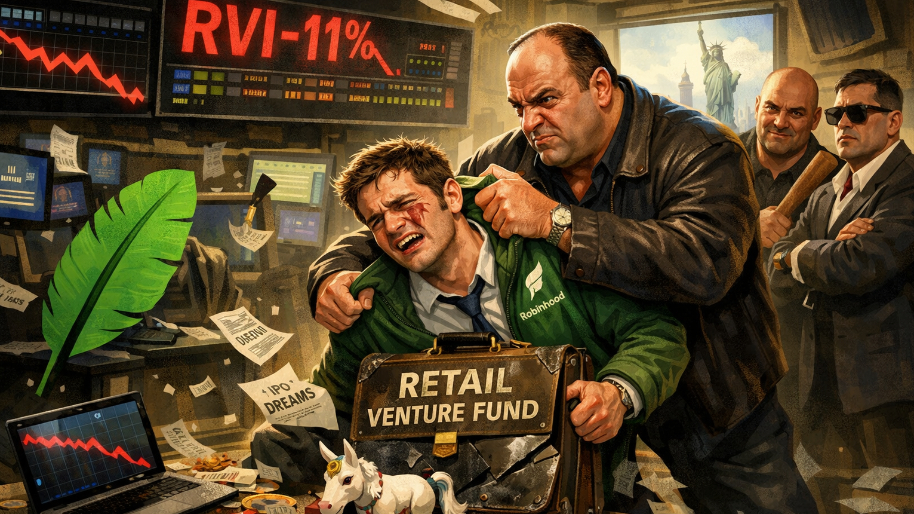
Robinhood’s new venture fund debuted on the New York Stock Exchange Friday… and the market immediately gave it the Tony Soprano collection call.
The fund (trading under the ticker RVI) dropped about 11% on its first day, which is not exactly the “democratizing finance” launch Vlad Tenev probably envisioned while getting his hair camera-ready for the media tour.
To be fair, the idea sounds awesome in theory. The fund gives retail investors exposure to private tech unicorns normally locked away on Sand Hill Road with the rest of Silicon Valley’s imaginary valuations.
I’m talking companies like Databricks, the $134B data factory… Fintech rocket ship Stripe… Digital bank Revolut… And even Oura, the company selling rings that track your sleep, heart rate, and probably how many times you checked your ex’s Instagram.
In theory, it lets everyday traders get in before these companies IPO at valuations that venture capitalists totally didn’t pull out of thin air.
In practice… well… that’s where retail traders wake up from their wet dream to cold hard reality.
Because what Robinhood actually launched isn’t direct ownership in those companies. It’s a closed-end fund holding stakes in several private businesses. Which means investors are essentially buying a basket of startup valuations that are updated maybe twice a year.
Meanwhile the share price trades in real time… driven mostly by reddit hype FinTwit posts, and whatever emotional breakdown the market is having that day.
Needless to say, the timing for this debut couldn’t have been worse considering markets are already in the gutter as traders worry about the ongoing U.S.-Iran situation.
So, it’s not exactly the environment where investors have an epiphany and think: “You know what sounds safe? A venture capital-style fund full of companies that don’t publish public financials.”
And there’s the structure fees.
The fund charges a 2% management fee (roughly double what many traditional closed-end equity funds charge) though investors thankfully dodge the typical 20% venture capital carry.
Still, the bigger problem is valuation. Private companies get valued during fundraising rounds that happen once or twice a year. Public markets… well… they revalue things every three seconds.
Which means RVI’s share price could drift wildly above or below what those holdings might actually be worth.
We’ve already seen this movie before.
A similar vehicle called Destiny Tech 100 (which holds stakes in companies like SpaceX and OpenAI) once traded at nearly 20× its net asset value before reality eventually showed up with a baseball bat.
So Robinhood’s promise to “blow the doors off private markets” might technically be true. Just… probably not in the way Vlad had in mind.
At the time of publishing this article, Stocks.News holds positions in Robinhood and Tesla as mentioned in the article.
Did you find this insightful?
Bad
Just Okay
Amazing
Disclaimer: Information provided is for informational purposes only, not investment advice. We do not recommend buying or selling stocks. Stock price discussions are based on publicly available data. Readers should conduct their own research or consult a financial advisor before investing. Owners of this site have current positions in stocks mentioned throughout the site, Please Read Full Disclaimer for details Here https://app.stocks.news/page/disclaimer