


Wall Street may be underestimating the scale of risks building within the private capital industry, according to one of the world’s largest credit-focused hedge funds.
Tony Yoseloff, managing partner and chief investment officer at Davidson Kempner Capital Management, said a “substantial portion” of private equity firms are already under financial pressure, even as traditional credit-market indicators suggest conditions remain relatively stable.
“You’re not looking at a problem five years from now,” Yoseloff said. “You’re looking at a problem that exists today.”
Davidson Kempner, which manages more than $38 billion in assets, published research arguing that vulnerabilities in the leveraged buyout market have been building for years. The firm said high leverage levels, weakening cash flows and looser lending terms have combined to create conditions that could lead to a rise in restructurings and corporate defaults.
The hedge fund is positioning itself to benefit if those pressures eventually force private credit lenders to sell assets at discounted prices.
Private credit has been among the fastest-growing segments of global finance over the past decade, providing loans to companies outside traditional bank lending channels. However, the sector has come under increasing pressure recently as retail investors have withdrawn billions of dollars from semi-liquid credit funds.
Yoseloff said the underlying stress in the credit system has been visible for several years, even during a period of relatively strong economic growth and resilient leveraged loan markets.
“Imagine a world where some of those things aren’t as true, and you still have the same issues that sit in the credit system,” he said.
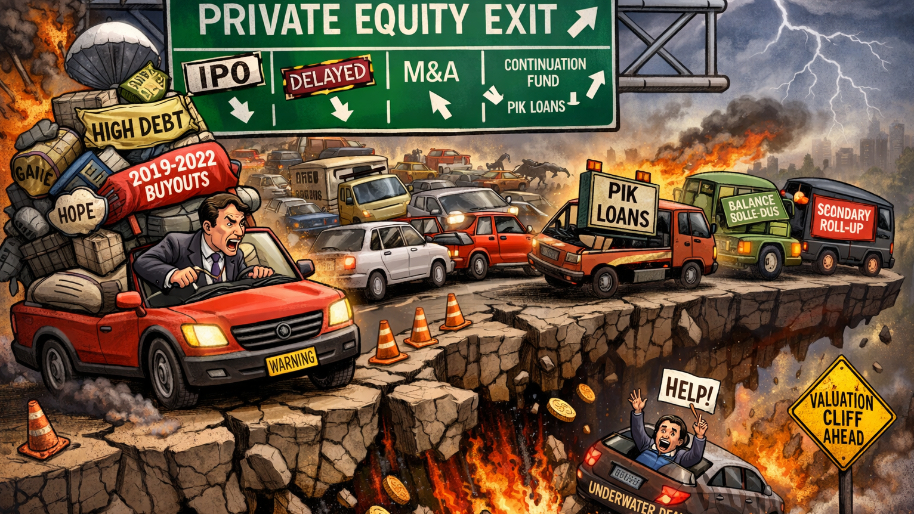
A major challenge for private equity firms is the large backlog of unsold portfolio companies. According to a recent report from Bain & Company, buyout firms held nearly $4 trillion in unrealized investments last year as exit activity slowed.
The slowdown has pushed many firms to rely on alternative methods to return capital to investors. These include secondary fund transactions and continuation funds, which allow sponsors to move assets between investment vehicles rather than selling them outright.
At the same time, buyout groups have increasingly pursued consolidation strategies in fragmented sectors such as car washes and insurance brokerages. These roll-up strategies were often financed with significant leverage and have produced mixed results as borrowing costs have risen.
Yoseloff said companies acquired during the private equity boom between 2019 and 2022 may be particularly vulnerable.
Many of those transactions were completed at elevated valuation multiples and funded with large amounts of debt. Since then, higher interest rates and declining valuation multiples have eroded the equity buffers sponsors typically rely on to absorb losses.
“Software valuation multiples have come down dramatically,” Yoseloff said. “Once you lose multiple, it’s really hard to get it back.”
Signs of strain are also emerging in private credit markets. Some borrowers have increasingly turned to “payment-in-kind,” or PIK, structures, which allow interest payments to be added to the principal balance rather than paid in cash. While this approach can delay defaults, it also increases the overall debt burden.
Davidson Kempner estimates that roughly $768 billion of debt in the U.S. leveraged loan and direct lending markets is currently under stress.
The firm also highlighted deterioration in interest coverage ratios, a measure of a company’s ability to service its debt with earnings. The share of companies with coverage below 1.5 times earnings, a level widely viewed as a sign of financial stress, has more than doubled since 2019.
Despite these warnings, large-scale asset sales have yet to materialize.
At the time of publishing this article, Stocks.News doesn’t hold positions in companies mentioned in the article.
Did you find this insightful?
Bad
Just Okay
Amazing
Disclaimer: Information provided is for informational purposes only, not investment advice. We do not recommend buying or selling stocks. Stock price discussions are based on publicly available data. Readers should conduct their own research or consult a financial advisor before investing. Owners of this site have current positions in stocks mentioned throughout the site, Please Read Full Disclaimer for details Here https://app.stocks.news/page/disclaimer