


“First time? Huh?” -Silicon Valley Bank to Blue Owl Capital

Blue Owl just found out what happens when you promise retail investors quarterly liquidity… on assets that take years to unwind. Spoiler: it gets awkward.
Yesterday, Blue Owl Capital (-6%) permanently restricted withdrawals from one of its retail-focused debt funds (the Blue Owl Capital Corp II) after getting smacked with a wave of redemption requests last year. Translation: the “semi-liquid” fund just became a little less liquid.
To raise cash, Blue Owl sold $1.4B worth of private loans across three funds. The bulk came from the retail vehicle that had promised investors the ability to cash out quarterly. Because nothing says “long-term private loans” like “see you in 90 days.”
The loans were sold at 99.7% of face value… so not exactly a fire sale. In fact, CEO Craig Packer (not related to Todd Packer from The Office) called it “an extremely strong statement.” Investors clearly disagreed because they responded by immediately hitting the sell button.

(Source: CNBC)
According to Verdad Capital’s Dan Rasmussen, this could be the “canary in the coal mine.” As in what Michael Burry thinks is happening to Nvidia and the entire AI complex… but with actual plumbing issues this time.
For context, private credit (which is really just Wall Street putting on a banker costume and saying “trust me bro”) has swelled into a $3 trillion global machine over the last decade. You can thank the Great Financial Crisis for that.
After 2008, regulators tightened the hatches on traditional lenders, rates fell through the basement, and safe yield became an endangered species. So naturally, capital went hunting. It drifted further and further out on the risk curve (smaller borrowers, heavier debt loads, prettier interest rates) because when the Fed gives you zero, you start convincing yourself 11% from a leveraged HVAC distributor is “diversification.”

Rasmussen calls it “fool’s yield”... income that looks attractive on the surface but doesn’t necessarily compensate you for the actual risk underneath.
Meanwhile, publicly traded lenders (the retail-friendly gateway into private credit) are flashing dividend yields as high as 16%, with Blue Owl paying north of 11%. That looks incredible… until you remember the S&P Global U.S. High Yield Corporate Bond Index has returned about 7.7% over one year, 9% over three years, and roughly 4% over five.
Now I’m no genius, but when someone is offering nearly double the income of traditional junk bonds, it’s not because they’re feeling generous. It’s because you’re underwriting more risk than the brochure suggests.
You see, private credit funds are writing five- to seven-year loans… but they sold retail investors the fantasy of quarterly liquidity. When markets are calm, incoming cashflows can cover normal redemptions. But when sentiment flips, everyone wants out at once. And now you’re stuck trying to turn long-term, hard-to-sell loans into quick cash. Spoiler: that doesn’t end well.
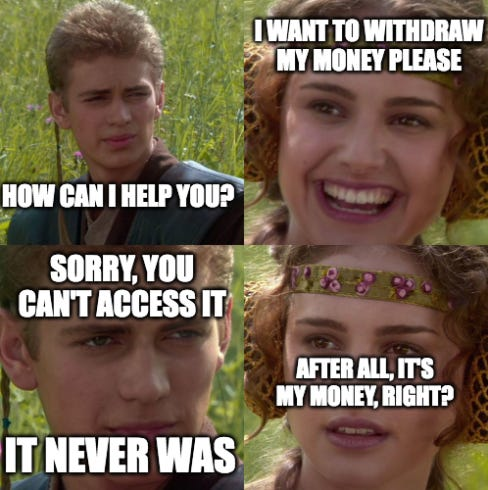
We’ve already seen early warning signs. The collapse of First Brands Group last year exposed how aggressively structured some private credit deals became during the easy-money era. Even Jamie Dimon warned that risks in private credit are “hiding in plain sight,” adding that “cockroaches” will likely show up when conditions deteriorate… which is not exactly comforting language from the head of the largest U.S. bank.
To meet redemptions, Blue Owl found buyers for the loans from three major North American pension funds and its own insurance arm, Kuvare (acquired in a $750 million deal in 2024).
To that, Barclays waved a red flag the size of Texas.
If this turns into a trend, loans currently chilling in relatively visible BDCs could start migrating into CLOs… which are basically the shadow realm with a leverage addiction. BDCs typically run around 1x leverage. But CLOs? Try closer to 9-10x. They’re the same underlying assets, just stacked with significantly more leverage and complexity.

You see the layering here, right? It’s not 2008. But it’s definitely giving “we’ve seen this movie before” energy. Blue Owl insists the buyers made an arm’s-length decision and there’s nothing funky behind the scenes. Maybe that’s true. Or maybe this is the first visible crack in a market that’s been priced for perfection for a decade.
At the time of publishing this article, Stocks.News doesn’t hold positions in companies mentioned in the article.
Did you find this insightful?
Bad
Just Okay
Amazing
Disclaimer: Information provided is for informational purposes only, not investment advice. We do not recommend buying or selling stocks. Stock price discussions are based on publicly available data. Readers should conduct their own research or consult a financial advisor before investing. Owners of this site have current positions in stocks mentioned throughout the site, Please Read Full Disclaimer for details Here https://app.stocks.news/page/disclaimer