


California AG: “Okay we’re rounding third and heading home. Let’s negotiate this merger privately and in good faith.”
David Ellison: “Best I can do is an anonymous-source media blitz.”
Just when it looked like Paramount and California might holster the legal firearms and discuss its $110 billion Warner Bros. takeover like civilized adults… somebody (read: little Davey boy) apparently started yapping to the press.
California Attorney General Rob Bonta canceled Monday’s settlement meeting with Paramount representatives after accusing the company of leaking and misrepresenting details from an earlier negotiating session on Friday.
Or as Bonta put it: “Not only did Paramount leak the alleged substance of settlement discussions, but they misrepresented these discussions, demonstrating a lack of good faith.”
Word of advice for the world’s biggest nepo baby: maybe wait until the ink dries before handing the story to reporters.
Bonta said his office would happily return to the negotiating table once Paramount “stops playing games and engages sincerely.”
Translation: the $110 billion media marriage is back in timeout until David Ellison quits trying to negotiate through headlines.
For those just tuning in, Paramount is attempting to combine its movie studio and television empire with Warner Bros, giving one company control over everything from CNN and HBO to Discovery, Warner Bros., DC Comics, and an assisted-living facility’s worth of cable channels under one umbrella.
The problem is that California and 11 other Democratic state attorneys general aren’t particularly thrilled about placing half of Hollywood inside the Ellison family trust.
The coalition sued last month to block the takeover, arguing that the combined company would control one-third of wide-release movie distribution and a similar share of basic cable programming.
According to the states, the sequel includes higher prices, fewer movies, lower wages, and a closing montage of Hollywood employees carrying cardboard boxes to their cars.
The Ellison boys insist this is all terribly pessimistic.
Paramount’s hush-hush pitch, now enjoying full media distribution, is that combining with Warner Bros. would create a legitimate rival to Netflix and Disney.
Lil Davey also accused his opponents of bringing politics into the fight, particularly over the possibility of CNN changing hands.
Bonta says that’s nonsense. According to him, any settlement would require “robust structural remedies.”
For anyone who didn’t attend law school (or bingewatch Suits), that means Paramount may have to sell cable channels, spin off businesses, or otherwise carve pieces from the $110 billion turkey before California lets it anywhere near the dinner table.
And based on Friday’s discussions, the two sides weren’t exactly choosing china patterns.
Bonta has accused Paramount of steering the conversation toward streaming and CNN instead of addressing the movie and cable-TV competition concerns at the center of California’s lawsuit.
Then details of the meeting somehow found their way into the press… and just like that, Monday’s follow-up disappeared from the calendar.
Normally, a canceled meeting would be no big deal.
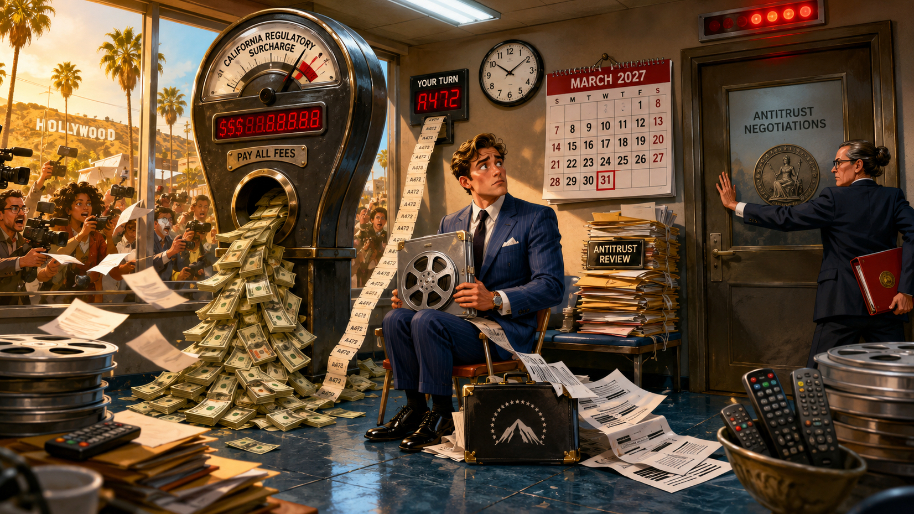
Unfortunately for Paramount, this particular argument has a meter running outside.
Under the merger agreement, Paramount must pay Warner Bros. shareholders approximately $7 million for every day the transaction remains unfinished after September 30.
That’s nearly $50 million per week for the privilege of waiting on California.
Oh and if the dispute drags through the scheduled March 2, 2027 antitrust trial, Paramount estimates the ticking fees could reach $1.3 billion.
The stopwatch is officially Paramount’s highest-paid employee.
Paramount is so terrified of that tab that it wants the court to make the states (and the Writers Guild of America) post a $1.88 billion bond.
In other words, if California insists on dragging this thing into next year, Paramount would like somebody else’s credit card behind the bar.
Bonta’s response was essentially that Paramount signed the deal, accepted the ticking fees, and can’t demand a refund because the legal system failed to respect its preferred closing date.
To Paramount’s credit, Paramount has already received regulatory approval from the Justice Department and dozens of countries. The company remains confident it can close the transaction and says it is prepared to fight through every available legal avenue.
But confidence gets considerably more expensive when it costs $7 million every 24 hours.
So now little Davey gets to watch his $110 billion prize sit behind glass while California charges him mansion money for every day he waits for his March trial date.
All because somebody couldn’t keep Friday’s meeting inside Friday’s meeting.
At the time of publishing this article, Stocks.News holds positions in Netflix and Disney as mentioned in the article.
Did you find this insightful?
Bad
Just Okay
Amazing
Disclaimer: Information provided is for informational purposes only, not investment advice. We do not recommend buying or selling stocks. Stock price discussions are based on publicly available data. Readers should conduct their own research or consult a financial advisor before investing. Owners of this site have current positions in stocks mentioned throughout the site, Please Read Full Disclaimer for details Here https://app.stocks.news/page/disclaimer