


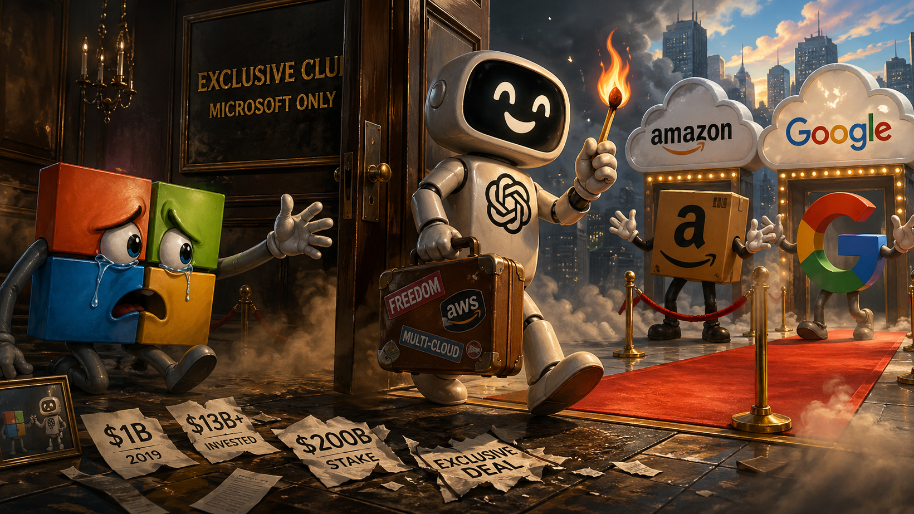
It’s been about seven years since Microsoft first cut a $1 billion check to Sam Altman and OpenAI to help get things off the ground. Since then, Microsoft has poured in roughly $13 billion (a stake that is now valued north of $200 billion) while locking in an exclusive partnership that put it at the center of the AI boom.
But as of today, that exclusivity is thrown out the window.
According to reports, OpenAI and Microsoft are reworking their partnership, giving OpenAI more freedom to operate on its own while still keeping the financial relationship between the two companies in place.
On Monday, the companies said they’ve updated their agreement to put a cap on how much OpenAI will pay Microsoft under their revenue-sharing deal. The rate stays the same at 20%, but there’s now a limit on total payments, and the arrangement will run through 2030 no matter how quickly OpenAI’s technology improves.
The update puts clearer limits on the financial side of a relationship that’s grown a lot since Microsoft first invested in OpenAI back in 2019. Microsoft has since committed more than $13 billion, making it one of OpenAI’s biggest backers.
At the same time, the new deal removes a big restriction. Microsoft no longer has exclusive access to OpenAI’s technology, which means OpenAI can now offer its models on other cloud platforms, including rivals like Amazon and Google.
OpenAI said the change is meant to give it more flexibility, especially as more businesses look for AI tools and the demand for computing power keeps growing.
“Today, we are announcing an updated agreement to simplify how we work together, with a focus on flexibility, clarity, and making AI more widely available,” the company said in a statement.
Even with the changes, Microsoft will remain OpenAI’s main cloud partner. New products are still expected to launch first on Azure, unless Microsoft decides otherwise. Microsoft will also continue to have access to OpenAI’s models through 2032, just no longer on an exclusive basis.
Another key change is how money moves between the two. OpenAI will still share a portion of its revenue (like from ChatGPT subscriptions) with Microsoft. But Microsoft will no longer send a cut back when customers use OpenAI’s models through Azure.
The changes reflect how complicated the AI space has become, with companies now working together in some areas while competing in others. OpenAI has been expanding its reach, including big cloud deals with Amazon, while Microsoft continues to build out its own AI tools.
That overlap has led to some tension. Earlier this month, OpenAI said the current setup had, at times, made it harder to serve customers across different platforms.
Across the industry, companies are making similar moves. They’re rushing to lock in more computing power and spread their workloads across multiple providers as AI systems become more demanding and run for longer periods. Meta, for example, has recently committed tens of billions of dollars to outside cloud providers to help handle the load.
Microsoft stock moved a bit lower directly after the announcement, as investors considered what the changes mean for a relationship that’s still important but no longer as valuable.
At the time of publishing this article, Stocks.News holds positions in Microsoft, Amazon, Google, and Meta as mentioned in the article.
Did you find this insightful?
Bad
Just Okay
Amazing
Disclaimer: Information provided is for informational purposes only, not investment advice. We do not recommend buying or selling stocks. Stock price discussions are based on publicly available data. Readers should conduct their own research or consult a financial advisor before investing. Owners of this site have current positions in stocks mentioned throughout the site, Please Read Full Disclaimer for details Here https://app.stocks.news/page/disclaimer