


Bank of America: Currently sitting on $700B in bonds bought at 1% yields in 2020… down roughly -40%...
Also Bank of America Strategist: “Guys the financial system is broken… how is no one else seeing this is what started the Great Recession?”
Back in 2007, the world was a simpler place.
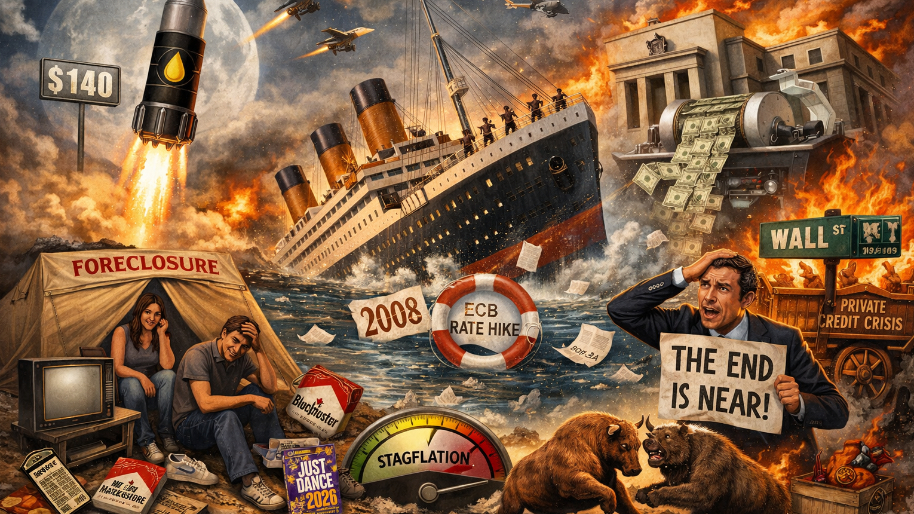
People weren’t fully addicted to their phones, Britney Spears had just shaved her head, and 50% 90% of Wall Street was handing out mortgages to people whose main financial asset was a pack of Marlboros.
What could possibly go wrong? Apparently… a lot.
Now fast-forward to present time (2026, in case you forgot), and according to one Wall Street doomer, markets are starting to give off some serious “hold my beer” vibes.
Cue the creepy violin soundtrack.
According to Michael Hartnett over at Bank of America, current market behavior is starting to look eerily similar to the period between mid-2007 and mid-2008… which, as historians will remember, was when the global economy started hearing the faint sound of the Titanic violin section warming up.
What is the main thing that’s got his panties in a wad? You’ll never gues… oil.
Back during the run-up to the financial crisis, crude prices doubled from $70 to $140 between July 2007 and August 2008. At the same time, the early rumblings of the subprime meltdown were already spreading through the system, taking down institutions like Northern Rock and Bear Stearns before the main event finally arrived.
Sound familiar? Because in 2026, oil has already skyrocketed more than 60% this year (with mostly all of that coming from the Iran war that kicked off on February 28).
And markets, according to Hartnett, are starting to trade in a way that looks suspiciously like the 2007-2008 (aka: the year some of us were playing Just Dance in the living room as our parents argued about if we’d have to sleep in a tent).
But oil is just one piece of this 2008 looking puzzle… Another area starting to look a little sketchy is private credit.
Ironically, the financial crisis that wrecked the banking system also gave birth to the modern private credit machine. Banks pulled back from risky lending, and Wall Street funds happily filled the vacuum.
After f*ing around for years turning private credit into the Wild West of lending**, the industry may finally be entering the “find out” phase.
According to reports, investors are now fearfully pulling out money, and lenders are suddenly re-reading the loan files they approved during the “free money forever” era.
Translation: history has a funny way of repeating itself.
Meanwhile, climbing energy costs are resurrecting a word economists would happily erase from the dictionary: stagflation.
That’s the charming scenario where inflation keeps rising… while economic growth slows… forcing central banks to raise rates at exactly the worst possible moment.
It’s essentially like trying to floor the gas pedal while the transmission is falling out.
And get this… officials at the European Central Bank are already hinting they may need to raise interest rates sooner than expected because of the inflation shock from the war with Iran.
Which brings back one particularly awkward historical moment.
In July 2008, the ECB decided to raise rates the same day oil prices peaked, right before the financial system began collapsing around them.
Hartnett described that move as “one of the greatest policy mistakes of all time.”
When all was said and done, the central bank ended up cutting rates by 325 basis points just 74 days later, after credit markets completely imploded and Lehman Brothers went under.
Oil prices also collapsed to $40 a barrel shortly afterward.
Again… probably nothing.
For now, investors seem pretty relaxed about the situation.
The general belief on Wall Street is that the Iran conflict won’t last long and that the private credit issues won’t turn into anything systemic.
Which means traders are continuing to pile into risk assets under the timeless financial assumption that: “The Fed will save us.” And with Trump’s newly appointed money printer (read: Kevin Warsh) about to start very soon… they’re probably right.
At the time of publishing this article, Stocks.News doesn’t hold positions in companies mentioned in the article.
Did you find this insightful?
Bad
Just Okay
Amazing
Disclaimer: Information provided is for informational purposes only, not investment advice. We do not recommend buying or selling stocks. Stock price discussions are based on publicly available data. Readers should conduct their own research or consult a financial advisor before investing. Owners of this site have current positions in stocks mentioned throughout the site, Please Read Full Disclaimer for details Here https://app.stocks.news/page/disclaimer