


If you’d walked up to me last November, right after the election, and asked me: “Which industry is thanking God Trump got elected?” I would’ve answered in under a second… oil companies. Trump’s campaign trail motto of “drill baby drill” was like dollar signs flashing in Times Square for Exxon, Chevron, BP, and every wildcatter with a dusty truck in Texas. Deregulation, faster permits, fewer tree-huggers in the way… it was supposed to be the golden age of crude.

Well, nine months later, reality has arrived, and it’s not pretty. Instead of celebrating, oil executives are in damage-control mode, cutting jobs, shelving projects, and pawning off assets like it’s a liquidation sale. Crude prices have been grinding along at about $64 a barrel in the U.S…. enough to keep the lights on, sure, but a far cry from the $77 average they enjoyed just last year. And Brent, the global benchmark, isn’t much better at around $66, with Wood Mackenzie projecting it could fall below $60 by early 2026 and stay there for years. That means the bullish assumptions about capex, dividends, and buybacks are already unraveling, because the math simply doesn’t add up.
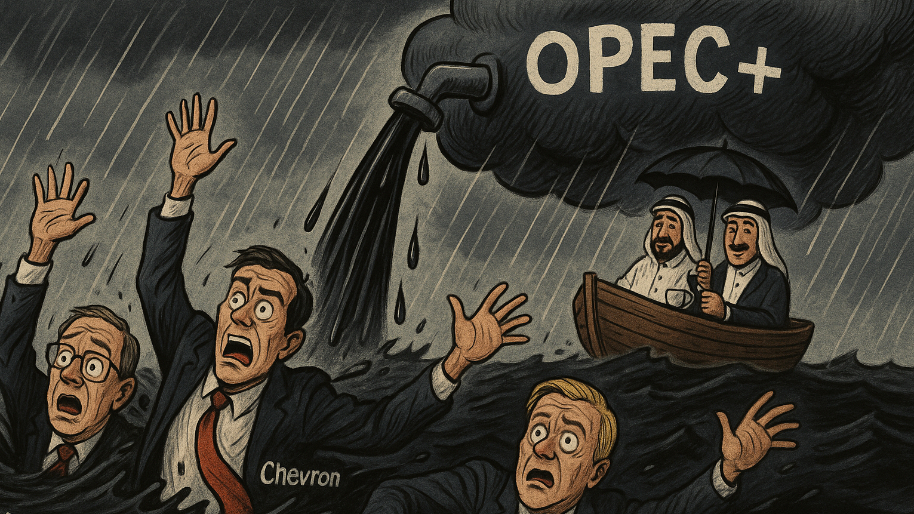
This comes down to OPEC+ deciding to play market disruptor. After a brief stint of holding production back to keep prices supported, they reversed course and opened the taps. Why? To crush higher-cost U.S. shale. And, for instance, when you look at the Dallas Fed’s breakeven estimates (roughly $65 a barrel for shale economics) you realize just how vulnerable U.S. producers are. With rigs and fracking crews now sitting at four-year lows, the strategy is working.

(Source: Semafor)
The human cost is savage. ConocoPhillips just said “Merry Christmas, here’s a pink slip” to about 25% of its workforce (3,250 people) barely a year after it spent $17 billion scooping up Marathon Oil. Chevron’s working through 8,000 cuts, BP has already canned nearly 4,700, and even Saudi Aramco, the oil industry’s Jeff Bezos, had to pawn a $10 billion pipeline stake just to raise cash. Petronas over in Malaysia? They’ve chainsawed 5,000 jobs too. Think about it, if the state-backed oil titans are struggling to keep their heads above water, the rest of the sector is drowning.
As for investors, well the frustration is equally obvious. At sub-$60 oil, none of the Western majors can simultaneously fund the giant capital budgets they’ve promised and keep up with the buybacks and dividends Wall Street has come to expect. BP has already dialed back its repurchase program, and Morgan Stanley expects others will follow suit. Meanwhile, borrowing levels are creeping back toward the highs last seen before the 2022 boom… which, in case anyone forgot, didn’t end well. Live look at oil shareholders:

What was supposed to be Big Oil’s mic-drop moment has turned into karaoke night where nobody knows the lyrics. Trump handed them every policy cookie in the jar, but at the end of the day, prices (not politics) still call the shots. And right now, the price deck looks less like a gravy train and more like a Greyhound bus with no Wi-Fi and a bathroom you wouldn’t wish on your worst enemy. If this is what “energy dominance” is supposed to feel like, someone might want to check the dashboard, because the tank’s flashing empty and the check engine light just came on for the entire oil sector.
At the time of publishing this article, Stocks.News doesn’t hold positions in companies mentioned in the article.
Did you find this insightful?
Bad
Just Okay
Amazing
Disclaimer: Information provided is for informational purposes only, not investment advice. We do not recommend buying or selling stocks. Stock price discussions are based on publicly available data. Readers should conduct their own research or consult a financial advisor before investing. Owners of this site have current positions in stocks mentioned throughout the site, Please Read Full Disclaimer for details Here https://app.stocks.news/page/disclaimer