


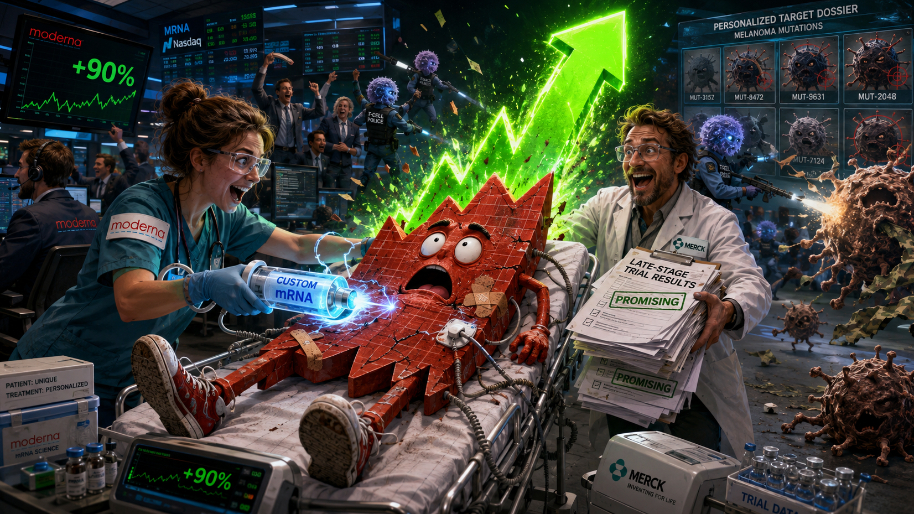
Moderna just turned the “scientist who cured cancer is on your flight” meme into a legitimate travel advisory.
Since Lebron went back to Cleveland (read: 2015), the labcoats at Moderna have been promising investors they were THIS close to finding a cure for cancer…
And this morning, we finally got some clinical receipts.
Shares of Moderna moon launched 90% after its personalized cancer vaccine, developed alongside Merck, delivered positive initial results in its first-ever late-stage trial.
Yes, 90%.
It only took 6 years for the CEO to realize helping prevent melanoma from returning is considerably better for shareholder health than trying to sell America its 14th COVID booster.
Merck shares also jumped 8%, which sounds miniscule until you remember the company has a market cap over 13 times larger than its pharma partner in crime.
So what exactly convinced investors that Moderna might be more than a one-pandemic wonder?
The experimental vaccine, called intismeran autogene, was tested alongside Merck’s blockbuster immunotherapy Keytruda in more than 1,100 patients with high-risk or advanced melanoma whose detectable cancer had already been surgically removed.
The combination met the study’s primary goal by significantly extending the amount of time patients lived without their melanoma returning compared with Keytruda alone.
It also reduced the risk of the cancer spreading to distant parts of the body.
That’s a pretty important distinction because melanoma accounts for only about 1% of skin-cancer cases but causes the large majority of skin-cancer deaths.
For reference, most melanoma recurrences happen within the first two or three years following treatment and removal, leaving patients trapped in the world’s worst waiting game after surgery.
Merck oncology executive Dr. Jane Healy said the new combination produced a “clinically meaningful improvement” over Keytruda, which is already the standard of care for these patients.
The treatment was reportedly well tolerated, with side effects that apparently didn’t require a cheerful narrator to whisper “including death” over footage of a family kayaking.
Now, before you begin picturing doctors pulling a universal “cancer vaccine” from the refrigerator beside the flu shots, this thing is considerably more complicated.
(Adjusts stethoscope that definitely came from a Halloween costume.) Every tumor carries its own collection of mutations, including tumors from patients diagnosed with the exact same type of cancer.
Moderna and Merck’s vaccine is personalized using the genetic blueprint of an individual patient’s tumor. Scientists identify its unique mutations, manufacture a custom mRNA shot designed to expose those targets, and then train the patient’s immune system to recognize and attack them.
Keytruda joins the fight by disabling one of cancer’s favorite biological cloaking mechanisms, helping immune cells do the murdering they were hired to do.
In other words, the vaccine shows the immune system the suspect’s face, while Keytruda unlocks the squad car.
The scientific approach has been under development for decades, but today’s results suggest the science might finally do something besides arouse venture capitalists.
The phase three trial will continue measuring additional outcomes, including whether the combination helps patients live longer overall. Merck and Moderna also plan to present the full data at an upcoming international medical conference.
Neither company has revealed exactly when it will ask U.S. regulators to approve the treatment, so nobody is walking into CVS for a personalized melanoma vaccine this weekend.
Still, reaching the primary endpoint in a large phase three trial brings the companies considerably closer to that possibility.
For Moderna, the stakes were difficult to overstate.
The company has spent the post-pandemic era watching COVID revenue completely disappear with nothing to take its place.
Its stock entered this morning down more than 90% from its 2021 peak, where the remaining shareholders were mostly next of kin.
Some analysts went as far as calling the phase three results a make-or-break event for Moderna.
And by the hair on its chinny chin, Moderna appears to have selected “make.”
But the truly enormous opportunity extends beyond melanoma.
Merck and Moderna are already testing the personalized vaccine across several other cancers, including non-small cell lung cancer, bladder cancer, and renal cell carcinoma.
If the same approach works across multiple tumor types, Moderna could transform from the company that made one extremely famous pandemic vaccine into the manufacturing engine behind an entirely new class of customized cancer treatments.
Of course, that expectation is already embedded in the company’s valuation, meaning Wednesday’s clinical victory doesn’t eliminate the pressure. It simply gives Moderna permission to keep dreaming at an offensively expensive scale.
But things are on the right track… which is something that hasn’t been said about the company in at least 4 years.
At the time of publishing this article, Stocks.News holds positions in Moderna and Merck as mentioned in the article.
Did you find this insightful?
Bad
Just Okay
Amazing
Disclaimer: Information provided is for informational purposes only, not investment advice. We do not recommend buying or selling stocks. Stock price discussions are based on publicly available data. Readers should conduct their own research or consult a financial advisor before investing. Owners of this site have current positions in stocks mentioned throughout the site, Please Read Full Disclaimer for details Here https://app.stocks.news/page/disclaimer