


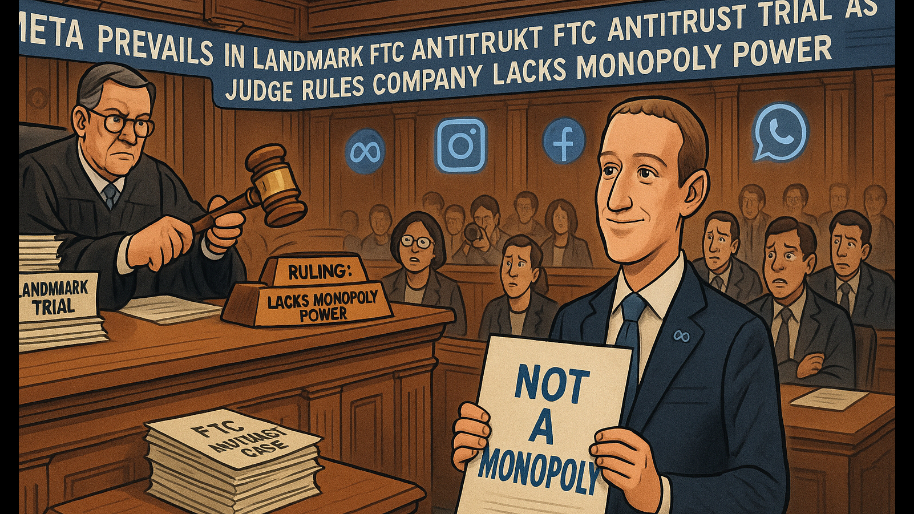
Meta Platforms scored a major legal victory Tuesday after a federal judge rejected the Federal Trade Commission’s long-running antitrust case, ruling that the agency failed to prove the company currently holds monopoly power in social networking.
The decision, issued by Judge James Boasberg of the U.S. District Court for the District of Columbia, arrives nearly seven months after the trial began and caps off a legal battle the FTC first launched five years ago. The case centered on Meta’s acquisitions of Instagram (2012) and WhatsApp (2014)... deals the FTC argued should never have been allowed. Boasberg’s memorandum opinion was unequivocal: the FTC did not meet its burden of proof.
“Whether or not Meta enjoyed monopoly power in the past, the agency must show that it continues to hold such power now,” Boasberg wrote. “The Court’s verdict today determines that the FTC has not done so.”
In his analysis, Boasberg emphasized that the social media market has transformed dramatically over the past decade. The FTC’s case relied heavily on historical arguments from the era when Facebook dominated photo sharing and friend-to-friend communication. But the judge said the modern landscape is defined by short-form video and cross-platform competition, particularly from TikTok and YouTube.
Boasberg noted internal industry documents showing how TikTok and YouTube view Meta as a competitive threat… and how consumers increasingly treat all three as substitutes.
“People treat TikTok and YouTube as substitutes for Facebook and Instagram,” he wrote, adding that the FTC offered “no empirical evidence of substitution whatsoever” to counter that.
Boasberg dismissed the FTC’s original complaint in 2021, saying the agency had not sufficiently demonstrated Meta’s market power. The FTC later filed an amended complaint in August 2021, bolstering its arguments with more metrics and competitor comparisons. In 2022, Boasberg allowed the revised case to proceed. Following months of testimony… including appearances from Mark Zuckerberg, former COO Sheryl Sandberg, and Instagram co-founder Kevin Systrom… the court ultimately sided with Meta. The FTC blasted the ruling, signaling possible next steps.
“The deck was always stacked against us with Judge Boasberg, who is currently facing articles of impeachment,” said Joe Simonson, the FTC’s director of public affairs. “We are reviewing all our options.”
Meta praised the decision as validation of the company’s argument that the social networking market is far from monopolistic.
“The Court’s decision today recognizes that Meta faces fierce competition,” said Jennifer Newstead, Meta’s chief legal officer. “Our products are beneficial for people and businesses and exemplify American innovation.”
Meta shares slipped less than 1% on the day. The stock is down -0.2% year-to-date, trailing broader indexes and most mega-cap tech peers.The ruling comes just months after Google avoided a breakup order in its own high-profile antitrust case, despite being found to hold an illegal monopoly in search. In contrast to the DOJ’s ongoing scrutiny of Google, the FTC failed to persuade the court that Meta’s past acquisitions constitute a present-day violation of antitrust law.
The crux of the issue: To force divestitures of Instagram and WhatsApp, the FTC needed to show a current or imminent violation. Boasberg concluded the agency did not. In fact, Boasberg’s opinion repeatedly highlighted how consumers have moved toward video-first platforms:
- TikTok’s explosive growth
- YouTube’s massive user base
- Meta’s own shift to Reels to keep pace
The judge noted that Meta has been compelled to spend “gobs of cash” to compete with emerging rivals, hardly the position of a monopolist insulated from competitive threats.
“Meta is not a monopolist insulated from competition,” Boasberg wrote. “The evidence favoring Meta on this issue is both credible and convincing.”
About Meta Platforms, Inc.
Meta Platforms, Inc. (NASDAQ: META) is a global technology company operating social apps including Facebook, Instagram, Threads, and WhatsApp. Founded in 2004 and headquartered in Menlo Park, California, Meta builds products and technologies that help people connect, discover communities, and grow businesses. The company is also investing heavily in artificial intelligence and the development of future computing platforms, including augmented and virtual reality.
At the time of publishing, Stocks.News holds positions in Meta and Google as mentioned in the article.
Did you find this insightful?
Bad
Just Okay
Amazing
Disclaimer: Information provided is for informational purposes only, not investment advice. We do not recommend buying or selling stocks. Stock price discussions are based on publicly available data. Readers should conduct their own research or consult a financial advisor before investing. Owners of this site have current positions in stocks mentioned throughout the site, Please Read Full Disclaimer for details Here https://app.stocks.news/page/disclaimer