


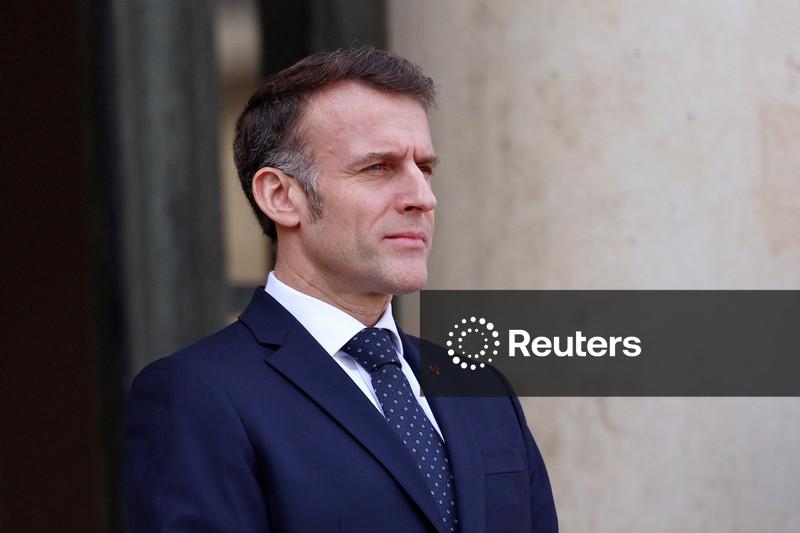
PARIS, Feb 26 (Reuters) - President Emmanuel Macron will update France’s nuclear doctrine on Monday, ruling out shared European control while outlining what Paris can offer allies worried about the reliability of the U.S. nuclear umbrella under President Donald Trump.
Although France and Britain are both nuclear powers, most European countries rely primarily on the United States for deterring any potential adversaries — a decades-old pillar of transatlantic security.
But Trump's rapprochement with Russia on the Ukraine war and his harsher posture towards traditional allies - including threats to seize Greenland, an autonomous territory of NATO ally Denmark - have rattled European governments.
Earlier this month in Munich, German Chancellor Friedrich Merz said Berlin had opened discussions with France on a potential European nuclear deterrent, something that Macron said should be a "holistic approach of defence and security".
Other states, including traditionally pro-U.S. Nordic nations, have cautiously expressed interest.
QUESTIONS OVER FRENCH CAPABILITIES
However, European officials privately question how far France’s arsenal can stretch to protect the continent. Concerns include cost-sharing, the issue of who would control launch decisions, and whether focusing on nuclear forces risks crowding out urgently needed investment in conventional capabilities.
France spends roughly 5.6 billion euros ($6.04 billion) a year to maintain its stockpile of 290 submarine- and air-launched weapons — the world's fourth-largest arsenal.
"For Europe, if you really want to go it alone... you have to build up your own nuclear capability. That costs billions and billions of euros," NATO Secretary-General Mark Rutte told the European Parliament in January.
"You would lose the ultimate guarantor of our freedom, which is the U.S. nuclear umbrella."
According to expert estimates, as part of NATO's nuclear deterrence, the U.S. stations around 100 nuclear bombs in total in Belgium, Germany, Italy, the Netherlands and Turkey.
In the event of a conflict, the air forces of these non-nuclear countries would carry the U.S. bombs, under the so-called "nuclear sharing" doctrine.
U.S. Undersecretary of Defence Elbridge Colby told allies in Brussels this month that Washington would continue to extend its nuclear deterrent to Europe, even as it ploughs more than a trillion dollars into modernising its own arsenal.
French officials say Paris does not seek to replace the U.S. umbrella or compete with NATO.
"While U.S. nuclear forces' primary mission is to target adversary nuclear arsenals, their French and British counterparts aim to inflict unacceptable damage on the political, military, and economic centres of potential adversaries," Etienne Marcuz of the FRS think-tank wrote in a recent note.
"This doctrine requires far fewer warheads to be credible."
UNDERSTANDING FRANCE'S DOCTRINE
French officials say they want Europeans to better understand what France's doctrine can — and cannot — provide. But Paris is adamant that funding its deterrent remains solely a French responsibility to ensure exclusive national control.
A core element of France's posture is "strategic ambiguity" over when nuclear weapons might be used, and where French vital interests overlap with broader European defence.
For some partners, this opacity is not reassuring.
"We first want to see what France has to offer... It's not about having deterrence. It's about how credible it is," said a senior eastern European diplomat.
Any expanded French role would also require Europe to develop deep-strike missiles with ranges beyond 2,000 km — capability it currently lacks.
Developing tactical nuclear weapons, intended for battlefield use, as opposed to strategic weapons designed to be fired across vast distances, is seen as even less likely.
Officials say doing so would trigger alarm bells under the nuclear non-proliferation treaty, long championed by European governments.
"We understand where these discussions are coming from. They're stemming from the fact that our transatlantic alliance is not what it used to be," European Union foreign policy chief Kaja Kallas told reporters in Brussels this month.
"My personal view is that, you know, if we have more nuclear weapons all around the world, I don't think we're going to be in a more peaceful world," she said.
MACRON'S NUCLEAR DOCTRINE
Speaking at France’s nuclear submarine base in Brittany, Macron will deliver the customary once-per-presidential-term update on the nuclear doctrine.
France's stance, under the doctrine, aims to maintain a minimal but credible arsenal designed to impose losses severe enough to deter any first strike.
"Just discussing alternatives is sending a message to Moscow," said one senior European official.
French officials offered no details ahead of Macron's speech but said the strategic landscape has shifted dramatically since his last one in 2020, citing Russia's growing arsenal and increased nuclear rhetoric since its 2022 invasion of Ukraine.
France has long said its vital interests have a European dimension. In 2020, Macron went further, inviting partners into strategic discussions — an overture that drew little enthusiasm at the time.
Officials said one principle remains unchanged: only the French president can order a nuclear strike.
"It is the case and will remain so," a French presidential adviser said.
(Additional reporting by Andrew Gray, Sabine Siebold and Lili Bayer; editing by Andrew Gray and Gareth Jones)
Did you find this insightful?
Bad
Just Okay
Amazing