


“The price is wrong, b*tch” - Fortitude Re, probably…
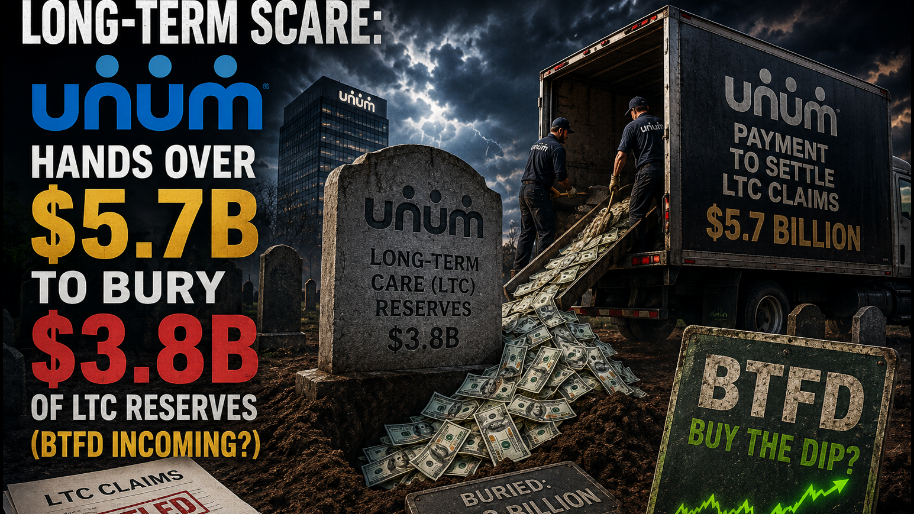
Would ya look at that, it’s the “$3.8 billion liability that costs $5.7 billion to make somebody else’s problem” clusterf*ck. Courtesy of Unum. In short, the company announced Monday that it will hand 50,000 individual long-term-care policies to The Undertaker (read: Fortitude Re), removing 52% of its individual LTC reserves and roughly 26% of the total block. Reinsurance is not a sale: Unum still owes policyholders, while Fortitude reimburses the claims and passes biometric risk to an unnamed global reinsurer. Translation: The liability moves backstage… it doesn’t NOT disappear.
For context, its policyholders average 76 years old, 83% have inflation protection and 43% carry lifetime benefits (yes, lifetime). Unum’s books hold $3.84 billion of statutory reserves against it and estimate the liability at $4.5 billion. Fortitude wants $5.66 billion of assets and cash at closing. The actual clearing price just walked in, slapped both accounting numbers, and asked who was paying the tab.
Before we go full send in the other direction though, those columns are not twins (read: different rulers). The $5.66 billion is fair-market-value assets; the reserve figures use different measurements and discounting. Unum’s own slides do the cleaner math that say after a $130 million required-capital release and $490 million of tax benefits, the deal still costs $540 million versus best-estimate reserves, or 12%. Management calls that paying $540 million to make the scary number go away disciplined risk transfer.
Friendly reminder, Fortitude took a $3.4 billion LTC block last year. That transaction cost $310 million, or 10%, versus best estimate after economic benefits. Spoiler: private capital will take legacy LTC, but it is not running a charity for actuarial sh*tshows. Case in point: Unum keeps claims administration and the rate-increase program, gets upside if future increases beat assumptions, and writes the unnamed retrocessionaire an up-to-$125 million volatility cover for a $5 million premium (which is one hell of an insurance quote). It will also retain about $11 billion of LTC statutory reserves. Joint custody, basically, except the emergency tab has nine figures.
For the bull case, they do get one very real W. See, Unum still expects $1.4 billion to $1.6 billion of 2026 capital generation, roughly $1.3 billion of buybacks and dividends, year-end holding-company liquidity of $1.5 billion to $2 billion, and RBC of 400% to 425%. The capital-return machine survives. Shares still tumbled roughly 4% Monday morning, which suggests the Street read past the “priorities unchanged” high.
Cui bono? Carlyle. Fortitude says the transaction will add to Carlyle’s fee-earning assets, while Carlye’s advisory agreement collects a recurring fee across Fortitude’s general account. Meaning, all this comes down to is Unum buying certainty, while Fortigue gets the assets and Carlye gets the meter running. Bigly.
So what do we do with this info-gasm? Well, nothing… right now. The “clean exit” headline is laughable especially after learning certainty costs another $540 million, but I’m sure as hell not shorting an insurer still planning to fire $1.3 billion back at shareholders either. Let the deal close. If RBC lands inside that 400% to 425% range and the buyback machine keeps eating shares, Monday’s selloff starts looking like a BTFD. If capital returns get trimmed or RBC misses the floor, walk. The expensive risk transfer has started eating the thing bulls actually own the stock for.
Additionally, do not mistake this for a buy signal on Genworth. It carries $42.4 billion of GAAP LTC future-policy-benefit liabilities while its holding company had $166 million of cash and liquid assets at March 31. Those measurements are not directly comparable to Unum’s deal math, but the message still clears: an exit exists if you can afford the cover charge. Genworth being slightly green on this news is main character energy from a company that cannot pay supporting-cast prices.
As for Carlyle, it’s the cleaner beneficiary and deserves to be put on the pullback list. But make management prove the new assets are moving fee-related earnings. One $5.7 billion handoff is a nice payday. It is not permission to go full Gluck Gluck 9000 on a $16 billion asset manager. Place your bets accordingly, friends. Until next time…

At the time of publishing, Stocks.News does not hold positions in companies mentioned in the article.
Did you find this insightful?
Bad
Just Okay
Amazing
Disclaimer: Information provided is for informational purposes only, not investment advice. We do not recommend buying or selling stocks. Stock price discussions are based on publicly available data. Readers should conduct their own research or consult a financial advisor before investing. Owners of this site have current positions in stocks mentioned throughout the site, Please Read Full Disclaimer for details Here https://app.stocks.news/page/disclaimer