


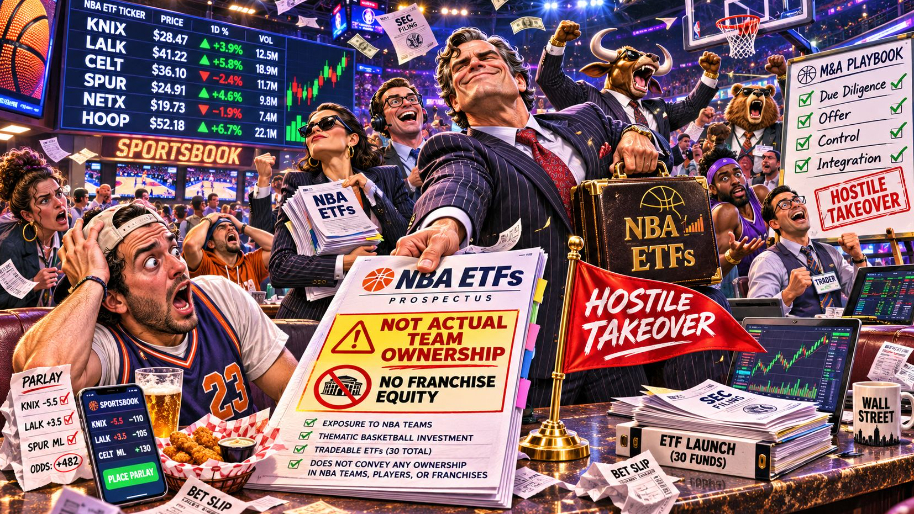
“Honey, it's not a gambling problem. I'm dollar-cost averaging into the Charlotte Hornets.”
The Venn diagram of dudes who spend their mornings on WeBull and their evenings on DraftKings is about to become a perfect circle.
On Tuesday, a company called LeagueShares filed paperwork with the SEC for 30 exchange-traded funds designed to give morons investors exposure to the on-court performance of every NBA team.
And yes, they've already got the ticker symbols picked out. The New York Knicks would trade under KNIX, the Lakers under LALK, and the Boston Celtics under CELT.
Get Jim Cramer on Inside the NBA talking to Charles Barkley and we'll have enough meme ammunition to last us through 2050.
The same morning, a company called FutureSports announced an exclusive agreement with the NBA to use its official statistics to develop team-specific performance indexes, which CME Group plans to list futures contracts on, pending regulatory review.
So what’s the catch, you ask?
Well, the catch is that these ETFs have virtually nothing to do with the actual businesses behind the NBA teams.
Rather than owning a piece of the franchise and collecting a portion of the proceeds every time someone spends $19 on a Michelob Ultra at Crypto.com Arena, these ETFs would invest in futures contracts tied to their respective team's performance index.
Each team starts the season with an index value of 7,500. Points, assists, and wins send the index higher, while turnovers, losses, and points allowed send it lower. Playoff performances count, too, before the index eventually resets during the offseason.
LeagueShares even included a little backtest in its SEC filing to show us how these team indexes would've performed last season.
The championship-winning New York Knicks ripped 78% higher, while the Brooklyn Nets did its best impression of Beyond Meat (-76%).
“Wait, so I correctly predict who's going to win the NBA Finals and I don't even double my money? WTF am I doing this for?”
Fair question.
Especially considering both the Lakers and Knicks finished the regular season with identical 53-29 records, yet the Lakers index gained just 16.5%. The Clippers didn't even make the playoffs and finished up 14%, while the Portland Trail Blazers made the playoffs and somehow managed to lose 35%.
Now, FutureSports has since tinkered with its scoring methodology, and these are historical index returns, not actual ETF returns.
Regardless, I wouldn't exactly lump these things into the same category as your Vanguard funds.
Unlike the S&P 500, where the underlying companies can collectively grow their earnings, the NBA can't manufacture more wins without manufacturing an equal number of losses.
In fact, had you added up all 30 team indexes last season, their combined value would've finished within 1% of where it started.
And that's BEFORE accounting for management fees and the costs associated with rolling futures contracts.
So much for diversifying your portfolio across all 30 NBA teams and letting compound interest do its thing.
There's also the small matter of NBA players doing most of their work while the stock market is closed. Just eight of last season's 1,322 games overlapped with regular market hours, prompting LeagueShares to warn investors about potentially substantial price gaps at the opening bell.
As if watching your team blow a 24-point lead wasn't already a miserable enough way to go to bed.
The earliest these ETFs could debut is February, with similar products for hockey and baseball already in the works.
God help us all.
At the time of publishing this article, Stocks.News holds positions in WeBull as mentioned in the article.
Did you find this insightful?
Bad
Just Okay
Amazing
Disclaimer: Information provided is for informational purposes only, not investment advice. We do not recommend buying or selling stocks. Stock price discussions are based on publicly available data. Readers should conduct their own research or consult a financial advisor before investing. Owners of this site have current positions in stocks mentioned throughout the site, Please Read Full Disclaimer for details Here https://app.stocks.news/page/disclaimer