


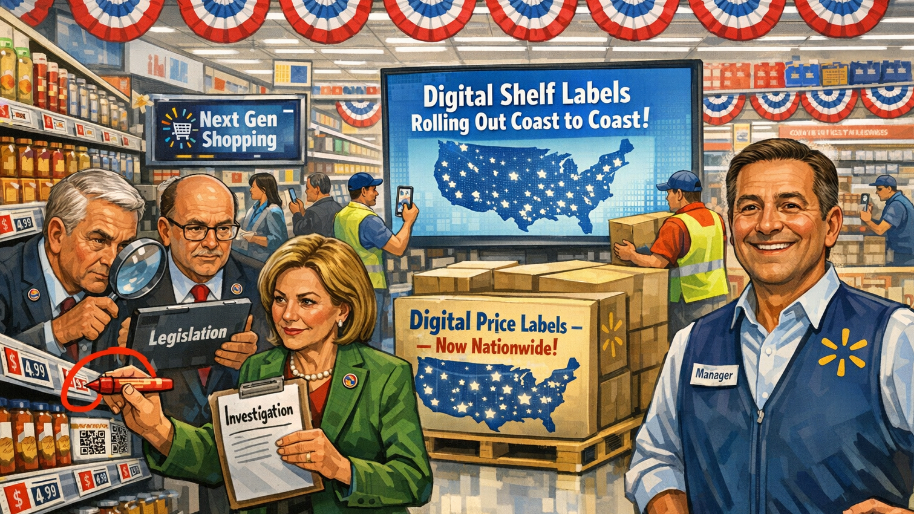
Federal lawmakers are pressing to restrict digital shelf labels in grocery stores as Walmart (NYSE: WMT) moves to install the technology across its U.S. locations by the end of 2026.
The pushback centers on concern that the labels could eventually be used to support dynamic pricing, even though there have been no reported cases tying the technology to surge pricing. Sen. Ben Ray Luján of New Mexico said his Stop Price Gouging in Grocery Stores Act is intended to place guardrails on large retailers, including a provision that would bar digital shelf labels in grocery stores larger than 10,000 square feet. Rep. Val Hoyle of Oregon is backing related legislation in the House and said the labels should be banned until stronger consumer protections are in place.
The proposed size threshold would apply to Walmart Supercenters, which can approach 200,000 square feet, and also to Walmart Neighborhood Market stores. It would also capture many Trader Joe’s locations, which generally range from about 10,000 to 15,000 square feet.
Walmart, however, says the labels are being introduced to improve store operations rather than alter prices by shopper. The retailer said prices displayed on the tags will remain the same for every customer in every store. The company is replacing paper shelf tags with digital versions across its U.S. footprint and expects the rollout to be completed by year-end 2026.
Store employees say the labels can reduce manual work. Amanda Bailey, an electronics team leader at a Walmart store in West Chester, Ohio, said the system has cut the time she spends on pricing duties by 75%.
She also said the labels help Walmart’s Spark delivery drivers locate products by flashing to identify the correct item on the shelf.
Kroger (NYSE: KR) is also experimenting with digital shelf tags. A spokesperson for the grocer said the labels are meant to provide clear and accurate shelf pricing while reducing the labor involved in replacing paper tags each week. Kroger said the tags are updated to match prices shown on its website or weekly promotional offers so shoppers receive consistent information across channels.
Retail consultant Scott Benedict, a former executive at Sam’s Club and Walmart, said concerns about the technology are understandable because it allows prices to be changed quickly. He said grocery shoppers are especially alert to even small price moves because of inflation, tariffs and wider economic pressure. Still, Benedict said dynamic pricing in retail is generally used for operational reasons such as clearing overstocks, managing seasonal merchandise or aligning prices across channels, rather than creating sudden price jumps that differ between shoppers.
Supporters of the restrictions argue the risk lies in how the technology could be used later. Luján said new systems in grocery stores should help lower costs, not raise them.
Hoyle said that without tighter regulation, retailers could eventually exploit the tools to push higher prices onto consumers.
About Walmart
Founded in 1962, Walmart (NYSE: WMT) is headquartered in Bentonville, Arkansas. The company operates supercenters, discount stores, neighborhood markets and e-commerce platforms. Walmart sells groceries, household goods, electronics, apparel, health products and general merchandise in the United States and international markets.
At the time of publishing, Stocks.News does not hold positions in companies mentioned in the article.
Did you find this insightful?
Bad
Just Okay
Amazing
Disclaimer: Information provided is for informational purposes only, not investment advice. We do not recommend buying or selling stocks. Stock price discussions are based on publicly available data. Readers should conduct their own research or consult a financial advisor before investing. Owners of this site have current positions in stocks mentioned throughout the site, Please Read Full Disclaimer for details Here https://app.stocks.news/page/disclaimer