


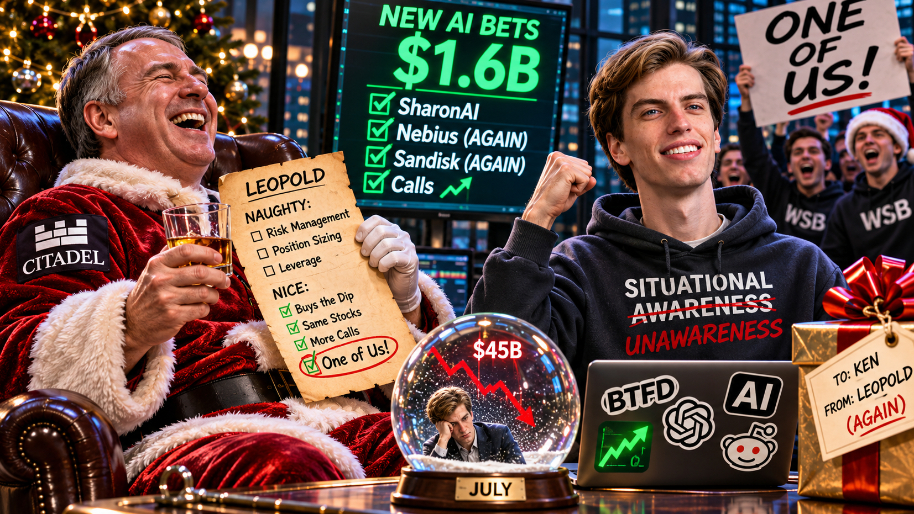
*Ken Griffin adjusting his tie in the mirror*: “Merry Christmas, you handsome son of a b****.”
I don't know about you, but if I lost control of a $45 billion hedge fund and had to call Ken Griffin to help liquidate my portfolio before the margin department repossessed my bloodline…
I might consider taking a few months off.
Maybe buy a boat. Learn to golf. Spend some quality time with the family. Maybe have some “Situational Awareness…”
Not Leopold “Liquidated” Aschenbrenner.
Unlike Keith Gill when the “CatSignal” lights up… this degenerate actually picks up the phone.
According to a fresh SEC filing, the man kid who wrote 165 pages explaining how AI will take over the world has returned with $1.6 billion in disclosed holdings. Evidently, the chapter on portfolio risk management is still being peer-reviewed.
Sadly for Leopold, the same AI stocks that nearly put him in a financial body bag in July are back to finish the job.
“No question about it. I am ready to get hurt again.” -Leopold Scott
Quick recap: Aschenbrenner first became famous in 2024 after publishing a 165-page AI manifesto called Situational Awareness, predicting that artificial general intelligence could arrive by 2027 and superintelligent machines before 2030.
His thesis?
AI development would accelerate so quickly that the world's largest technology companies would eventually need computing clusters costing as much as $1 trillion.
Which is a pretty bold prediction coming from a guy who was barely old enough to rent a car.
But unlike the average 22-year-old posting 47-part threads on Twitter about how ChatGPT is going to replace humanity, Leopold actually convinced some VERY wealthy people to give him money.
We're talking Stripe founders Patrick and John Collison, former GitHub CEO Nat Friedman, and investor Daniel Gross.
And with their backing, he launched a hedge fund dedicated to profiting from the AI infrastructure boom.
Not by betting on the chatbots themselves.
But by buying the companies supplying the electricity, computer chips, and data centers those chatbots would need.
And for a while, the kid was absolutely PRINTING.
At its peak, Situational Awareness reportedly controlled $45 billion in assets.
Then July happened.
And Leopold learned a valuable lesson about the difference between artificial intelligence and actual intelligence.
One can predict the arrival of superintelligent machines.
The other knows better than to leverage a $45 billion hedge fund to the tits.
By July, his public stock holdings had shrunk 67%, while total fund assets collapsed to around $10 billion.
“Following this month’s events, we've decided to rename the fund Situational Unawareness. Our lawyers also suggested changing our identities.”
The situation got so ugly that Aschenbrenner had to unload his public stock portfolio to Ken Griffin's Citadel.
Which, believe it or not, wasn't even the most embarrassing part.
Because Citadel subsequently turned around and unloaded more than 80% of the acquired portfolio's aggregate risk through nearly 100 block trades worth over $4 billion.
In other words, the 24-year-old AI prophet couldn't afford to hold his own positions…
So he sold them to a billionaire who immediately started flipping them like distressed houses on HGTV.
Turns out, Ken Griffin may have liquidated Leopold's portfolio, but the man's BUY THE F’ING DIP gene survived completely unharmed.
Days after the July meltdown, his fund committed another $400 million to an undisclosed private company, bringing its total investment in that business to $500 million.
And now?
He's back in the public markets, too.
According to Monday's 13F filing, Situational Awareness ended September with a fresh collection of AI infrastructure bets.
The biggest?
A more than $440 million position in Australian neocloud company SharonAI.
He also disclosed nearly $39 million in CleanSpark, more than $21 million in IREN, over $20 million in Bitdeer, and another $11 million-plus in Fermi.
And because owning regular shares wasn't sufficiently stimulating for a man who just survived a margin-call apocalypse…
He also loaded up on (wait for it) call options.
Those included bets on Nebius, Sandisk, the Roundhill Memory ETF, and Bloom Energy.
Albeit the SAME Nebius and Sandisk that helped turn his summer into a financial episode of Survivor.
“The tribe has spoken. Please surrender your remaining collateral.”
And just when our boy thought he'd earned his spot on Redemption Island…
October showed up with another elimination challenge.
Since September 30, several major names in his disclosed portfolio have been doing disappearing acts.
SharonAI alone collapsed 58% in October, then shed another 11% in November.
IREN plunged 41% in October.
Nebius lost 35%, then suffered another 16%-plus single-day beatdown last week after delivering a weak full-year forecast.
To be clear, we don't actually know whether he's still holding these positions.
The SEC filing only shows what Situational Awareness owned at the end of September.
He could have sold everything before the October bloodbath.
He could have hedged his exposure.
Or he could still be sitting in his office explaining to investors why a 58% drawdown is actually bullish for the long-term development of artificial general intelligence.
The filing doesn't tell us.
What it DOES tell us is that Aschenbrenner returned to the exact corner of the stock market that nearly blew up his fund just three months earlier.
One of us… one of us…
At the time of publishing this article, Stocks.News doesn’t hold positions in companies mentioned in the article.
Did you find this insightful?
Bad
Just Okay
Amazing
Disclaimer: Information provided is for informational purposes only, not investment advice. We do not recommend buying or selling stocks. Stock price discussions are based on publicly available data. Readers should conduct their own research or consult a financial advisor before investing. Owners of this site have current positions in stocks mentioned throughout the site, Please Read Full Disclaimer for details Here https://app.stocks.news/page/disclaimer