


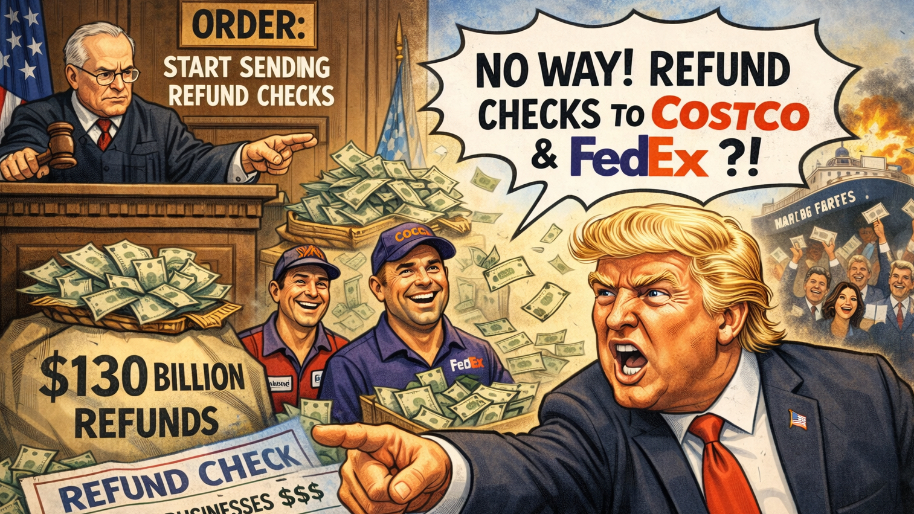
A federal judge just handed U.S. businesses what could become one of the largest refund checks in modern trade history.
On Wednesday, Judge Richard Eaton ruled that the federal government must begin issuing more than $130 billion in tariff refunds to American companies after the Supreme Court struck down President Donald Trump’s sweeping “reciprocal” tariffs earlier this year.
The decision comes after more than 2,000 companies filed lawsuits arguing they were forced to pay tariffs that ultimately turned out to be illegal. Some of the names involved aren’t exactly small operators either. Major firms including Costco and FedEx are among the businesses now seeking refunds for duties they paid while the tariffs were in effect.
Judge Eaton’s ruling doesn’t mean checks are about to start flying out of Washington tomorrow morning. What it does do is force the government to begin figuring out how those refunds will actually be processed. That process could take years as courts work through thousands of individual claims from companies trying to recoup the money they paid under the policy.
The legal battle traces back to a major decision earlier this year from the Supreme Court of the United States, which ruled that the administration overstepped its authority when it imposed broad “reciprocal” tariffs on foreign goods. Once that ruling came down, businesses that had been paying those duties suddenly realized something important. If the tariffs were illegal, then the payments tied to them might need to be returned.
The aftermath of Trump’s decisions resulted in 2,000 lawsuits and a potential refund bill that now exceeds $130 billion.
But while courts are sorting through the aftermath of the old tariffs, the administration is already moving ahead with a new round of duties. President Donald Trump recently imposed a 10% blanket tariff under Section 122 of the Trade Act of 1974, a rarely used law that allows presidents to temporarily raise tariffs in response to trade imbalances.
Treasury Secretary Scott Bessent said those tariffs could rise to 15% as soon as sometime this week. Under the law, the duties can remain in place for up to 150 days before Congress would need to approve any extension.
In other words, Washington now finds itself in the slightly awkward position of potentially refunding billions of dollars in old tariffs while simultaneously preparing to roll out new ones.
The uncertainty has already started to ripple through global trade negotiations. The European Union recently paused ratification of a trade agreement with the United States, saying it wants “full clarity” on the direction of U.S. trade policy before moving forward.
At the same time, the administration has also discussed rolling back certain tariffs on metals as it tries to ease pressure on consumers facing rising prices ahead of the midterm elections.
For American companies that paid the now-invalidated tariffs, the court ruling could eventually result in a massive payout, even if the legal process drags on for years.
At the time of publishing this article, Stocks.News doesn’t hold positions in companies mentioned in the article.
Did you find this insightful?
Bad
Just Okay
Amazing
Disclaimer: Information provided is for informational purposes only, not investment advice. We do not recommend buying or selling stocks. Stock price discussions are based on publicly available data. Readers should conduct their own research or consult a financial advisor before investing. Owners of this site have current positions in stocks mentioned throughout the site, Please Read Full Disclaimer for details Here https://app.stocks.news/page/disclaimer