


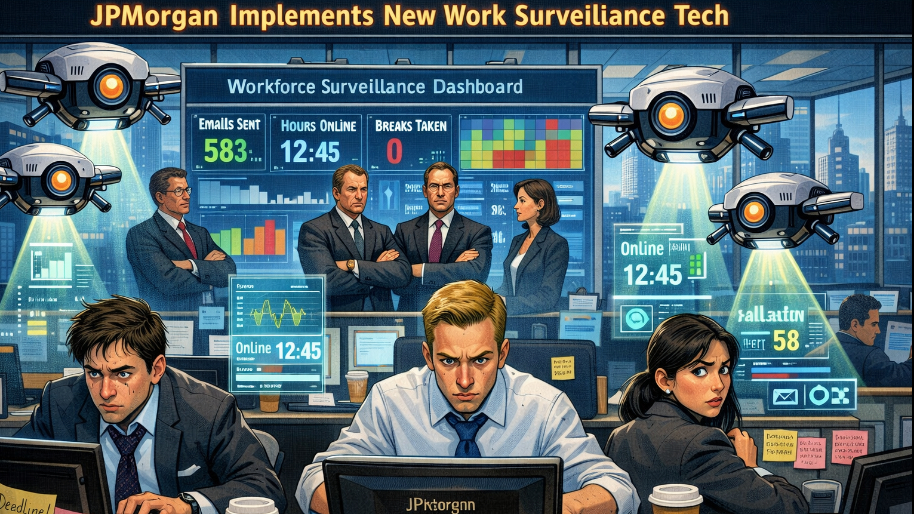
JPMorgan Chase (NYSE: JPM) is using an internal system to estimate how long junior investment bankers are actually working, part of a broader Wall Street effort to address concerns about extreme workloads after a series of high-profile deaths linked to punishing schedules.
The tool compares self-reported time sheets with computer-generated estimates drawn from employees’ digital activity, including scheduled meetings, video calls and keystrokes, according to the Financial Times. JPMorgan told the newspaper the system is meant to promote transparency and support conversations about workload rather than serve as a disciplinary measure.
“Much like the weekly screen time summaries on a smartphone, this tool is about awareness… not enforcement,” the bank told the Financial Times. It said the program is designed to encourage openness around working hours and employee wellbeing.
Large banks have faced mounting scrutiny over whether junior staff are being pushed beyond formal limits. In 2024, JPMorgan set an 80-hour weekly cap for junior bankers, while Bank of America introduced a timekeeping system that required associates to break down how their hours were spent.Those steps followed renewed attention on working conditions after the death of Leo Lukenas III, a 35-year-old Bank of America associate, former Green Beret and married father of two young children. Reports said Lukenas had been working days of at least 16 hours and weeks approaching 100 hours before he died of a heart attack in 2024.
The fallout from his death extended beyond internal policy questions. Social media criticism focused on Lukenas’s manager, Gary Howe, Bank of America’s co-head of the financial institutions group, who later deleted his LinkedIn account. Reports also said Lukenas had been searching for another job in the weeks before his death because of the strain of his schedule.
Questions about whether banks are enforcing their own safeguards have persisted. A Wall Street Journal investigation later reported that Bank of America managers had been disregarding the firm’s 80-hour limit for junior bankers. The industry had confronted a similar issue more than a decade earlier. In 2013, Bank of America adopted an 80-hour weekly cap after Moritz Erhardt, a 21-year-old intern in London, died of what officials described as an epileptic seizure. Reports at the time said Erhardt had worked until 6 a.m. on three consecutive nights before his death.
Concerns around junior banker workloads also resurfaced after the January 2025 death of Carter McIntosh, a 28-year-old Jefferies associate in Dallas. His death was later ruled an accidental overdose involving fentanyl and cocaine, though colleagues and media reports said he had been working close to 100-hour weeks.
Some mental health professionals say monitoring alone may not solve the underlying problem. Jonathan Alpert, a New York-based psychotherapist who works with Wall Street clients, said junior bankers already face intense pressure from long hours, constant availability and fear of falling behind. He warned that additional surveillance could reinforce the sense that employees are never truly off duty and may worsen burnout instead of easing it.
Alpert said the larger issue is cultural, arguing that overwork is still often treated on Wall Street as evidence of commitment. Until that changes, he said, tools that track activity risk addressing the symptom more than the cause.
Long hours have remained embedded in investment banking, where analysts and associates often work through the night to meet deadlines and support major deals. The jobs continue to attract recruits because compensation for entry-level bankers can reach roughly $200,000 including salary and bonuses, with higher earnings and exits to private equity and hedge funds still serving as a major draw.
About JPMorgan Chase
JPMorgan Chase & Co. (NYSE: JPM) is a New York-based financial services company formed in 2000 through the merger of J.P. Morgan & Co. and Chase Manhattan Corp. The bank operates across consumer banking, commercial banking, investment banking, asset and wealth management, and payments.
At the time of publishing, Stocks.News does not hold positions in companies mentioned in the article.
Did you find this insightful?
Bad
Just Okay
Amazing
Disclaimer: Information provided is for informational purposes only, not investment advice. We do not recommend buying or selling stocks. Stock price discussions are based on publicly available data. Readers should conduct their own research or consult a financial advisor before investing. Owners of this site have current positions in stocks mentioned throughout the site, Please Read Full Disclaimer for details Here https://app.stocks.news/page/disclaimer