


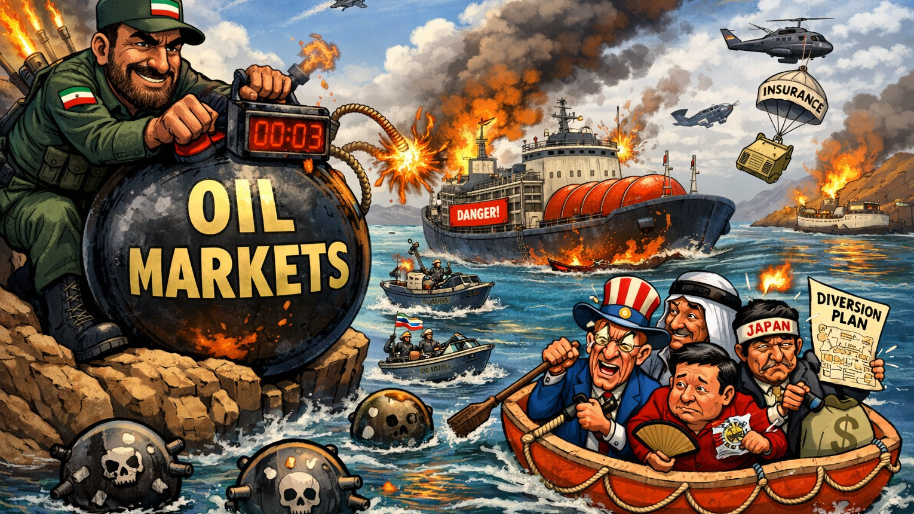
Oil markets are heading into the new week with a fresh layer of uncertainty after the joint U.S.-Israeli strike on Iran raised the stakes in the Middle East.
At the center of it all is the Strait of Hormuz… a narrow waterway that carries a massive share of the world’s energy supply.
For instance, roughly one-third of global seaborne crude exports, or more than 14 million barrels per day, pass through the strait. Around 20% of the world’s liquefied natural gas shipments move through it as well. Most of those barrels head to Asia, with China alone sourcing about half of its crude imports through Hormuz.
That’s why this situation has the potential to move markets in a big way.
Iran, OPEC’s fourth-largest producer at just over 3 million barrels per day in January, shares a coastline with the strait. In a worst-case scenario, Tehran could attempt to disrupt commercial traffic there in retaliation. Even limited interference (mines, missile threats, or pressure on insurers) could slow tanker flows and drive up shipping costs.
On Friday, Brent crude settled at $72.48 a barrel, up 2.45%, while U.S. West Texas Intermediate closed at $67.02, up 2.78%. Analysts expect prices to open $5 to $7 higher as traders price in additional risk.
So far, no barrels have been knocked off the market. But traders aren’t only focused on output… they’re focused on whether those barrels can actually move.
More than 20 million barrels of crude have been loaded for export from Gulf producers including Saudi Arabia, Iraq, the UAE, Kuwait and Qatar. Importantly, most of the world’s spare oil production capacity sits in those same countries. If Hormuz were disrupted, that spare capacity would struggle to reach global markets.
There are partial alternatives. Saudi Arabia operates a pipeline that runs east to west across the kingdom, allowing some crude to bypass the strait. The UAE has a line that terminates at the Gulf of Oman. Still, those routes handle only a fraction of normal Hormuz flows.
And then there’s natural gas. About one-fifth of global LNG exports (much of it from Qatar) transits the strait. Gas markets tend to have less flexibility than oil, making rerouting more difficult.
Meanwhile, OPEC+ is set to meet Sunday. Prior to the strike, the group had been leaning toward a modest production increase of roughly 137,000 barrels per day as part of a gradual supply return. Now delegates are weighing whether a larger increase is warranted.
Saudi Arabia holds an estimated 1.8 million barrels per day of spare capacity, while the UAE could contribute about 1 million. But additional supply only helps if export routes remain open.
Strategic reserves offer another lever. The U.S. Strategic Petroleum Reserve currently holds about 415 million barrels, according to the Department of Energy. A coordinated release by the U.S. and International Energy Agency members could temper short-term spikes. Still, analysts caution that reserves address duration… not a prolonged closure.
“If Hormuz were shut for an extended period, prices would need to rise enough to reduce demand,” one energy strategist noted. In other words, the adjustment could come through slower economic activity rather than new supply.
Crude futures have already climbed about 19% this year amid sanctions, disruptions and stockpiling in Asia. Until recently, many traders believed the market was heading into a surplus. That view is now being tested.
At the time of publishing this article, Stocks.News doesn’t hold positions in companies mentioned in the article.
Did you find this insightful?
Bad
Just Okay
Amazing
Disclaimer: Information provided is for informational purposes only, not investment advice. We do not recommend buying or selling stocks. Stock price discussions are based on publicly available data. Readers should conduct their own research or consult a financial advisor before investing. Owners of this site have current positions in stocks mentioned throughout the site, Please Read Full Disclaimer for details Here https://app.stocks.news/page/disclaimer