


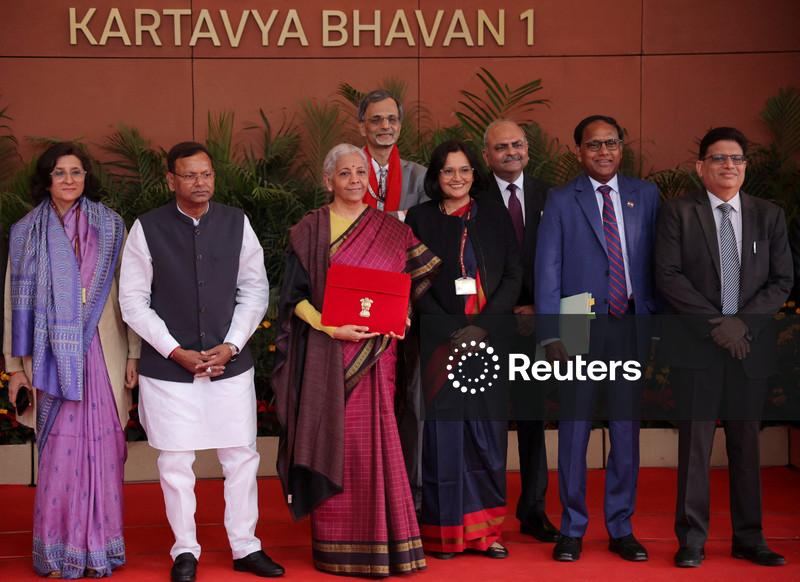
NEW DELHI, Feb 1 (Reuters) - India's annual budget made a fresh bet on the country's manufacturing sector as it sought to accelerate and sustain strong economic growth, amid a volatile global environment, Finance Minister Nirmala Sitharaman said as she laid out priorities for Asia's third-biggest economy.
The budget for the next fiscal year will focus on structural reforms particularly in the manufacturing sector, building a robust financial sector and stepping up investments in cutting-edge technologies, including artificial intelligence, she said.
The Modi government has been struggling to raise manufacturing from the current level of under 20% of GDP to 25% to generate jobs for the millions entering the nation's workforce each year.
The Indian economy is seen growing at 7.4% in the current financial year, with inflation expected at near 2%. The government's fiscal deficit for the year is expected at 4.4% of GDP.
To spur private investment and demand, New Delhi has rolled out a series of reforms in recent months, including consumption and income tax cuts, overhaul of labour laws and steps to open up the tightly controlled nuclear-power sector. More policy changes are expected in the budget.
The budget will prioritise scaling up manufacturing across seven sectors, Sitharaman said. They include pharmaceuticals, semiconductors, rare earth magnets, chemicals, capital goods, textiles and sports goods.
The government will also revive 200 legacy industrial clusters.
"The nation is moving away from long-term problems to tread the path of long-term solutions. Long term solutions provide predictability that fosters trust in the world," Prime Minister Narendra Modi said on Thursday before the government's economic survey forecast growth of between 6.8% and 7.2% for the fiscal year starting in April.
India will continue with "next-generation reforms", as the next 25 years will be key to meeting the goal of making the South Asian nation a developed economy, he said.
India is also striking deals such as a landmark trade agreement with the European Union to offset the hit from the 50% tariffs President Donald Trump has imposed on some Indian goods shipped to the U.S.
To keep economic growth strong, the government will also spend 12.2 trillion Indian rupees ($133.08 billion)on infrastructure in the new year, compared to 11.2 trillion rupees last year.
($1 = 91.6710 Indian rupees)
(Reporting by Aftah Ahmed, Sarita Chaganti Singh, Nikunj Ohri in New Delhi; Writing by Ira Dugal in Mumbai; Editing by William Mallard and Shri Navaratnam)
Did you find this insightful?
Bad
Just Okay
Amazing