


By Ahmed Elimam
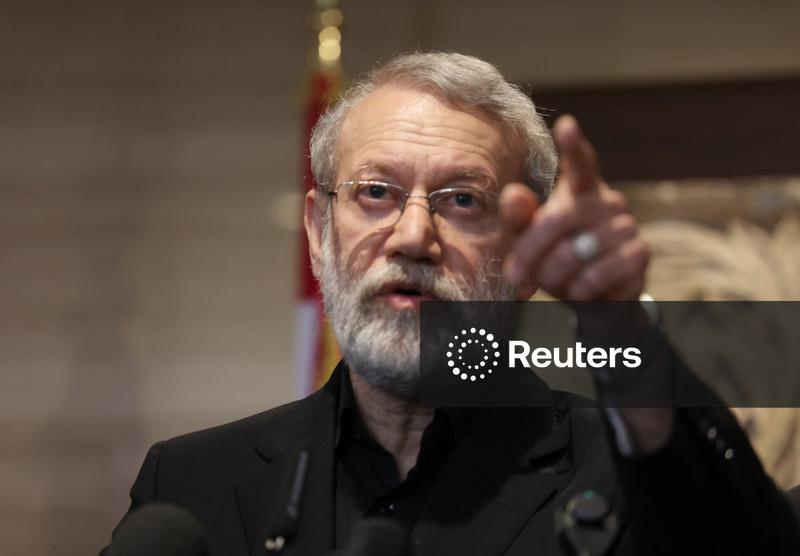
March 1 (Reuters) - Veteran Iranian politician Ali Larijani, who said on Sunday a temporary leadership council would be set up after an air strike killed Supreme Leader Ayatollah Ali Khamenei, reemerged last year as one of the most powerful figures in the security hierarchy.
He has been managing a broad portfolio from nuclear negotiations to Tehran’s regional ties to its violent suppression of internal unrest.
An establishment insider who hails from one of the country's leading clerical families, Larijani had been overseeing Iran’s efforts to reach a nuclear deal with the United States - just a month after Washington sanctioned him in January for allegedly directing a deadly crackdown on anti-government protests.
He accused the United States and Israel of trying to plunder and disintegrate Iran and warned "secessionist groups" of a harsh response if they attempted any action, state television said on Sunday, nearly 24 hours after they began a wave of attacks on Iran.
Iran's Armed Forces Chief of Staff Abdolrahim Mousavi was also killed in strikes, broadcaster Iran TV said.
Appointed in August as Secretary of the Supreme National Security Council (SNSC), Larijani has held senior jobs throughout a career marked by loyalty to Khamenei and a reputation for pragmatic relations with the system's often-rival factions.
His status as a trusted Khamenei strategist was underscored last month by a trip to mediator Oman to prepare for indirect nuclear talks with the U.S., as Washington built up its military forces in the Middle East to try to force concessions from Iran ahead of the strikes.
Larijani had also made several trips to key ally Moscow in recent months to discuss a range of security ties, in a further sign of his return to high-level diplomacy.
LARIJANI SEES NUCLEAR ISSUE AS 'RESOLVABLE'
Larijani, who had an earlier stint heading the SNSC 20 years ago, resumed its leadership following last year's 12-day air war between Iran and Israel that was joined by the U.S., returning formally to the heart of Iran’s security establishment.
Some of his public statements on the nuclear issue struck a pragmatic tone.
"In my view, this issue is resolvable," Larijani told Oman state television last month, referring to the talks with the U.S. "If the Americans’ concern is that Iran should not move toward acquiring a nuclear weapon, that can be addressed."
But in the wake of January's outpouring of anti-government anger, his security council role was denounced by Washington.
According to a U.S. government announcement detailing sanctions against him and other officials in response to the crackdown, Larijani was at the forefront of efforts to crush the series of demonstrations that swept Iran in January.
"Larijani was one of the first Iranian leaders to call for violence in response to the legitimate demands of the Iranian people," a U.S. Treasury statement said on January 15, saying Larijani had acted at Khamenei's behest.
Rights groups say thousands of people were killed in a crackdown on the protests, the worst domestic unrest in Iran since the era of its 1979 Islamic Revolution.
'A PEARL FOR A CANDY BAR'
Like other Iranian officials, Larijani expressed understanding for demonstrations staged in protest at economic hardship. But he condemned armed actions he alleged were fomented by Iran's arch-enemy Israel.
"Popular protests must be completely separated from these terrorist-similar groups," state media reports published on January 10 quoted him as saying. "The rioters are an urban quasi-terrorist group," he was quoted as saying on January 26.
A former member of Iran's Revolutionary Guards, Larijani served as chief nuclear negotiator from 2005-2007, defending what Tehran says is its right to enrich uranium. He once likened European incentives to abandon nuclear fuel production to "exchanging a pearl for a candy bar".
Back then, Iranian analysts said he sought to persuade the West through diplomacy and was regarded as a pragmatist.
The U.S. and Israel believe Iran aspires to build a nuclear weapon that could threaten Israel's existence. Iran says its nuclear programme is purely peaceful.
Larijani was parliament speaker from 2008 to 2020. During that posting, Iran struck a nuclear deal with six world powers in 2015 after almost two years of delicate negotiations. President Donald Trump withdrew the U.S. from the hard-fought agreement during his first term in 2018.
ENGAGING WITH PUTIN
Larijani has cautioned that Iran's nuclear program "can never be destroyed".
"Because once you have discovered a technology, they can’t take the discovery away," he told PBS Frontline in September 2025. "It’s as if you are the inventor of some machine, and the machine is stolen from you. You can still make it again."
Larijani has made repeated visits to Moscow and met President Vladimir Putin, helping Khamenei manage a key ally and world power that acts as a counterweight to pressure from Trump.
Larijani was also tasked with advancing negotiations with China which led to a 25-year cooperation agreement in 2021.
He ran unsuccessfully for president in 2005. He later sought to contest the 2021 and 2024 presidential elections but was barred both times by the Guardian Council, which cited issues including lifestyle standards and family ties abroad.
Born in Najaf, Iraq, in 1958 to a leading Iranian clerical family, Larijani moved to Iran as a child and went on to earn a philosophy PhD. Several of his brothers have also held senior establishment jobs including in the judiciary and foreign ministry.
One of Larijani's daughters was dismissed in January from a medical teaching position at the U.S. Emory University following protests by Iranian-American activists angered by his role in the suppression of that month's demonstrations.
(Reporting by Ahmed Elimam, Editing by Michael Georgy, William Maclean)
Did you find this insightful?
Bad
Just Okay
Amazing