


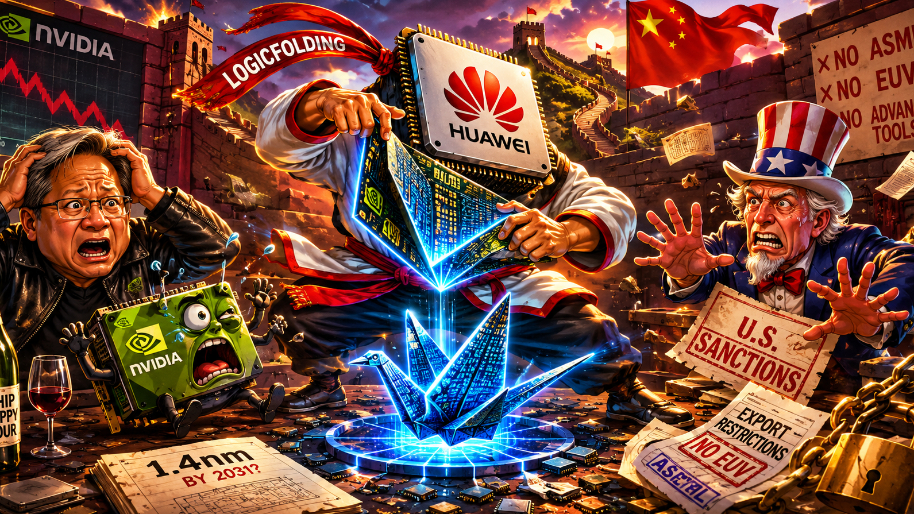
Live footage of Jensen Huang and Ren Zhengfei at the next chip happy hour…
If you’ve been following the global semiconductor industry closely, then you know it’s operated a lot like this lately: the United States sanctions China… China complains about the sanctions… and then Nvidia sells another billion dollars worth of AI chips anyways.
But the fine folks over at Huawei just claimed that cycle is about to be put to rest for good.
On this beautiful memorial day morning, Jensen’s great Chinese enemy unveiled a bizarre-sounding new semiconductor engineering strategy called “LogicFolding.”
Might sound confusing since we’re talking about chips… but it’s pretty much the manufacturing strategy that makes their chips even more high performing… mostly speed.
More importantly, according to Huawei, this new approach could eventually help China sidestep getting locked out of the world’s most advanced chipmaking tools by the United States.
And if the company’s claims end up being even partially true… this could create a pain in the a** not just for NVIDIA… but also for Apple in the world’s second-largest economy.
Naturally, Wall Street immediately started paying attention after Huawei said its upcoming Kirin smartphone chips launching this fall will use the new architecture for the first time.
That matters because Huawei already embarrassed a lot of people back in 2023 when it launched the Mate 60 smartphone with a surprisingly advanced 5G chip despite years of U.S. restrictions designed to slow China’s semiconductor progress.
Meanwhile over at Apple, Huawei’s comeback has already been eating into iPhone market share in China. So now investors are trying to figure out whether this new chip strategy is another genuine breakthrough… or just a lot of talk.
Huawei claims the technology could eventually deliver capabilities comparable to 1.4-nanometer chips by 2031.
For context, smaller nanometer processes generally allow chips to become faster and more powerful. Right now, Taiwan Semiconductor Manufacturing Company (you know them as TSMC) has only recently started volume production of 2-nanometer chips.
So Huawei walking onto the stage and saying “forget 5 years, we can do this today” is a YUGE eyebrow raiser.
Because according to several semiconductor experts, Huawei’s claims may sound much sexier on paper than they do in actual large-scale manufacturing reality.
Paul Triolo from DGA Group argued that stacking and folding chip designs can absolutely improve density and efficiency… but that doesn’t magically solve the nightmare-level problems tied to heat management, manufacturing yields, power consumption, scaling (and all the other nerd stuff).
To put another way: designing a futuristic chip concept in a lab is one thing. Mass producing millions of them without turning smartphones into portable frying pans is a very different problem.
That’s especially important because Huawei still lacks access to the world’s most advanced EUV lithography machines from Dutch chip equipment giant ASML thanks to export restrictions.
Which means China’s semiconductor industry has been forced to redneck its own alternate tech tree.
Instead of brute-forcing smaller and smaller chip nodes the same way the west has traditionally done… Huawei appears to be experimenting with entirely different architectural approaches.
And you better believe Nvidia investors aren’t ignoring this. Especially after Jensen Huang admitted the U.S. has effectively “conceded” parts of the Chinese AI chip market to Huawei.
For now a lot of Huawei’s claims are like Bezos and Elon claiming data centers will be in space soon… sounds great but it’s just talk for now.
But if Huawei successfully pulls this off over the next decade, it could become one of the biggest examples yet of how sanctions sometimes force countries into developing entirely different technological pathways.
Which is probably gonna put a trillion-dollar fracture in Jensen and Donnie’s relationship.
At the time of publishing this article, Stocks.News holds positions in Apple as mentioned in the article.
Did you find this insightful?
Bad
Just Okay
Amazing
Disclaimer: Information provided is for informational purposes only, not investment advice. We do not recommend buying or selling stocks. Stock price discussions are based on publicly available data. Readers should conduct their own research or consult a financial advisor before investing. Owners of this site have current positions in stocks mentioned throughout the site, Please Read Full Disclaimer for details Here https://app.stocks.news/page/disclaimer