


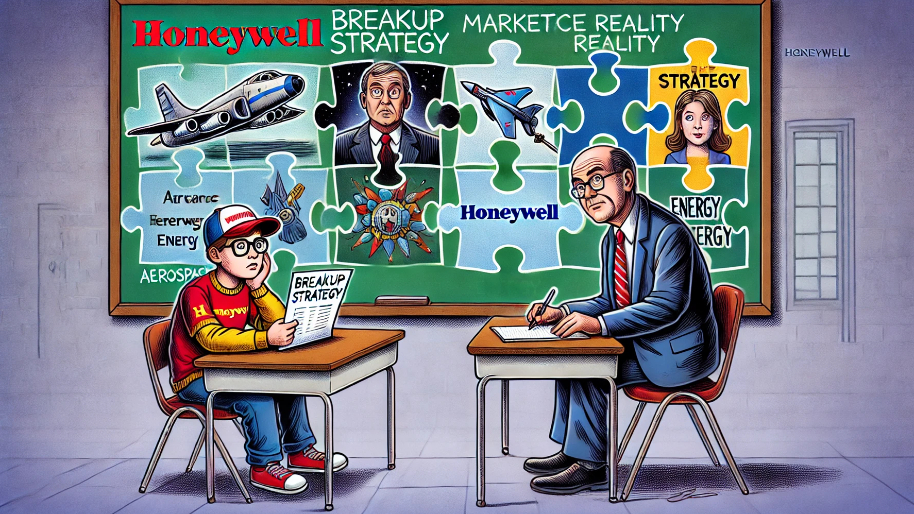
Honeywell just did what every washed-up industrial conglomerate does when it realizes it's too bloated, too slow, and too uninspiring to keep up with the rest of the market—it’s breaking itself into three separate companies and praying that investors will finally give two craps.

(Source: Giphy)
That’s right, the 119-year-old behemoth, best known for making everything from aerospace tech to thermostats your dad won’t let you touch, is about to carve itself up like a Thanksgiving turkey. Why? Because activist investors—specifically Elliott Investment Management, which threw down a $5 billion stake and didn’t come to play nice—decided Honeywell was worth more in pieces than as a single, whole company.
Now, with that said, are they wrong for this? Not necessarily. Like I mentioned in yesterday's Final Tally piece, GE pulled the exact same move last year, and now its aerospace unit alone is worth more than double what GE was worth before it split. So, of course, Honeywell’s board looked at that and thought, “Why not us?”

(Source: Wall Street Journal)
For more context, Honeywell’s grand plan involves spinning off its aerospace division, automation business, and advanced materials unit into separate entities. Because again, as we’re told, the only way to make industrial conglomerates sexy again is to stop being one entity. The aerospace unit, which makes up 40% of Honeywell’s revenue, is obviously the crown jewel here—so separating it from things like warehouse automation and chemical coatings (both topics investors don’t get too excited about) is technically smart.
But, but, but… here’s the problem: Honeywell isn’t GE. GE had an aerospace division that was already the backbone of the aviation industry. Meanwhile, Honeywell is more of an expensive side piece to Boeing and Airbus—and while the breakup will probably unlock some value, it’s not guaranteed to be a diamond hand ticket to the moon.

(Source: Reuters)
Naturally, you’d think that with a similar success intertwined (read: GE), an announcement like this would send the stock soaring, but nope—investors yeeted Honeywell shares 4% after the news. The reason is mainly due to the fact that investors aren’t stupid. They’ve seen these breakups before, and they know it takes time for the market to “realize” the value of the separate companies.
And even though RBC Capital Markets say that industrial spin-offs tend to outperform in the long run (they must be “How to Be a Stock Market Wizard” die-hards), the short term is a different story. It’s just another corporate restructuring that doesn’t change the fact that Honeywell’s core businesses are facing sluggish demand.

(Source: Giphy)
On top of that, Honeywell also missed expectations on its 2025 profit and revenue forecasts. The company expects 2025 revenue between $39.6 billion and $40.6 billion, which sounds fine until you realize Wall Street was expecting $41.22 billion. Plus, earnings per share guidance of $10.10 to $10.50 missed analysts’ expectations of $10.93—which, in this market, is just asking for investors to punish you. (Just ask Amazon).
In the end though, Elliot definitely got what it wanted (like they always do)---Honeywell is breaking itself up, and now the aerospace and automation businesses will be separately traded entities that can be valued more like pure-play stocks instead of being dragged down by the rest of the company’s sluggish industrial baggage. But whether this actually unlocks real value or just gives investors something to pretend to get excited about for a few months is still up in the air.

(Source: Giphy)
So while this breakup might make Honeywell look better on paper, it doesn’t magically fix the fundamentals of the company. For now, the market is treating this whole thing like a lukewarm attempt to copy GE’s homework—and unless one of these spin-offs turns into an absolute cash-printing machine, investors aren’t going to care nearly as much as Elliott hoped.
Meaning, keep your eyes on Honeywell going forward as there might be a needle in the haystack here. But still, don’t get your hopes up. Place your bets accordingly, and as always, stay safe and stay frosty, friends! Until next time…

P.S. If you want a front-row seat to the stock market puppet show… Become a Premium Member to get access to our Insider Trading Tool. We built it so you can see exactly where CEOs and Congress members are quietly investing their millions. Plus, you'll get exclusive stock write-ups and reports. Click here to see all the benefits of becoming a premium member.
Stocks.News holds positions in GE and Amazon as mentioned in the article.
Did you find this insightful?
Bad
Just Okay
Amazing
Disclaimer: Information provided is for informational purposes only, not investment advice. We do not recommend buying or selling stocks. Stock price discussions are based on publicly available data. Readers should conduct their own research or consult a financial advisor before investing. Owners of this site have current positions in stocks mentioned throughout the site, Please Read Full Disclaimer for details Here https://app.stocks.news/page/disclaimer