


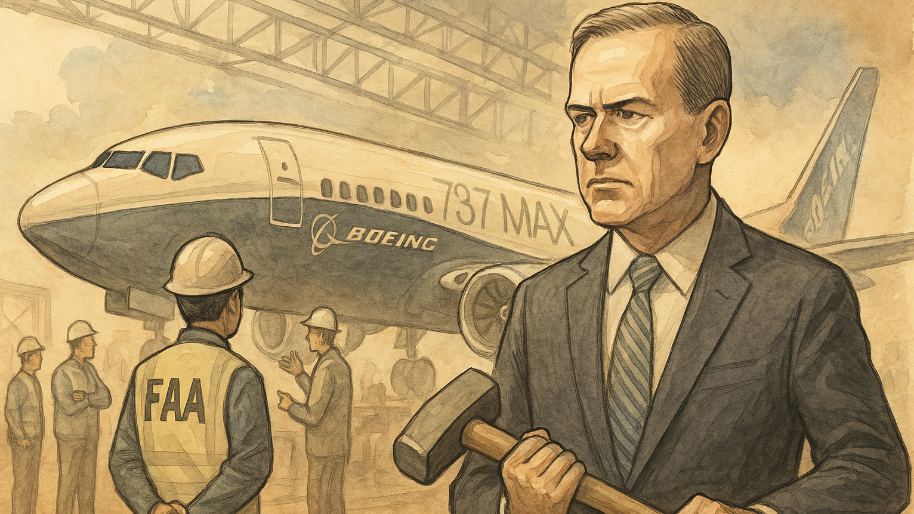
Despite over 3,000 of its workers still on strike, Boeing just caught a very much needed break. The aerospace company secured approval from the Federal Aviation Administration to increase production of its 737 MAX jetliners, marking another big step forward in its long-running recovery from years of crises and safety failures.
The FAA said on Friday it would permit Boeing to produce 42 planes a month, up from the 38-jet ceiling imposed in early 2024 after a door plug on a nearly new Alaska Airlines 737 MAX 9 blew out mid-flight at 16,000 feet. That near-catastrophe forced an emergency landing and reignited concerns over Boeing’s quality controls.
Investigators later found the company had failed to reinstall key bolts on the panel before the jet left the factory… a lapse that put Boeing back in crisis mode just as executives were promising stability.
“FAA safety inspectors conducted extensive reviews of Boeing’s production lines to ensure that this small production rate increase will be done safely,” the agency said in a statement, adding that heightened oversight would remain in place.
Chief executive Kelly Ortberg, brought in last year to stabilize America’s largest plane maker, called the approval an important milestone. “We appreciate the work by our team, our suppliers and the FAA to ensure we are prepared to increase production with safety and quality at the forefront,” Boeing said on Friday.
The move reflects a tentative vote of confidence by regulators after years of turbulence. The 737 MAX program (grounded worldwide following two fatal crashes in 2018 and 2019 that killed 346 people) has been under strict supervision ever since.
Last month, the FAA restored Boeing’s authority to sign off on some aircraft certifications itself, reversing a ban imposed in the wake of those crashes. The regulator said it would continue to monitor manufacturing closely as Boeing raises output in stages… potentially reaching 47 planes a month once suppliers can match demand.
Even though shares are up over 23% this year, the production increase is crucial to Boeing’s financial survival. Especially considering the company hasn’t turned an annual profit since 2018 and remains burdened with $53 billion in debt, up sharply from $12 billion before the MAX crisis. Planemakers receive the bulk of customer payments upon delivery, making higher production rates essential for cash flow.
Wall Street analysts project Boeing will remain unprofitable this year but could return to the black by 2026 as deliveries recover. Still, the manufacturing overhaul remains delicate. Supply-chain bottlenecks, from engines to fasteners, continue to frustrate aerospace firms. Boeing has stockpiled $11 billion in raw materials (nearly double pre-crisis levels) to guard against disruptions.
“Boeing seems to be better prepared for this ramp-up than they have been for previous ones,” said aerospace analyst Glenn McDonald. “But the system is still fragile… a single factory fire or late engine delivery can throw off months of planning.”
The FAA’s partial thaw offers Boeing breathing room, but not redemption. The company still faces a $3.1 million fine for safety-system violations and an ongoing Justice Department investigation into the Alaska Airlines incident.
Boeing will report quarterly results on October 29, and both investors and regulators will be watching closely to see whether the company can finally pull out of its profit slump… and prove it can keep its planes, and its promises, in one piece.
At the time of publishing this article, Stocks.News doesn’t hold positions in companies mentioned in the article.
Did you find this insightful?
Bad
Just Okay
Amazing
Disclaimer: Information provided is for informational purposes only, not investment advice. We do not recommend buying or selling stocks. Stock price discussions are based on publicly available data. Readers should conduct their own research or consult a financial advisor before investing. Owners of this site have current positions in stocks mentioned throughout the site, Please Read Full Disclaimer for details Here https://app.stocks.news/page/disclaimer