


Back in the early days, Elon’s biggest problem wasn’t keeping up with Sam Altman in the AI race or politics… it was convincing people that electric cars wouldn’t leave you stranded with a dead battery halfway to work. The original Roadster barely cracked 244 miles of range (and you really didn’t want to test that in winter).

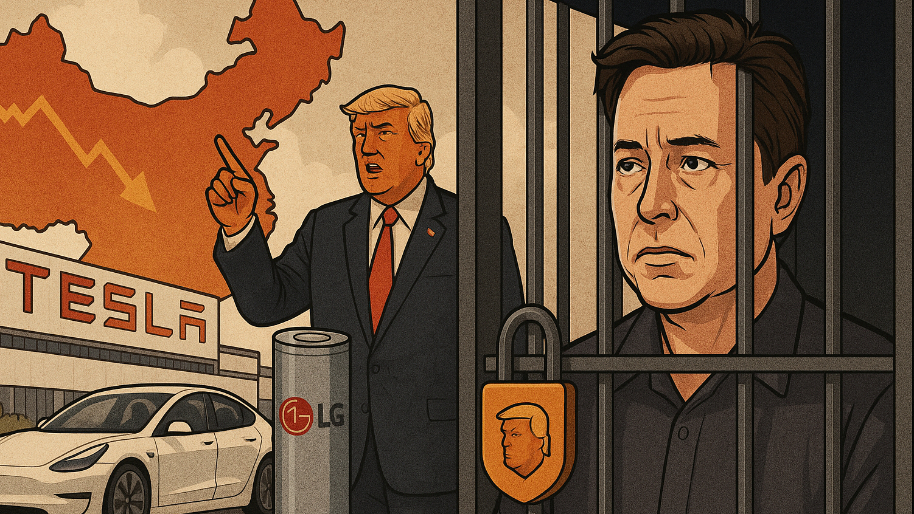
Obviously, things have changed. Elon became the richest guy on Earth, EVs went mainstream, and Tesla turned into a household name. But now, with the hype cooling off and profit margins getting squeezed, Tesla’s biggest threat isn’t building more cars… it’s building enough batteries without being handcuffed to China or wrecked by U.S. tariffs. Which brings us to the headline: Tesla just inked a $4.3 billion battery supply deal with LG Energy Solution. And while that sounds boring on the surface, it quietly says a lot about where Elon’s empire is going next.
First, these batteries aren’t for your Model 3. They’re for Tesla’s lesser-known, fast-growing cash engine… its energy storage division. Think Powerwalls, Megapacks, and the massive battery banks backing up solar grids, AI data centers, and utility-scale power projects. For instance, in 2023, Tesla’s energy division brought in $6.04 billion… roughly 6% of total revenue. That jumped to $9.27 billion in 2024. And in the first half of 2025 alone, they’ve already pulled in $6.2 billion from energy, on pace to shatter last year’s numbers with ease. It’s not getting much attention from the masses yet, but this quiet little division is turning into Tesla’s next great growth engine.
(Source: Energy Storage News)

That said, here’s the challenge: all that energy storage runs on lithium iron phosphate (LFP) batteries. They’re cheaper, safer, and last longer than the nickel-based ones used in long-range EVs. But the problem is that almost all LFP cells come from China, mainly through battery giant CATL. Tesla has relied on them for years, especially out of its Shanghai factory.
That was fine… until the U.S. painted a “25% tariff” sign on Chinese EV components. Suddenly, importing LFP batteries turned into a multi-billion-dollar tax nightmare… particularly for Tesla’s energy division, which already runs on thinner margins than the car side. Tesla CFO Vaibhav Taneja even said tariffs were having an “outsized impact” on the energy business. But what he really wanted to say was: “We’re getting destroyed over here.”

That’s where LG Energy saw an opportunity. While others were nervous, LG came to play. They started cranking out LFP cells at their Michigan plant in May 2024… becoming one of the only non-Chinese players producing at scale inside U.S. borders. Tesla saw the writing on the wall and moved fast. The two companies signed a deal locking in battery deliveries from August 2027 through July 2030, with an option to extend another seven years and ramp up supply. It’s not just a supply contract… it’s a safety net. A hedge against tariffs, supply chain chaos, and the increasingly awkward dance with Beijing.
Even better? Since the batteries will be built in Michigan, they qualify for Inflation Reduction Act subsidies… potentially worth billions in tax credits over the life of the deal. But here’s where things get messy.
Those subsidies are set to vanish in September, thanks to Trump’s “Big Beautiful Bill.” So yes, Tesla dodged the tariff bullet… but now it’s getting kneecapped by the same government that helped supercharge its growth in the first place. Classic.

Still, the shift makes sense. As EV demand softens (let’s face it, not everyone’s racing to drop six figures on a Cybertruck), Tesla is going all in on energy storage. The company’s been dropping hints that this division could one day rival its auto business… and this LG deal makes that vision feel a lot more real.
It’s also a savvy move in D.C. politics. When you’re building America’s energy infrastructure with U.S.-made batteries, it becomes a lot harder for lawmakers to block your next expansion… or deny your next tax break. So no, Tesla didn’t just make a random battery deal. It bought freedom. From China. From tariffs. From a fragile supply chain. And LG may have just locked in the most lucrative battery contract on American soil.
At the time of publishing this article, Stocks.News holds positions in Tesla as mentioned in the article.
Did you find this insightful?
Bad
Just Okay
Amazing
Disclaimer: Information provided is for informational purposes only, not investment advice. We do not recommend buying or selling stocks. Stock price discussions are based on publicly available data. Readers should conduct their own research or consult a financial advisor before investing. Owners of this site have current positions in stocks mentioned throughout the site, Please Read Full Disclaimer for details Here https://app.stocks.news/page/disclaimer