


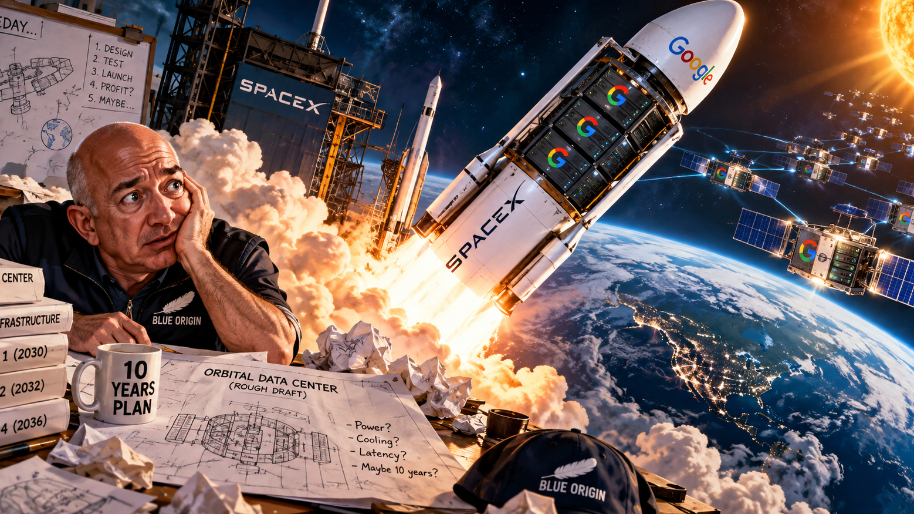
Jeff Bezos: “In the next 10 years, we’re going to start building data centers in space.”
Elon Musk: “This is why you’re going poor.”
Welp, someone might wanna check on Jeff.
Because while Bezos is talking about putting data centers in space sometime over the next decade, the newly minted millionaires over at SpaceX (lunchlady included) strapped Google’s AI chips to a Falcon 9 today and yeeted them where the sun don’t shine (well I guess it kinda does since they’ll be solar powered, allegedly).
The launch is part of Google’s Project Suncatcher, its extremely normal attempt to figure out whether the future of AI infrastructure belongs inside giant warehouses on Earth… or floating above it.
And for the first time, Google is about to find out whether its homegrown Tensor Processing Units can actually survive up there.
Houston, we have a server bill.
More specifically, SpaceX’s Transporter-18 mission is carrying a Planet Labs satellite equipped with Google TPUs into low-Earth orbit, where they’ll finally get subjected to the kind of working conditions that would make an Amazon warehouse employee call OSHA.
This includes radiation, extreme temperatures, launch vibrations, cosmic rays…
Oh, and absolutely no air.
Minor inconvenience for a computer chip that gets hotter than a Waffle House grill.
Google has already been preparing for this little problem by blasting its TPUs with proton beams at UC Davis while they were actively running AI workloads.
The early results were surprisingly encouraging.
Google says its Trillium TPUs survived radiation doses exceeding what the chips would likely experience during a five-year orbital mission.
Which leaves another tiny engineering problem:
How the hell do you cool a data center in space?
On Earth, AI facilities can use ungodly amounts of water, fans, chillers and other cooling infrastructure to keep thousands of GPUs from turning themselves into extremely expensive Easy-Bake Ovens.
Unless I’ve been lied to, space doesn’t have air.
So instead, Google is experimenting with heat pipes and radiators designed to pull heat away from its chips and dump it into the cold void surrounding the satellite.
And if Google can make all of this work, the payoff could be enormous.
One of the biggest constraints facing the AI buildout right now is obviously power.
Hence why Elon (the guy who once called burning fossil fuels the “dumbest experiment in history”) just pulled the mother of all 180s and started surrounding xAI’s Colossus data centers with natural-gas turbines.
All so a bunch of morons on twitter can ask “Grok is this true?” under videos like THIS.
Well, Sundar’s nerd herd says satellites in low-Earth orbit can access near-constant sunlight and generate up to eight times more solar power than comparable systems on Earth.
Cue AOC demanding Google leave some sunlight for the rest of us.
Eventually, Google wants to connect entire constellations of these satellites together, allowing thousands of processors to share workloads and effectively create enormous AI computing clusters in orbit.
Not to be outdone, Elon has somehow proposed something even more insane.
SpaceX has discussed building its own orbital data centers using swarms of satellites equipped with high-powered computing hardware and BIGLY solar arrays.
Musk has said space could become the cheapest place to train AI within two or three years, while SpaceX President Gwynne Shotwell has said the company plans to deploy “supercompute in space” beginning in 2027.
And because Google owns an astronomical chunk of SpaceX, Sundar gets paid twice if this works… once from the partnership, and again when his SpaceX shares go brrrr.
Needless to say, Jeff might wanna shave a few years off that forecast.
At the time of publishing this article, Stocks.News holds positions in Google and Amazon as mentioned in the article.
Did you find this insightful?
Bad
Just Okay
Amazing
Disclaimer: Information provided is for informational purposes only, not investment advice. We do not recommend buying or selling stocks. Stock price discussions are based on publicly available data. Readers should conduct their own research or consult a financial advisor before investing. Owners of this site have current positions in stocks mentioned throughout the site, Please Read Full Disclaimer for details Here https://app.stocks.news/page/disclaimer