


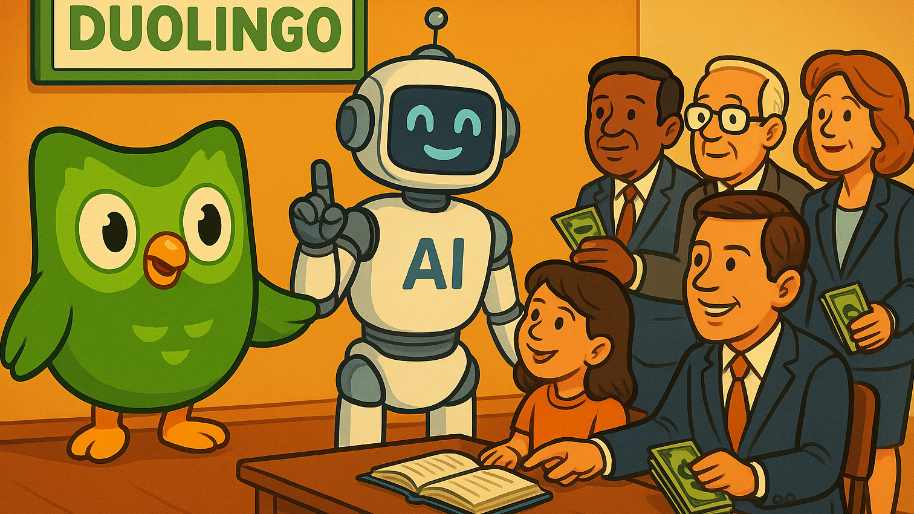
When Duolingo laid off a chunk of its human staff and replaced them with AI tutors, the internet absolutely melted down. Countless reddit threads popped up all at once calling it a betrayal. Twitter turned into a pitchfork parade of “capitalism run amok” threads and “late-stage tech dystopia” memes.
(Source: The Byte)

Even analysts on Wall Street (who normally throw a parade anytime a company cuts headcount) took a moment to flinch. It looked like Duolingo had drunk a little too much of the AI Kool-Aid… even for BlackRock executives, which is saying something, considering these are the same folks bidding $80K over asking on three-bedroom ranches just to rent them back to teachers.
And yet, here we are. Because in classic market fashion (short attention span, big appetite for profits), everyone seems to have memory-holed the outrage. Why? Because the owl won.

This wasn’t one of those “we’re investing in AI and hope to monetize it by 2030” updates. This was AI translating directly into cold, hard cash… right now. And the numbers were stupid good.
The company hauled in $252.3 million in revenue last quarter, up 41% year-over-year. (Wall Street was expecting $240.8 million, and Duolingo griddied past that with ease.) Net income nearly doubled, jumping 84% to $44.8 million, and earnings per share came in at $0.91… demolishing the $0.58 estimate. That kind of margin expansion doesn’t just happen by accident… it happens when you replace half your workforce with machines and the users love it anyway.

But it gets better. Daily active users jumped from 34 million to 47.7 million… a 40% increase year-over-year. Paid subscribers rose from 8 million to 10.9 million. And to everyone’s surprise… in addition to adding users… they’re also monetizing them better. Average revenue per user rose 6%, thanks in large part to people upgrading to Duolingo’s pricier Max plan… the one where AI powers things like real-time video call practice sessions, personalized lessons, and instant feedback.
Which proves Duolingo did way more than throw a chatbot on the homepage and call it innovation. They reengineered the entire learning experience around AI… which made the product smarter, stickier, and more valuable. That translated into real growth and real money. Investors got the message loud and clear. The stock’s currently up 28%, tacking on nearly $5 billion in market value (which, ironically, probably came from the same people who were tweeting “this is unethical” six months ago).

That kind of price action doesn’t happen because people are impressed by the owl’s UX. It happens because institutional investors now see this as more than a language-learning app. They see it as a high-margin, AI-native growth engine.
So what made this all possible? For starters, Duolingo didn’t wait around to see what everyone else was doing. While Big Tech was still stuck in design meetings debating whether their AI should sound more “encouraging” or “neutral,” Duolingo was pushing updates live. And according to CFO Matt Skarupa, the cost of running all these AI tools (including Duolingo Max) actually came in lower than expected. What do you know? Turns out automating the hardest parts of teaching is good business… and users kind of prefer it.

Because of this, Duolingo pulled off one of the rarest moves in tech: growing faster, making more per user, and keeping costs in check… all at once.
All of which brings us to the bigger picture: Duolingo is now the official poster child for what it looks like when AI isn’t just a vague press release… but an actual, functioning revenue engine. If you’re looking for even more proof… all you got to do is glance at the numbers: Full-year guidance was raised across the board. Revenue is now expected to land between $1.011 and $1.019 billion. Bookings got bumped to a new range of $1.15 to $1.16 billion. And adjusted EBITDA? That’s climbing too… potentially hitting $295.5 million (68% higher than last year).

Ironically, Duolingo’s AI bet isn’t a bet anymore… it’s the entire business model. And don’t be surprised if we start seeing a wave of copycats. Because somewhere right now (in a corner office at some San Francisco-based tech company still stuck in the “AI vision board” phase) a C-suite exec is scrolling through Duolingo’s earnings deck, turning to their team, and asking, “Wait… why aren’t we doing this?”
At the time of publishing this article, Stocks.News doesn’t hold positions in companies mentioned in the article.
Did you find this insightful?
Bad
Just Okay
Amazing
Disclaimer: Information provided is for informational purposes only, not investment advice. We do not recommend buying or selling stocks. Stock price discussions are based on publicly available data. Readers should conduct their own research or consult a financial advisor before investing. Owners of this site have current positions in stocks mentioned throughout the site, Please Read Full Disclaimer for details Here https://app.stocks.news/page/disclaimer