


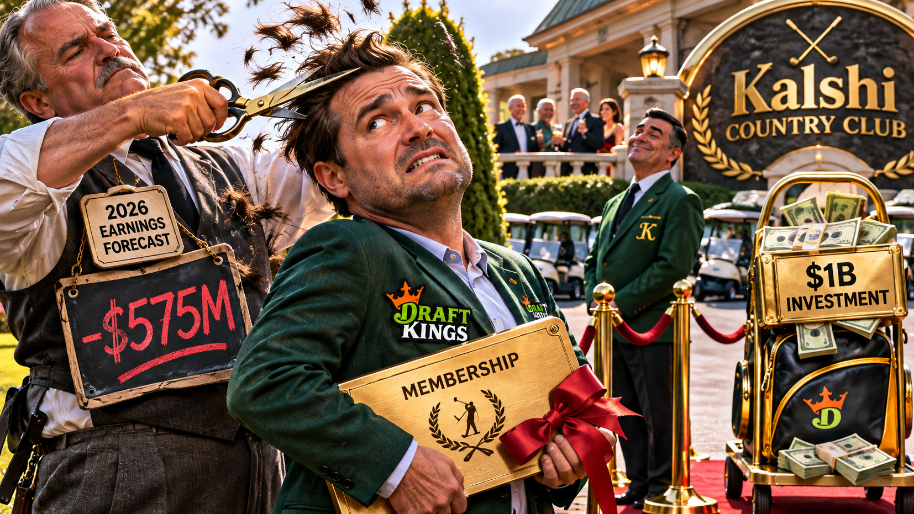
DraftKings is betting hundreds of millions of dollars that prediction markets will become its next big business. But for now, that gamble is taking a pretty serious bite out of the company's profits.
Shares of DraftKings fell sharply Friday after the sports-betting company slashed its full-year earnings outlook and lowered its revenue forecast as it pours money into competing with Kalshi and Polymarket.
And the size of that earnings downgrade caught investors' attention.
DraftKings now expects to generate between $175 million and $275 million in adjusted EBITDA for 2026, down from its previous forecast of $700 million to $900 million.
That's a $575 million reduction at the midpoint, wiping out most of the profits the company had previously expected to generate this year.
Revenue expectations also took a hit.
DraftKings lowered its full-year sales forecast to between $6.35 billion and $6.55 billion, compared with its earlier projection of $6.5 billion to $6.9 billion.
So where's all that money going?
A good chunk of it is being spent on prediction markets, where customers can trade contracts tied to sporting events, elections and other real-world outcomes.
It's a business that has attracted enormous attention over the past year, and DraftKings wants to make sure it doesn't get left behind.
But breaking into an industry where Kalshi and Polymarket already have a head start isn't cheap.
DraftKings expects to spend between $650 million and $700 million building its prediction-market business this year, including as much as $225 million in the fourth quarter alone.
And while the company is bringing in customers, making money from them is another story.
More than 1.6 million people have used DraftKings' prediction-market offering this year.
The problem? DraftKings expects promotional incentives to eat up nearly all of the business's gross revenue in 2026.
In other words, the company is spending heavily to attract customers without much revenue left over to show for it.
Meanwhile, its traditional sports-betting business is still growing, although the latest quarterly results weren't quite what investors had hoped for.
Third-quarter revenue climbed 16% to approximately $1.33 billion, missing Wall Street's $1.39 billion estimate.
DraftKings also reported a net loss of $468.7 million, or $0.94 per share, even as monthly unique paying customers increased 13% to 4.1 million.
Still, management believes the spending will eventually pay off.
For 2027, DraftKings expects its prediction-market business to generate between $650 million and $750 million in revenue.
Of course, getting there won't be free either.
The company plans to spend another $250 million to $350 million on prediction markets next year, bringing its planned two-year investment to $1 billion.
CEO Jason Robins believes the long-term economics make the investment worthwhile, with DraftKings estimating it can recover the cost of acquiring its 2026 prediction-market customers in roughly 20 months.
Of course, that assumes DraftKings can keep those customers coming back without having to spend a fortune on promotions.
As of now, investors are being asked to stomach a pretty significant hit to earnings in hopes that prediction markets become a much bigger business down the road.
And with nearly $1 billion on the line, DraftKings will have plenty to prove over the next couple of years.
At the time of publishing this article, Stocks.News doesn’t hold positions in companies mentioned in the article.
Did you find this insightful?
Bad
Just Okay
Amazing
Disclaimer: Information provided is for informational purposes only, not investment advice. We do not recommend buying or selling stocks. Stock price discussions are based on publicly available data. Readers should conduct their own research or consult a financial advisor before investing. Owners of this site have current positions in stocks mentioned throughout the site, Please Read Full Disclaimer for details Here https://app.stocks.news/page/disclaimer