


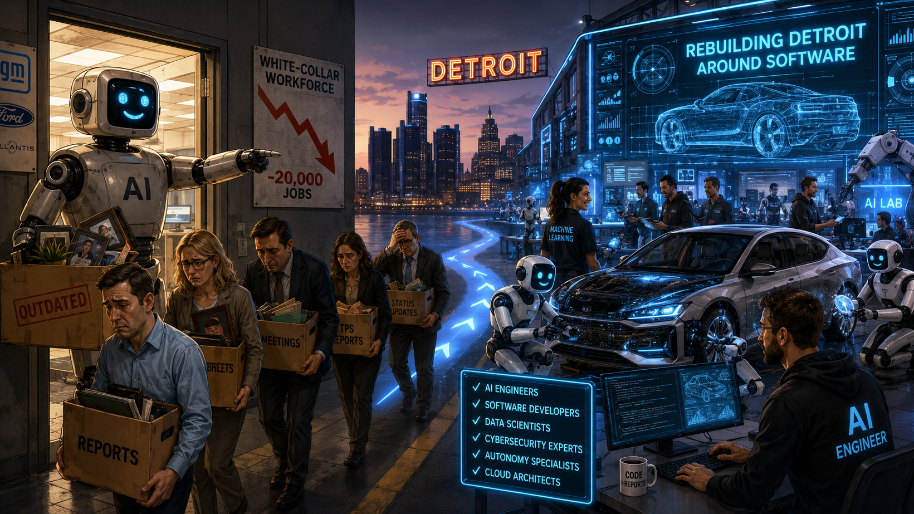
Ever since ChatGPT launched to the public, the biggest fear in the auto industry was robots replacing factory workers.
But now, that pressure is starting to move upstairs.
According to employment filings and company data, General Motors, Ford, and Stellantis have together eliminated more than 20,000 U.S. salaried jobs from recent employment peaks earlier this decade. That works out to roughly 19% of their combined white-collar workforce.
And while each company has its own reasons for the cuts, one theme keeps showing up over and over again: artificial intelligence.
The latest round came this week, when GM reportedly laid off between 500 and 600 salaried workers globally, many of them tied to information technology operations in Michigan and Texas. According to reports, part of the reductions were connected to changing workforce needs involving AI tools and automation.
That lines up pretty closely with what Ford CEO Jim Farley said earlier this year at the Aspen Ideas Festival. “Artificial intelligence is going to replace literally half of all white-collar workers in the U.S.,” Farley said. “AI will leave a lot of white-collar people behind.”
That’s obviously a dramatic statement, but the direction of the industry is getting harder to ignore.
Modern vehicles are increasingly becoming rolling computers. Automakers are spending heavily on software-defined vehicles, autonomous driving systems, cybersecurity, EV platforms, and AI-assisted engineering. And as more of that work becomes automated, some traditional corporate roles are starting to look a lot less essential.
GM alone reduced its U.S. salaried headcount by roughly 11,000 workers between 2022 and last year after aggressively hiring during the pandemic-era expansion. Ford has cut about 5,300 white-collar jobs from its 2020 peak, while Stellantis reduced salaried staffing from around 15,000 workers to roughly 11,000 over the same period.
Combined white-collar employment across the Detroit Three peaked around 102,000 jobs in 2022. By the end of last year, that figure had fallen to roughly 88,700.
And a lot of the cuts are happening in exactly the kinds of jobs AI already handles well. As we’ve seen across corporate America lately, repetitive office functions like coding, finance, and clerical work are becoming increasingly vulnerable as AI systems improve.
That doesn’t necessarily mean the auto industry is shrinking overall.
Factory employment across the U.S. auto sector has stayed relatively stable, according to Labor Department data. Meanwhile, some automakers are actually expanding white-collar hiring. Toyota, for example, reportedly increased its U.S. salaried workforce by roughly 31% between 2020 and 2025.
The Detroit automakers are still hiring too… just in different categories.
GM, Ford, and Stellantis currently have more than 2,000 open U.S. positions posted online. Nearly 400 involve AI-related work, with GM alone reportedly seeking more than 250 AI-focused roles.
So this isn’t exactly Detroit waving a white flag because nobody’s buying cars anymore. In a lot of ways, it looks more like automakers ripping apart the org chart and rebuilding themselves around software, AI, and automation. Unfortunately, that transition comes with real consequences for workers caught in the middle of it.
At the time of publishing this article, Stocks.News holds positions in Ford as mentioned in the article.
Did you find this insightful?
Bad
Just Okay
Amazing
Disclaimer: Information provided is for informational purposes only, not investment advice. We do not recommend buying or selling stocks. Stock price discussions are based on publicly available data. Readers should conduct their own research or consult a financial advisor before investing. Owners of this site have current positions in stocks mentioned throughout the site, Please Read Full Disclaimer for details Here https://app.stocks.news/page/disclaimer