


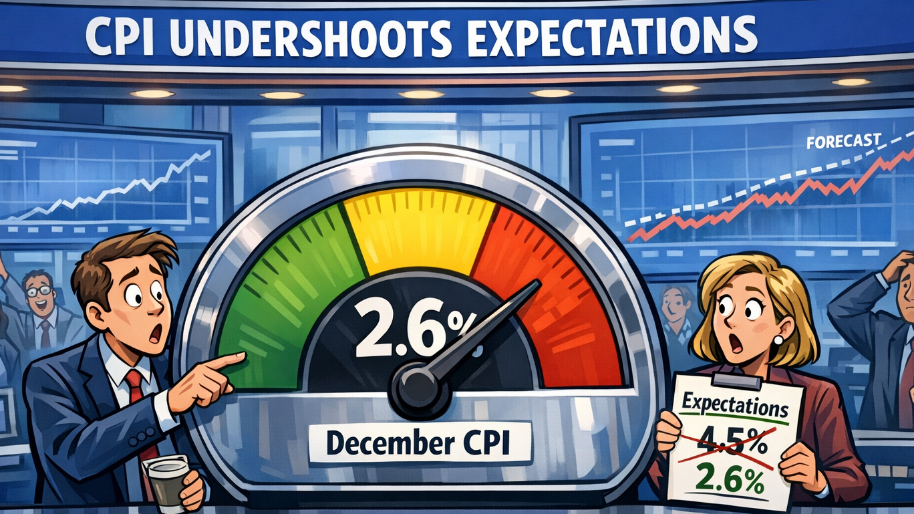
U.S. inflation showed further signs of cooling in December, with core consumer prices rising at a 2.6% annual rate, slightly below economists’ expectations, reinforcing the view that inflation pressures are easing but not yet fully back to the Federal Reserve’s target.
According to data released Tuesday by the Bureau of Labor Statistics, the core consumer price index, which excludes volatile food and energy costs, increased 0.2% month-over-month and 2.6% year-over-year. Both readings came in 0.1 percentage point below forecasts.
On a headline basis, the CPI rose 0.3% in December, putting the all-items inflation rate at 2.7% annually, in line with Wall Street expectations. Shelter costs remained the largest contributor to monthly inflation, rising 0.4% and accounting for more than one-third of the CPI’s weighting. Shelter inflation stood at 3.2% year-over-year, underscoring why policymakers remain cautious.
Food prices jumped 0.7% for the month, though egg prices plunged 8.2%, extending their sharp reversal after last year’s surge. Energy prices increased 0.3%, but gasoline prices fell 0.5% in December and were down 3.4% from a year earlier.
Other categories showing notable increases included recreation, airfares, and medical care. Recreation prices surged 1.2%, the largest monthly increase on record for that index since tracking began in 1993. Meanwhile, some goods categories continued to show deflationary trends, with used car and truck prices falling 1.1% and communication services declining 1.9%. Financial markets reacted modestly to the report. Stock futures ticked higher briefly, while Treasury yields edged lower. Traders largely maintained expectations that the Federal Reserve will keep interest rates unchanged at its upcoming meeting, with the earliest potential rate cut now seen around June, according to CME Group’s FedWatch tool.
President Donald Trump seized on the softer inflation data to renew pressure on the central bank. “Great (LOW!) Inflation numbers for the USA,” Trump wrote on Truth Social, calling on Fed Chair Jerome Powell to cut rates “MEANINGFULLY.” Economists, however, cautioned that the report is unlikely to prompt an immediate policy shift.
“We’ve seen this movie before, inflation isn’t reheating, but it remains above target,” wrote Ellen Zentner, chief economic strategist at Morgan Stanley Wealth Management. “Today’s inflation report doesn’t give the Fed what it needs to cut interest rates later this month.”The Fed’s 2% inflation goal remains just out of reach, even as price pressures moderate. Policymakers cut rates three times in late 2025 and are now weighing lingering inflation risks against potential softening in the labor market. Tariff policy adds another layer of uncertainty, though most officials have signaled they expect any inflationary impact to be temporary.
Adjusted for inflation, real wages were flat in December and up 1.1% from a year earlier, according to a separate BLS report, suggesting that easing inflation is helping stabilize household purchasing power — but not yet delivering strong gains.Overall, December’s CPI report strengthens the case that inflation is cooling gradually, keeping the Fed on pause while it waits for clearer evidence that price growth is firmly on a path back to target.
At the time of publishing, Stocks.News does not hold positions in companies mentioned in the article.
Did you find this insightful?
Bad
Just Okay
Amazing
Disclaimer: Information provided is for informational purposes only, not investment advice. We do not recommend buying or selling stocks. Stock price discussions are based on publicly available data. Readers should conduct their own research or consult a financial advisor before investing. Owners of this site have current positions in stocks mentioned throughout the site, Please Read Full Disclaimer for details Here https://app.stocks.news/page/disclaimer