


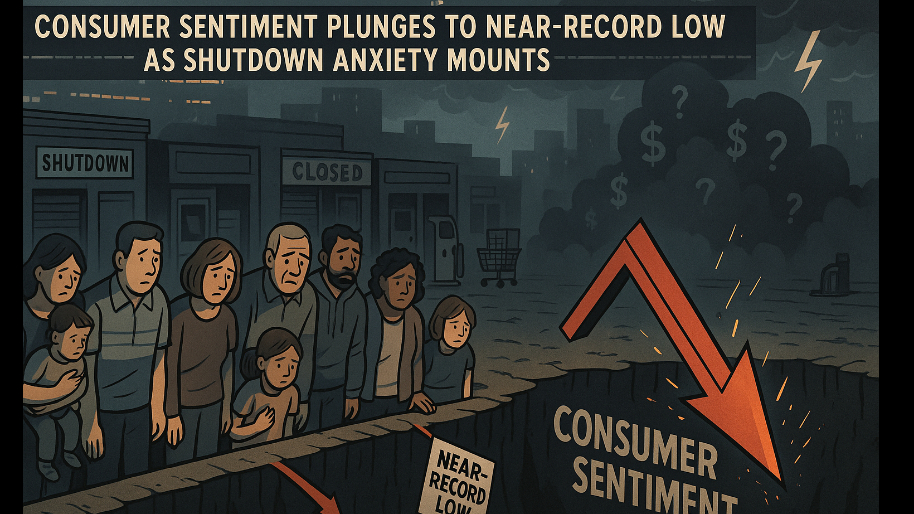
Consumer confidence in the U.S. has plunged to its lowest level in more than three years,and just shy of the worst reading ever recorded, as Americans grow increasingly anxious over the ongoing government shutdown and its ripple effects across the economy.
According to the University of Michigan’s preliminary November survey, the headline Index of Consumer Sentiment dropped 6.2% to 50.3, far below economists’ expectations for 53.0. The reading marks a 30% decline from a year ago and is the second-lowest on record since 1978, trailing only June 2022 when inflation peaked at four-decade highs. The report shows that worries about Washington’s budget standoff have outweighed any optimism stemming from record stock market highs or easing inflation trends.
“With the federal government shutdown dragging on for over a month, consumers are now expressing worries about potential negative consequences for the economy,” said Joanne Hsu, director of the university’s Surveys of Consumers.
“This month’s decline in sentiment was widespread throughout the population, seen across age, income, and political affiliation.”
The Current Conditions Index… which measures consumers’ assessment of their personal finances and buying power…fell nearly 11% to 52.3, the lowest reading in its history going back to 1951. The Expectations Index, which tracks views on the economic outlook, slid to 49.0, down 2.6% from October.
Compared with the same month a year earlier, the two measures are down 18.2% and 36.3%, respectively. Economists say the shutdown’s direct and indirect effects, from delayed paychecks to halted federal assistance programs, are now filtering through to household sentiment and spending plans.
“Across the economy, segments of the population are increasingly dealing with tighter financial conditions,” said Elizabeth Renter, senior economist at NerdWallet.
“That’s certainly true for federal workers and people dependent on food assistance from the federal government. But it’s also increasingly true for middle-income Americans.”
Despite the plunge in confidence, inflation expectations remained mostly anchored. Consumers see prices rising 4.7% over the next year, a slight uptick, while the five-year outlook declined to 3.6%, down 0.3 percentage point. With federal agencies unable to publish data during the shutdown, the University of Michigan survey has taken on heightened importance for policymakers and markets seeking clues about the economy’s direction.
Hsu noted that sentiment among wealthier households…particularly those with significant stock holdings…actually rose 11%, underscoring a growing gap between upper- and middle-income consumers.
The collapse in consumer confidence coincides with late-breaking movement in Congress to end the shutdown. On Sunday, eight Senate Democrats broke with party leadership to vote in favor of a House-passed continuing resolution that funds the government through January 30. The measure cleared the Senate in a 60-40 vote, just meeting the threshold to advance.
Sen. John Fetterman (D-Pa.), who voted to reopen the government, said in a statement:
“I’m sorry to our military, SNAP recipients, government workers, and Capitol Police who haven’t been paid in weeks. It should’ve never come to this.”
Still, the economic damage may already be reflected in consumer sentiment — and could take months to recover even if federal operations resume soon.
About the University of Michigan Surveys of Consumers
The University of Michigan’s Surveys of Consumers, conducted monthly since 1946, measure U.S. consumer confidence and expectations. The widely followed Index of Consumer Sentiment is considered a leading indicator of household spending and overall economic health, frequently cited by the Federal Reserve and financial markets.
Did you find this insightful?
Bad
Just Okay
Amazing
Disclaimer: Information provided is for informational purposes only, not investment advice. We do not recommend buying or selling stocks. Stock price discussions are based on publicly available data. Readers should conduct their own research or consult a financial advisor before investing. Owners of this site have current positions in stocks mentioned throughout the site, Please Read Full Disclaimer for details Here https://app.stocks.news/page/disclaimer