


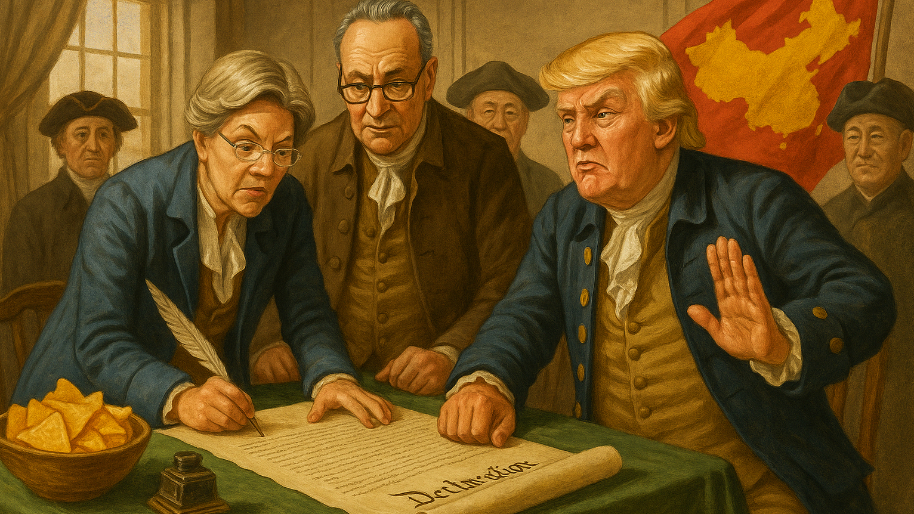
While the rest of us were out here trying to squeeze the last drops of summer into a weekend (before school drop-offs, calendar invites, and Pumpkin Spice Latte season sends every suburban Starbucks into full-on chaos)... Elizabeth Warren and Chuck Schumer were busy rallying their political besties to draft what they clearly believe is the modern-day Declaration of Independence. Except this time, it’s not about breaking free from King George… it’s about breaking free from Trump’s latest attempt to turn U.S. tech policy into a commission-based side hustle.

Of course, if you’ve been paying attention… this all started on Monday, when Trump announced what he called a “little deal” with chipmakers Nvidia and AMD. And when Trump says “little,” you can usually assume it’s either massive or wildly unhinged (in this case, both). The deal lets these companies sell their most advanced AI chips to China… in exchange for a cool 15% cut of the revenue going straight to Uncle Sam. So yeah, not exactly textbook free-market capitalism… and definitely not hardline foreign policy. It’s more like, “What if we ran U.S. national security like a pawn shop?” (Picture Trump in Pawn Stars mode, arms crossed behind the counter: “Best I can do is 15% and a handshake deal it won’t be used for cyber warfare.”)

To be clear, this isn’t a question of whether we should sell chips to China… it’s a question of whether we should sell these chips, the most powerful and strategically sensitive ones we’ve got, to a geopolitical rival that’s currently ramping up its own AI arms race. We’re talking about hardware that could fundamentally shift global military power, algorithmic warfare, surveillance tech, and yeah, probably help optimize TikTok’s ability to hypnotize teenagers. So essentially, the concern isn’t just about trade… it’s about giving China the building blocks for dominance in AI, defense, and anything else that relies on raw computational power.
Which is why six Senate Democrats (Schumer, Warren, Warner, Reed, Shaheen, and Coons) fired off a dramatic open letter begging Trump to rethink the deal. And let’s be honest: it wasn’t so much about policy as it was about optics. The whole thing read like it was written to be quoted on cable news. They even squeezed in a line about “our national security depending on American innovation,” which sounds noble, but really translates to: “Please stop handing military-grade tech to the one country that actively wants to dethrone us.”

Their argument’s actually pretty logical… even if they wrapped it in five layers of diplomatic word salad. The U.S. shouldn’t be exporting next-gen AI chips to China. Full stop. Not for 15%. Not for 50%. Not even for a limited-edition Xi Jinping NFT with laser eyes and a rare hat trait. These chips aren’t inventory… they’re strategic assets. And treating them like they’re just another SKU at Micro Center is… probably not what the Founding Fathers had in mind when they dreamed up a global superpower. But of course, this isn’t just about geopolitical strategy… because why stop at one controversy when you can throw in a potential constitutional crisis for good measure?
Legal experts (aka the people who live for this stuff) are pointing out that the 15% revenue skim might violate the Emoluments Clause… you know, that dusty part of the Constitution everyone suddenly Googles when Trump does something shady. Found in Article I, Section 9, it’s basically a giant neon sign that says, “No Foreign Money, Bro,” aimed at federal officials. In plain English: presidents (and their cronies) aren’t supposed to accept financial perks from foreign governments unless Congress signs off first.

The idea is to prevent foreign powers from buying influence, which, in a surprise twist, might actually apply to cutting deals with China in exchange for a revenue share. (Imagine telling James Madison that one day we’d be debating whether the president could take a cut of AI chip sales to Beijing. He’d throw the whole quill.) And if this sounds familiar, it’s because it is. This isn’t the first time Trump has tiptoed (or stomped) into Emoluments Clause territory. Remember when foreign diplomats were throwing money at Trump’s D.C. hotel like it was the Ritz-Carlton for influence peddlers? Yeah, that raised a few constitutional eyebrows. Legal scholars like Laurence Tribe were sounding the alarm back then… and now they’re back at it. Only this time, instead of overpriced mini bar charges and suite upgrades, we’re talking about cutting-edge AI hardware that could literally reshape the future of warfare. (So… slightly higher stakes.)
Meanwhile, Nvidia’s in full damage control mode. They’re claiming the chips in question (the H20s) are the declawed house cats of AI hardware, totally harmless. Also, hey, blocking exports is costing taxpayers billions, so maybe let them cook? (Translation: “Sure, it’s messy... but capitalism made us do it.”) AMD, on the other hand, has chosen the classic "if we say nothing, maybe it’ll go away" strategy (which is pretty smart considering Nvidia is the headline of this whole thing).

As for Trump’s team? They didn’t really defend the deal… they just hit back with some classic political judo. Spokesman Kush Desai called it “quite rich” for Democrats to freak out now, since the Biden crew also let chips flow to China. (“Yeah, we’re doing it… but they did it first, so checkmate.”) Solid deflection, sure, but it still doesn’t answer why the U.S. is playing tech reseller to the very country we’re trying to outpace in, well… everything. And here’s the weirdest part of all: even with Trump’s green light, China’s not exactly sprinting to the checkout. Reports say regulators over there told ByteDance, Tencent, and Alibaba to chill until their own national security folks give the thumbs-up. So yeah, the U.S. flung the door wide open… and China’s just standing there like, “Cool, we’ll let you guys argue with yourselves a bit longer.” (Why rush in when your opponent’s already tripping over their own feet?)
So when you strip out all the noise, this whole thing boils down to one pretty massive question: how should the U.S. actually handle its most advanced tech? Are chips like these just another exportable product… throw a license on it, take a government skim, and call it a day? Or are they what they actually are: strategic assets, the 2025 equivalent of nuclear codes… too powerful to monetize and way too risky to casually ship overseas?

Because this isn’t some one-off trade deal buried in the back pages of a policy memo. It’s precedent. And however it shakes out, it’s going to help define how America plays the long game on emerging tech, national security, and the entire AI arms race with China.
And sure, there’s a “deadline” on the books (August 22) when the Trump administration is supposed to respond to the Senate’s strongly worded group project. But let’s be honest, that deadline has about as much weight as one of Trump’s old tariff threats. Big vibes, minimal follow-through. And hey, if they don’t like the answer? Well… third time’s the charm on impeachment, right?
At the time of publishing this article, Stocks.News holds positions in Starbucks as mentioned in the article.
Did you find this insightful?
Bad
Just Okay
Amazing
Disclaimer: Information provided is for informational purposes only, not investment advice. We do not recommend buying or selling stocks. Stock price discussions are based on publicly available data. Readers should conduct their own research or consult a financial advisor before investing. Owners of this site have current positions in stocks mentioned throughout the site, Please Read Full Disclaimer for details Here https://app.stocks.news/page/disclaimer