


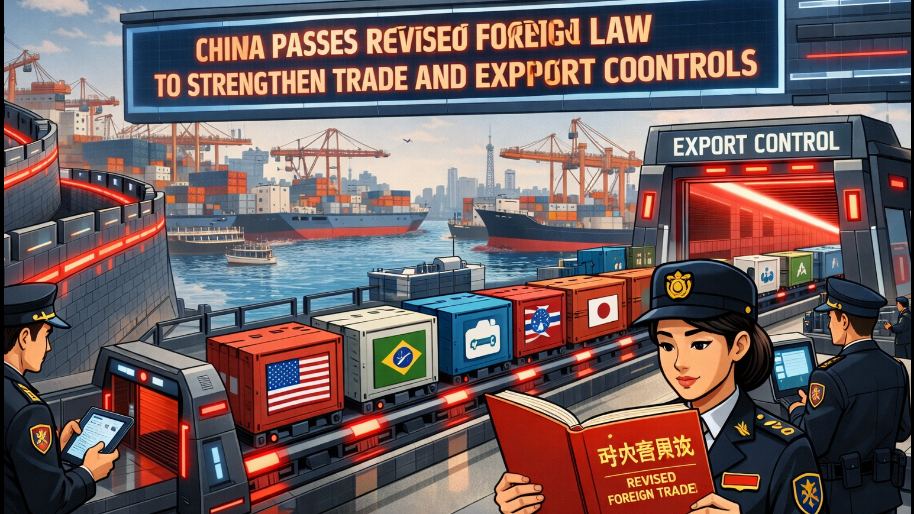
China has approved sweeping revisions to its Foreign Trade Law, a move aimed at strengthening Beijing’s ability to respond to trade disputes, regulate outbound shipments of sensitive goods, and further open parts of its economy to foreign participation.
The revised law was passed Saturday by China’s top legislative body and will take effect on March 1, 2026, according to state news agency Xinhua. First adopted in 1994 and revised multiple times since China joined the World Trade Organization in 2001, the Foreign Trade Law provides the legal foundation for Beijing’s trade policy. The latest update expands and clarifies the government’s authority to counter actions by foreign trading partners that restrict Chinese exports.
Under the revised framework, policymakers are empowered to deploy retaliatory measures and use mechanisms such as “negative lists” to open restricted sectors to foreign firms, while also tightening oversight of outbound trade in strategically sensitive goods.The law now explicitly states that foreign trade should “serve national economic and social development” and support China’s goal of becoming a “strong trading nation,” according to Xinhua.
Unlike earlier revisions that emphasized trade defense tools during periods of tariff escalation, the latest changes focus on areas such as digital trade, green trade, and intellectual property protections. These updates are seen as necessary steps for China to align more closely with the standards of the Comprehensive and Progressive Agreement for Trans-Pacific Partnership (CPTPP), a major trade bloc Beijing has sought to join.
The overhaul also reflects China’s effort to modernize its trade governance as it seeks to reduce reliance on the United States and strengthen ties with regional and global partners.Trade diplomats say the revised law also sharpens the legal language governing export controls and enforcement actions, partly in anticipation of potential lawsuits from private firms. As China’s private sector becomes more prominent in global trade, government agencies face growing pressure to justify regulatory actions with clear legal grounding.
“China is a rule-of-law country, so the government can stop a company’s shipment, but it needs a reason,” said one Western trade diplomat with decades of experience working with China, speaking on condition of anonymity.Recent controversies involving Chinese exporters — including scrutiny over products sold abroad through e-commerce platforms — have highlighted the growing tension between state policy objectives and private enterprise operations.
The revised law may also come into play as China enforces broad trade bans or restrictions tied to geopolitical disputes, such as its prohibition on Japanese seafood imports amid ongoing tensions between the two countries. By expanding and codifying its trade powers, Beijing appears to be positioning itself to navigate a more fragmented global trade environment while maintaining tighter control over exports deemed sensitive to national interests.
About China
China is the world’s second-largest economy, with a gross domestic product of approximately $19 trillion. As a major global manufacturing and export hub, the country plays a central role in international trade, supply chains, and investment flows. China joined the World Trade Organization in 2001 and continues to reshape its trade and regulatory frameworks as it adapts to evolving global economic and geopolitical dynamics.
Did you find this insightful?
Bad
Just Okay
Amazing
Disclaimer: Information provided is for informational purposes only, not investment advice. We do not recommend buying or selling stocks. Stock price discussions are based on publicly available data. Readers should conduct their own research or consult a financial advisor before investing. Owners of this site have current positions in stocks mentioned throughout the site, Please Read Full Disclaimer for details Here https://app.stocks.news/page/disclaimer