


By David Ljunggren and David Shepardson
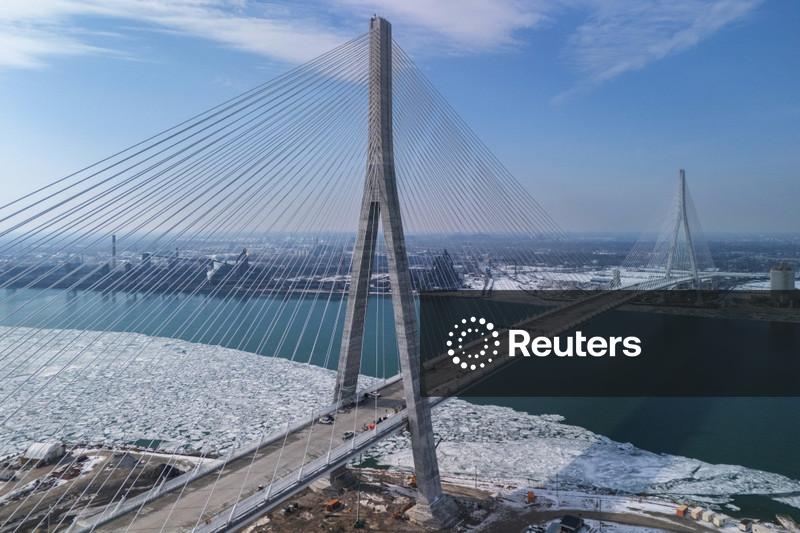
OTTAWA/WASHINGTON, Feb 10 (Reuters) - Canada and the United States will resolve the issue of a $4.7 billion bridge connecting Detroit and Windsor, Ontario, that U.S. President Donald Trump is unhappy about, Canadian Prime Minister Mark Carney told reporters on Tuesday.
Carney said he and Trump had a conversation on Tuesday morning about a range of topics, including the bridge.
"The situation will be settled," Carney said, but did not give details.
Trump threatened to bar the new bridge opening, in his latest salvo against Canada over trade issues, which drew significant alarm among elected officials in Michigan.
Trump cited Canada's financing of the Gordie Howe International Bridge, its refusal to stock some U.S. alcoholic beverages on Canadian store shelves, Canada's tariffs on dairy products and its trade talks with China.
The bridge was financed by Canada because the U.S. refused to pay for it and is set to open in the coming months. The costs will be financed by tolls over 30 years.
Trump incorrectly suggested the bridge would be owned by Canada even though the bridge is jointly owned.
"I explained that Canada, of course, paid for the construction of the bridge, over $4 billion. That the ownership is shared between the state of Michigan and the government of Canada," Carney said.
The White House said Tuesday that the deal was not acceptable.
"The fact that Canada will control what crosses the Gordie Howe Bridge and owns the land on both sides is unacceptable to the president," White House press secretary Karoline Leavitt said.
The New York Times reported billioniare Matt Moroun whose family owns the rival Ambassador Bridge that connects Detroit and Windsor met with Commerce Secretary Howard Lutnick on Monday, hours before Trump's statement.
Commerce and the Ambassador Bridge company did not immediately comment.
The Detroit Regional Chamber, a Michigan business group, said the bridge is the most consequential infrastructure project in the state and region of this generation.
"Any effort to block this project would have tremendous consequences for the region, state, and country," the group said.
In 2012, Michigan's then-Governor Rick Snyder accepted a Canadian government offer to fund most of the new bridge's costs, and took the unusual step of using executive authority to bypass the legislature. Construction began in 2018.
The U.S. Department of Homeland Security on January 30 published a rule declaring the bridge an official port of entry. It said the bridge will save $12.7 million annually for travelers by reducing congestion and travel time while easing traffic flows.
(Reporting by David Ljunggren and David Shepardson, editing by Deepa Babington and Michael Perry)
Did you find this insightful?
Bad
Just Okay
Amazing