


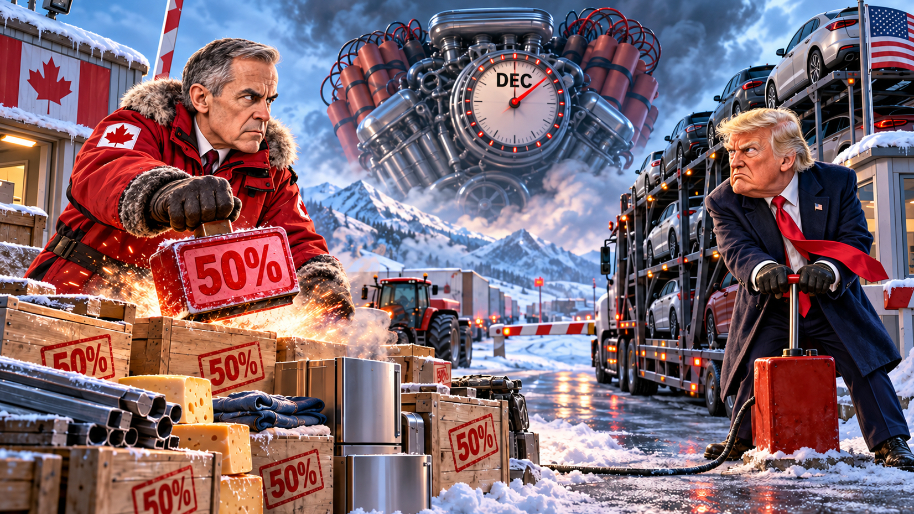
Canada imposed retaliatory tariffs of up to 50% on $20 billion worth of American goods Tuesday, opening another front in its trade fight with the US after negotiations collapsed last month.
The new duties cover hundreds of products, including steel, aluminum, clothing and agricultural equipment. And with neither government showing much interest in backing down, the real question is no longer whether the dispute will cause economic pain. It is where that pain will land.
Starting with the tariffs themselves. Duties on American steel and aluminum products have doubled to 50%, while other targeted goods face rates ranging from 15% to 50%. Canada calls the measures a “dollar-for-dollar” response to the 50% tariffs President Trump imposed after talks broke down in August.
But the retaliation is not quite dollar for dollar. Trump’s tariffs affect approximately $28 billion in Canadian imports, compared with the $20 billion targeted by Ottawa. That partly reflects the enormous difference in economic size between the two countries… The US economy is more than 10 times larger than Canada’s.
That leaves Prime Minister Mark Carney in a difficult position. Canada depends heavily on the American market, but backing down under pressure could invite further demands from Washington. For now, it appears Carney is choosing confrontation.
“We will do whatever it takes for as long as it takes,” he said in a video released Tuesday, acknowledging that Canadians could face economic pain but arguing that accepting what he considers a bad agreement would be worse.
The dependence he is trying to reduce is substantial to say the least. The US exported approximately $333.6 billion in goods to Canada in 2025 and imported $381.9 billion, according to the Office of the United States Trade Representative. That makes the relationship worth more than $700 billion a year in merchandise alone.
And the connection runs much deeper than those totals suggest.
Auto parts can cross the border several times before becoming a finished vehicle. American farmers rely on Canadian potash fertilizer, while manufacturers on both sides depend on energy, metals, machinery and components supplied by the other.
That is why tariffs rarely remain a problem for foreign exporters alone. American importers pay Canada’s duties first. They must then absorb the added expense, negotiate lower prices with suppliers or pass some of the cost along to customers.
Trump’s threat to block Canadian aircraft manufacturer Bombardier from selling planes in the US shows how quickly those consequences can circle back home. Bombardier is based in Canada, but it employs more than 1,200 workers in Kansas and works with 2,800 suppliers across 47 states.
Meaning, restrictions aimed at a Canadian company could also affect American jobs and suppliers.
And the the stakes could rise even further. Trump has threatened to impose 50% tariffs on Canadian automobiles and auto parts before the end of the year. Because the North American auto industry operates through an integrated supply chain, those measures could raise costs for manufacturers and consumers on both sides of the border.
For the time being, both governments have avoided some of the relationship’s most sensitive areas, including Canadian oil, natural gas and potash fertilizer. That has limited the immediate damage.
But every round of retaliation brings those products closer to the table. Tuesday’s tariffs still cover only a fraction of the commerce between the two countries. Let’s see how long it remains that way.
At the time of publishing this article, Stocks.News doesn’t hold positions in companies mentioned in the article.
Did you find this insightful?
Bad
Just Okay
Amazing
Disclaimer: Information provided is for informational purposes only, not investment advice. We do not recommend buying or selling stocks. Stock price discussions are based on publicly available data. Readers should conduct their own research or consult a financial advisor before investing. Owners of this site have current positions in stocks mentioned throughout the site, Please Read Full Disclaimer for details Here https://app.stocks.news/page/disclaimer