


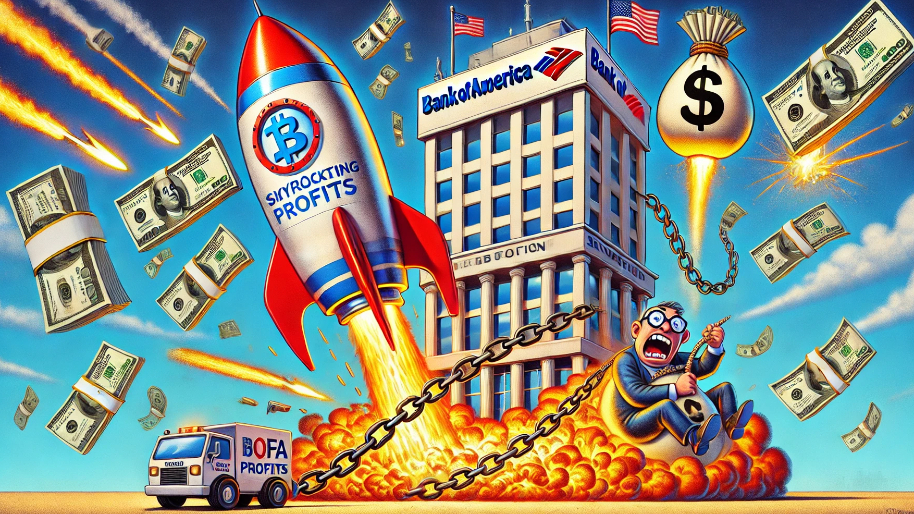
Last week, the whispers on Wall Street were all about Bank of America and whether it was staring down a financial crisis that would force David Tepper to sell the Carolina Panthers (Charlotte would have a party). Back in 2020-2021, when interest rates were practically nailed to the floor, BofA acted like a kid let loose in a candy store. The bank loaded up on fixed-rate securities, locking in what seemed like stable returns in a low-rate world. Fast forward to today, and Jerome Powell’s Federal Reserve has hiked interest rates at warp speed to combat inflation, leaving those bonds worth significantly less on paper. And the damage has left an astronomical $100 billion in unrealized losses.

If this scenario gives you flashbacks, you’re not alone. Fannie Mae and Freddie Mac (once the poster children of mortgage-backed securities) collapsed during the 2008 financial crisis after their overexposure to risky loans left them underwater. Lehman Brothers, anyone? Their downfall was a masterclass in overleveraging and unchecked risk-taking. But here’s the difference… Bank of America’s $100 billion in losses are unrealized. Meaning, as long as the bank doesn’t sell those bonds, the losses stay on paper. That’s a crucial distinction, but it’s not a free pass to ignore the risks.

Just when it seemed like BofA might be prepping its farewell tour, the bank dropped an earnings report that left critics eating crow. Bank of America’s fourth-quarter profits more than doubled to $6.7 billion, up from $3.1 billion in the same period last year. That’s an 111% jump… not bad for a bank that’s been getting more hate than Taylor Swift during a Chiefs game. For the full year, profits hit $27.1 billion, and CEO Brian Moynihan couldn’t resist bragging a little: “We finished 2024 with a strong fourth quarter. This broad momentum sets up 2025 very well for Bank of America.” In other words? We’re good, stop stressing about those bond losses.

So if they have $100 billion in unrealized losses, what’s behind the turnaround? Investment banking and trading… two areas that performed like Jordan and Pippen against the Jazz in the 1998 Finals. Banking fees soared 44% in Q4, bringing in $1.7 billion, while trading revenue climbed 10% to $4.1 billion. And it’s not just BofA getting a piece of the action. Rivals like JPMorgan Chase, Goldman Sachs, and Wells Fargo all posted strong profits, thanks to a huge increase in dealmaking after a two-year drought. Of course, equity markets also had a banner year, with the S&P 500 climbing 23.3% in 2024. That market rally played nice with BofA’s wealth management business, which saw revenue jump 15% to $6 billion, powered by $4.3 trillion in client balances.

Let’s not pretend those $100 billion in unrealized losses aren’t sitting there like the teacher who told you you’d never amount to anything. High interest rates have battered fixed-rate securities, and while BofA’s playing it cool, those losses aren’t exactly going away. That said, Net Interest Income (NII) (the lifeblood of banking) rose 3% in Q4 to $14.4 billion, beating expectations. Moynihan’s betting on NII growth throughout 2025, predicting it will climb to $15.7 billion by year-end. If he’s right, that might just paper over some of the ugliness.
P.S. Our "Insider Trade Tracker" recently flagged John F. Barry, CEO of Prospect Capital Corp, splurging $8.58 MILLION to scoop up 2 million shares of his own company’s stock at $4.29 per share. With PSEC trading near its 52-week low, Barry’s wallet says he’s betting big on the company’s 12.6% dividend yield and 21-year track record of payouts. Moves like this are why our tool is your ticket to tracking where the smart money flows… in real time. Oh, and FYI, we’re currently ranked #23 for free News Apps, ahead of Bloomberg and The Washington Post. 🎉 Curious to see what other power plays we’re tracking? Become a Stocks.News premium member today… or just keep enjoying our free content. No pressure. 😉
Stock.News does not have positions in companies mentioned.
Did you find this insightful?
Bad
Just Okay
Amazing
Disclaimer: Information provided is for informational purposes only, not investment advice. We do not recommend buying or selling stocks. Stock price discussions are based on publicly available data. Readers should conduct their own research or consult a financial advisor before investing. Owners of this site have current positions in stocks mentioned throughout the site, Please Read Full Disclaimer for details Here https://app.stocks.news/page/disclaimer