


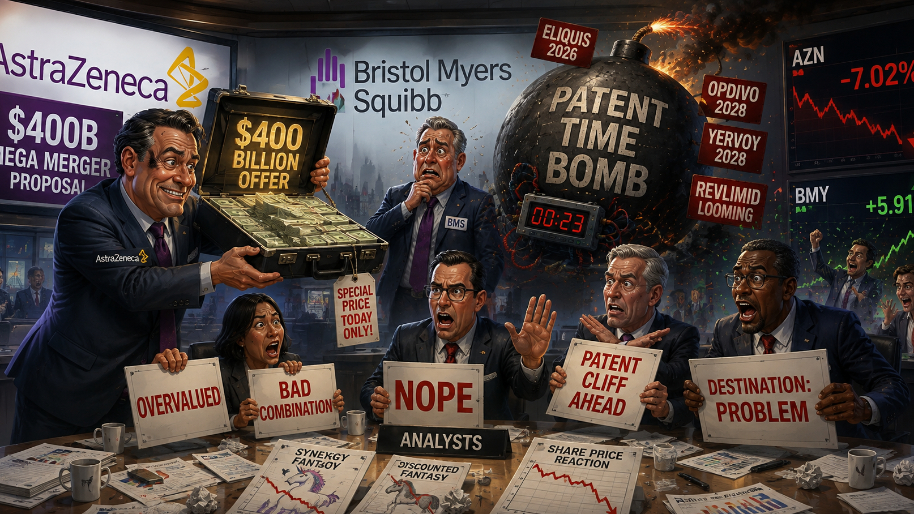
Warning: This merger may cause dizziness, confusion, and a 7% drop in AstraZeneca shares.
Normally, when a household name goes shopping for an acquisition, shareholders give the benefit of the doubt and assume it's about to make a brilliant purchase.
(That is unless you’re Ryan Cohen attempting to buy eBay with non-existent money.)
Well, that wasn't the reaction this morning after reports surfaced that AstraZeneca had been holding talks with Bristol Myers Squibb about a potential mega-merger that could create a pharmaceutical behemoth worth $400 billion.
Investors took one look at the rumor and responded like a mom meeting her son's first college girlfriend.
"Honey... I think you can do better."
Shares of AstraZeneca got smacked as much as 7%, while Bristol Myers did exactly what you'd expect the weaker partner in a rumored merger to do... it rallied about 6% as soon as the news hit the tape.
And all of this is well… over a deal that might not even exist.
Neither company confirmed the report, AstraZeneca politely declined to comment, Bristol Myers kept its mouth shut, and sources told the Financial Times the talks might not even lead anywhere.
Yet Wall Street still looked at the mere possibility and went: "Wait... why?"
Because if there's one company that doesn't look like it needs saving...
It's AstraZeneca.
Since taking over in 2012, Pascal Soriot has transformed the company from takeover bait into one of the industry's premier growth stories, complete with a $264 billion valuation and one of the deepest pipelines in healthcare.
For instance, management is still shooting for $80 billion in annual sales by 2030, up from $58.7 billion last year.
Meanwhile, Bristol Myers Squibb has a market value closer to $133 billion, and it's staring down one of pharma's biggest nightmares: the patent cliff.
Several blockbuster drugs (including blood thinner Eliquis and cancer treatment Opdivo) are about to lose exclusivity, which is pharma-speak for "here come the generic vultures."
Translation: One company is planting money trees. The other is watching the harvest end.
Which explains why analysts sounded about as confused as my grandparents trying to use ChatGPT.
Jefferies said it was "perplexed" by the reports, arguing AstraZeneca is the last company that needs financial engineering to juice growth. Even RBC pointed out the timing feels odd, with Bristol Myers approaching several major clinical trial readouts that could dramatically change its outlook over the next year.
Of course, there is one theory that actually makes some sense.
Earlier this year, AstraZeneca took another step toward becoming an honorary American company by directly listing its shares on the New York Stock Exchange.
That matters because the U.S. already accounts for 42% of AstraZeneca's sales.
As for Bristol Myers? Well, nearly 69% of its revenue comes from the United States.
So if AstraZeneca wanted to bulk up its American footprint overnight… buying Bristol Myers would certainly do the trick.
It would also stitch together one of the deepest cancer drug portfolios the pharmaceutical industry has ever seen.
Between AstraZeneca's strength in solid tumors and Bristol Myers' dominance in blood cancers and cell therapies, this deal would almost certainly spark one YUGE antitrust fight.
Of course...
That's assuming it ever gets that far.
Right now it's nothing more than merger gossip. And based on how everyone reacted so far… shareholders would probably prefer management leave it there.
At the time of publishing this article, Stocks.News doesn’t hold positions in companies mentioned in the article.
Did you find this insightful?
Bad
Just Okay
Amazing
Disclaimer: Information provided is for informational purposes only, not investment advice. We do not recommend buying or selling stocks. Stock price discussions are based on publicly available data. Readers should conduct their own research or consult a financial advisor before investing. Owners of this site have current positions in stocks mentioned throughout the site, Please Read Full Disclaimer for details Here https://app.stocks.news/page/disclaimer