


By Stella Qiu
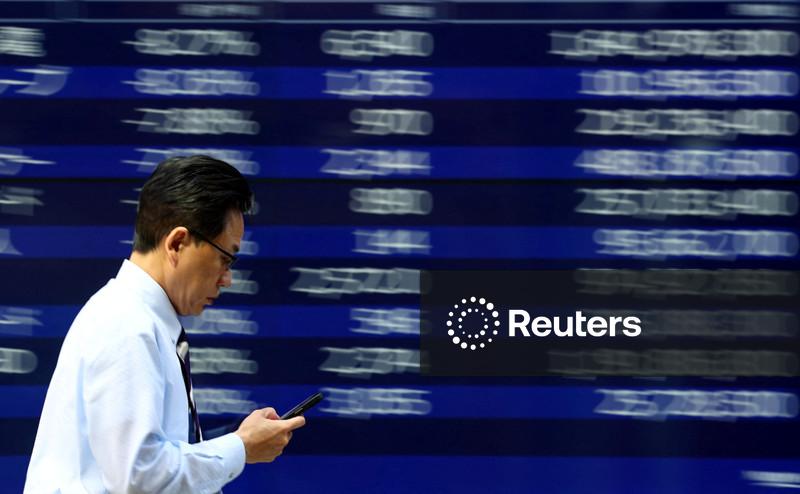
SYDNEY, Jan 27 (Reuters) - Asian shares hit a new record on Tuesday as investors hoped for the best from a barrage of U.S. large-cap earnings, though uncertainty caused by President Donald Trump's latest tariff moves on South Korea boosted gold and silver.
Accusing South Korea's legislature of "not living up" to its trade deal with Washington, Trump late on Monday said he would increase tariffs on imports from Asia's fourth-largest economy into the U.S. to 25%.
Stocks appeared to take the news in stride, with Nasdaq futures up 0.5%, as investors geared up for a slew of earnings from the likes of Microsoft, Apple and Tesla starting on Wednesday.
Even South Korea's KOSPI quickly reversed earlier losses to surge by more than 2%, hitting a new peak. European stocks are braced for a higher open, with EURO STOXX 50 futures up 0.3%.
"Enthusiasm over the most eventful earnings week of the season has investors raising exposure to tech shares ahead of four of the Magnificent Seven reporting results," said Jose Torres, senior economist at Interactive Brokers.
On Trump's higher tariffs on South Korea, Torres believed a visit from South Korean Industry Minister Kim Jung-kwan to Washington as soon as this Friday could "ease tensions and buy its government some additional time to improve relations."
Still, the uncertainty lifted safe-haven gold by 1% to $5,065 an ounce, just shy of an all-time high of $5,110, while silver gained 4% to $108 an ounce, not far from a record of $117.70 that was set on Monday.
"The frenetic nature of uncertainty, coupled with a weaker dollar, have been the primary contributors to this latest leg higher (for gold)," said Christopher Louney, a commodity strategist at RBC Capital Markets.
Louney said history suggested the current gold rally could run into early September or mid-December this year, adding that prices could go as high as $7,100 per ounce at the end of the year based on its 2025 performance.
In Asia, MSCI's broadest index of Asia-Pacific shares outside Japan rose 0.9% to hit a new record high. The Nikkei gained 0.7%, even with the recent sharp rebound in the yen clouding the outlook for Japan's vast export sector.
Chinese blue chips rose 0.2%, while Hong Kong's Hang Seng index gained 1%.
U.S. DOLLAR MALAISE
The U.S. dollar is coming under fire again in the first few weeks of 2026 as a growing range of factors - including Washington's desire for a weaker currency and Trump's erratic policymaking - prompts a rethink of investors' optimistic assumptions for a period of greenback stability.
Its latest slump to more than four-month lows was driven by sharp gains in the Japanese yen starting on Friday when chatter about rate checks by the New York Fed fuelled the risk of a joint U.S.-Japan intervention to halt the yen's slide.
The dollar rose 0.2% to 154.55 yen on Tuesday, having lost a staggering 2.6% over the past two sessions, which was well below the 160 yen level that is viewed as a line in the sand for Japanese authorities.
Against six major currencies, the greenback was flat at 97.12, near a 4-1/2 month low of 96.8.
In the Treasuries market, the benchmark 10-year yield edged up 2 basis points to 4.2292% after falling for four straight sessions away from a recent peak of 4.313%.
Worries about another U.S. government shutdown are also brewing in the background, with Republicans and Democrats at odds over funding for Trump's Department of Homeland Security after the fatal shooting of a second U.S. citizen by federal immigration officers in Minnesota.
Oil prices fell on Tuesday as investors kept an eye on a resumption in supply from Kazakhstan. Brent crude futures dropped 0.7% to $65.13 a barrel, while U.S. West Texas Intermediate crude fell 0.6% to $60.25.
(Reporting by Stella Qiu; Editing by Shri Navaratnam and Thomas Derpinghaus)
Did you find this insightful?
Bad
Just Okay
Amazing