


By Kevin Buckland
TOKYO, Jan 6 (Reuters) - Asian stocks extended their record climb on Tuesday, taking the baton from Wall Street where gains for oil companies and financials helped the Dow Jones Industrial Average hit an all-time peak.
U.S. big oil got a boost from the country's military raid at the weekend that captured Venezuelan President Nicolas Maduro. Crude oil eased back after rising $1 a barrel overnight as traders assessed the possible impact on crude flows from Venezuela, home to the world's largest oil reserves.
Overall, however, the events had a limited effect on risk sentiment, with equities driven more by momentum and currencies focused on macroeconomic data.
The U.S. dollar was on the defensive ahead of monthly jobs figures on Friday. It surged to a four-week top in the prior session only to give back all of its gains by the close, after a gauge of manufacturing activity slumped to a 14-month low.
Precious metals hovered not far from all-time peaks, while copper set a record high.
MSCI's broadest index of Asia-Pacific shares climbed 1.1% to its highest-ever level, driven primarily by advances for Japanese stocks, with the Topix index rising 1.6% to a record peak.
Taiwan's Taiex rallied 1% and South Korea's KOSPI advanced 0.7%, with both reaching all-time highs.
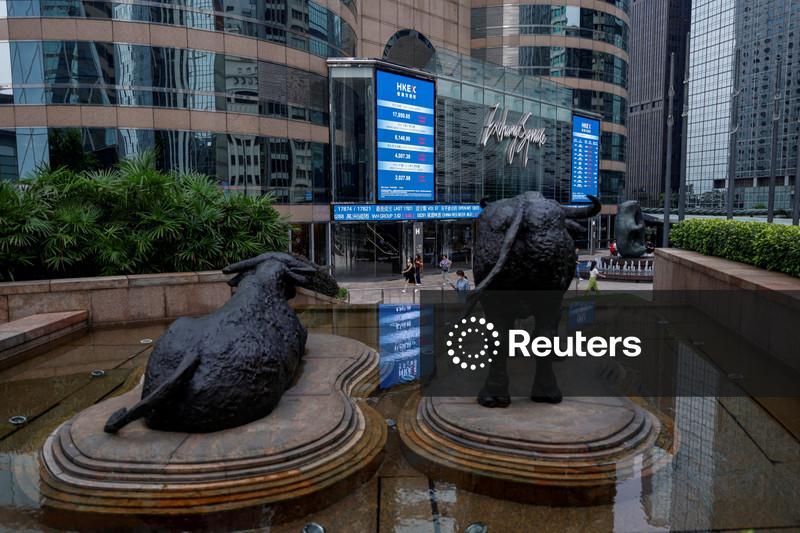
Hong Kong's Hang Seng rose 1.8% and mainland Chinese blue chips leapt 1.2%.
European STOXX 50 futures pointed 0.2% higher after the STOXX 600 closed at a record high on Monday.
U.S. S&P 500 futures tacked on 0.1% following a 0.6% rise in the cash index overnight. Chevron surged more than 5%.
U.S. President Donald Trump said he would put Venezuela under temporary American control and that he could order another strike if the South American nation does not cooperate with U.S. efforts to open up its oil industry and stop drug trafficking. He also threatened military action in Colombia and Mexico.
Trump plans to meet with executives from U.S. oil companies later this week to discuss boosting Venezuelan oil production, Reuters reported, citing a person familiar with the matter.
Venezuela's "relatively small economy ... seems to have convinced investors that the global economy and financial markets are unlikely to be directly affected," while ramping up the country's oil production "will require years to come to fruition," Yusuke Matsuo, senior market economist at Mizuho Securities, wrote in a client note.
"That said, geopolitical concerns seem likely to persist in 2026, and while risk assets remain solid performers, we think gold - considered a safe-haven asset - will also do well."
Brent crude futures lost 17 cents to $61.59 a barrel in the latest session, while U.S. West Texas Intermediate crude eased 21 cents to $58.11.
Gold rose 0.4% to around $4,466 an ounce after a 2.7% climb on Monday. It sits less than $100 from its record peak, reached last month, of $4,548.92. Silver and platinum each jumped about 2.6%.
Copper prices rose to record highs in London and Shanghai as concerns about supplies intensified following a strike at a Chilean mine. U.S. Comex copper reached an all-time peak on Monday.
The dollar ticked down 0.1% to $1.1733 per euro and lost 0.1% to $1.3558 versus sterling. It was flat at 156.47 yen.
The dollar index, which measures the currency against a basket of those three rivals and three more major peers, edged down 0.2% to 98.238. It had popped as high as 98.861 on Monday for the first time since December 10.
The closely watched U.S. monthly employment report, due on Friday, will be key in shaping expectations for the outlook for monetary policy.
In an interview on CNBC on Monday, Minneapolis Fed President Neel Kashkari warned of the risk that the jobless rate could "pop" higher.
Traders currently expect two Federal Reserve interest rate cuts this year, showed LSEG calculations based on futures.
(Reporting by Kevin Buckland; Editing by Christopher Cushing)
Did you find this insightful?
Bad
Just Okay
Amazing